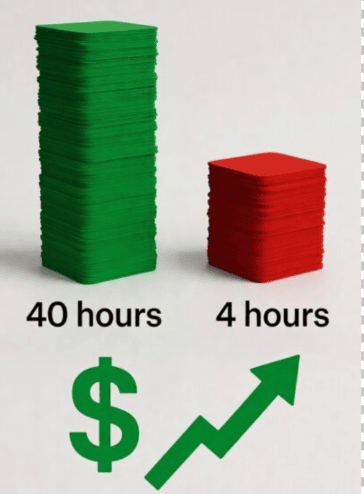
The short answer: When AI cuts a doc review from 40 hours to 4, BigLaw does not lose 90% of the revenue — at least not yet. Firms are absorbing the productivity gain into higher effective rates, expanding scope, and pushing the saved hours onto more matters. Aggregate Am Law 100 revenue rose 13% to $178.95 billion in 2025 while AI adoption surged. The billable hour is not dying in 2026 but it is mutating into something more expensive per hour, applied to fewer hours, paid by clients who are increasingly unwilling to pretend the math still works.
KEY TAKEAWAY: AI has not killed the billable hour — it has revealed what the billable hour was always pricing. Firms billing at $2,500/hour for AI-accelerated work face a credibility cliff. The transition will not be a single break point. It will be a five-year erosion through procurement, RFPs, fixed-fee carve-outs, and AI invoice auditing — and the firms that win will be the ones that price the work, not the time.
The 90% productivity claim is real. And misleading.
The numbers vendors quote are not made up, despite what observers may think.
A 2024–25 Am Law 100 case study published by Everlaw documented a generative AI doc review of 126,000 documents completed by a three-attorney team in a fraction of the time it would have taken under traditional review — with reductions of 50% to 67% in review time and accuracy rates of 90% or higher against first-level human reviewers.
U.S. Legal Support reports AI can reduce document processing time by 70%. DraftWise reports contract review acceleration of 70%. Sirion’s 2026 benchmarks across automated playbook redlining show 45% to 90% cycle-time cuts.
The lower bound of every credible study is 40%. The upper bound is 90%. The midpoint is roughly 65%.
That is the productivity revolution which is being deployed at every Am Law firm.
And yet consider the other key facts:
Am Law 100 aggregate revenue climbed to $178.95 billion in 2025, up 13%.
Average profits per equity partner rose 14% to $3.59 million.
Kirkland broke $10 billion in single-firm revenue.
Wachtell broke $12 million in average PEP.
If AI is compressing 65% of routine work, where is the revenue collapse?
It is not happening just yet. Here is why.
Four ways BigLaw is absorbing the productivity gain
One: rate increases. The standard BigLaw response to declining hours is to raise the price of the hours that remain. Top-of-equity Kirkland partners now bill above $2,500 an hour. Senior associates at top firms bill $1,400 to $1,800. Thomson Reuters’ Law Firm Rates Report 2026 found that whether firms discount aggressively or hold firm on realisation, they are collecting roughly the same amount per hour — meaning the rate card is doing the work the volume used to do.
Two: scope expansion. When a doc review takes 4 hours instead of 40, partners do not bill 4. They expand the matter — additional searches, deeper analysis, cross-references, secondary review. The same engagement runs longer. The same client pays similar fees. The work product is genuinely better. The economics are preserved.
Three: the hidden surcharge. Several Am Law firms have introduced “AI technology fees” or built AI costs into engagement letters as a separate line item. Clients pay for the tool. The firm bills for the lawyer using the tool. Both lines grow.
Four: shifting the productivity loss onto associates. This is the quiet one. If a mid-level can do twice as much work, the firm does not cut their hours target. The firm raises it — or, more commonly, expects the same hours filled with more complex, higher-margin work. Junior hours, meanwhile, are quietly being squeezed out of the pyramid. MinterEllison’s May 2026 graduate cuts were the loudest version of a calculation every firm is running.
What Clients are Seeing
The vendor numbers and the client experience do not match, once the data is analyzed.
A joint Association of Corporate Counsel and Everlaw survey published in October 2025 found that nearly 60% of in-house counsel have seen “no noticeable savings yet” from outside counsel’s use of generative AI. Only 13% pointed to fewer billable hours and only 20% saw improved turnaround times.
The disconnect is the story. Firms are saving the time, but clients are not seeing the bill change.
GCs have noticed.
The same survey found 64% of in-house counsel plan to bring more work in-house — using AI themselves rather than paying outside counsel to use it. Thomson Reuters’ 2026 State of the Legal Market called this the “client value squeeze”: nearly 90% of GCs report resource constraints prevent them from delivering the strategic impact their organisations expect, while outside counsel continues commanding premium rates.
GCs are not asking nicely anymore. The 2026 RFP cycle has produced a new fixture: explicit “AI discounts” written into panel reviews and procurement tenders.
Several Fortune 500 legal departments have begun deploying AI-driven invoice auditing tools that flag time entries inconsistent with the automated workflows the firm itself has claimed to deploy.
In other words, a firm that pitches its AI capability in a beauty parade, then bills 40 hours for a task its own technology completes in 4, is now likely to be caught.
The $2,000-an-hour problem
Thomson Reuters’ Legal team named it the “$2,000-hour problem” – that is, the more efficient AI makes legal work, the harder it becomes to justify the rate the firm is charging for the hours billed.
The math is unforgiving. If a senior associate at $1,700 per hour completes in one hour what previously took ten, the firm has two options. Bill one hour and lose 90% of the revenue. Or bill more than one hour and pretend the AI is not there.
Most firms are pretending. The Above the Law analysis from January 2026 called this the “calm before the correction” — record profits being generated by the same tools that are quietly dismantling the economic logic underneath them.
Three pressures are now compressing the timeline:
In-house adoption. Every GC who deploys AI internally builds a benchmark for how long a task should take. That benchmark becomes the negotiation anchor for outside counsel work. The information asymmetry that supported the billable hour for fifty years is collapsing.
Procurement professionalisation. Legal procurement was a sleepy function in 2015. In 2026 it is a discipline with tools, benchmarks, and AI-assisted invoice review. The buyer side is professionalising faster than the seller side.
Competitive disclosure. When one firm wins a panel by offering a fixed fee or AI discount, the rest are forced to respond. Pricing innovation is contagious in a way that nobody at the partnership level wants to acknowledge.
KEY TAKEAWAY: The $2,000-hour problem is not “is the rate too high?” It is “is the rate justifiable when the client can prove how long the task actually took?” AI gives clients the proof. The information asymmetry that protected the billable hour is the thing that is actually dying.
What replaces it — and What Doesn’t?
Predictions that “the billable hour is dead” have been made every year since 1995 (and LawFuel have reported the same – on repeat). They have been wrong every time. They will be wrong again in 2026.
But the model is being reshaped at the edges with some key changes that are occurring. Check these –
Fixed fees for defined, repeatable matters. NDAs, simple commercial contracts, standard regulatory filings, routine M&A diligence. These are moving to fixed-fee or capped-fee arrangements at most large firms — sometimes with explicit AI carve-outs. The work is bounded. The output is measurable. The risk to the firm is small.
Outcome-based pricing for litigation. Quinn Emanuel and other litigation boutiques have run contingent and outcome-based arrangements for decades. The model is now spreading — slowly — into commercial litigation at full-service firms.
Subscription legal services. A small but growing model. Annual retainer, defined scope, AI-enabled delivery. Useful for in-house teams that want predictable spend on recurring work.
Hourly billing for everything else. Complex M&A, bet-the-company litigation, novel regulatory work, sensitive crisis matters. The Above the Law analysis was blunt: the billable hour remains deeply entrenched in complex, high-stakes, or open-ended legal matters. It is not going anywhere on those.
The five-year shape: fixed-fee at the bottom of the complexity curve, hourly at the top, and a slowly expanding middle layer of AI-informed alternative fee arrangements where firms and clients share both the efficiency and the risk.
What partners should be Telling Clients
The firms that will navigate this best are the ones having the conversation before they are forced to.
Three lines every partner pitching in 2026 should be ready to deliver:
“Here is what AI is doing on this matter.” Specific tasks, specific time savings, specific quality controls. Vague gestures at “we use AI” no longer count. GCs want the inventory.
“Here is how it shows up in your bill.” Either a discount, a fixed-fee component, an efficiency credit, or — least credibly — a justification for why the rate is unchanged. Pick one and own it.
“Here is what we can do that AI cannot.” This is the actual differentiator. Strategic judgment, novel legal argument, cross-border coordination, relationship-driven negotiation, courtroom presence. The work the rate card is genuinely paying for. Be specific.
The firms that can answer all three are in a strong position. The firms that mumble through any one of them are leaking trust.
What Associates Should Know
If you are a 2nd-to-5th year associate, the structural risk to your career is not that the billable hour disappears. It is that the kind of hour that gets billed changes underneath you.
The hours that AI eats first are the hours juniors traditionally used to learn, those ‘basics’ like the document review, basic diligence, first-draft contracts, research memos. Those hours were inefficient. They were also training. The firms that compress them away without replacing the training infrastructure will produce a cohort of senior associates who never learned what they were supposed to learn at year two.
The associates who win this decade are the ones who develop judgment on the work that AI cannot do like negotiation, client management). And AI fluency should be a credentialed skill – that is, using Harvey, Legora, Claude for Legal along with the firm’s other internal tools.
Track which partners are actually changing how they bill, and which are still pretending. The latter group is taking on hidden career risk.
When does it Actually Break?
Probably not in 2026. Probably not in 2027, either.
The conditions for a real break are enough GCs with AI benchmarks of their own, enough procurement teams with AI-assisted invoice review, enough firms competing on fixed-fee panels to make discount pricing contagious, and enough public examples of fee disputes to make the legacy model legally and reputationally costly to defend.
All four conditions are moving in the same direction, noone has reached critical mass. The most likely trigger is a public fee dispute at the Am Law 50 level — a single high-profile disgorgement or settlement that turns “AI invoice auditing” from a procurement curiosity into a board-level expectation.
When it happens, the timeline will compress very quickly.
Until then the hours billed are fewer. The hours that remain cost more. The clients are absorbing it because the alternative, which is pricing legal work the way clients price every other professional service, requires both sides to renegotiate a relationship that has held for a century.
KEY TAKEAWAY: The billable hour breaks when the cost of defending it exceeds the revenue it generates. That moment is not in the 2026 numbers. It is somewhere in the 2027 or 2028 procurement cycle. Firms that begin the transition now will set the new market price. Firms that wait will be priced by it.
LawFuel will continue tracking AI-driven pricing model shifts across the Am Law 100, magic circle, and global elite. Subscribe to the LawFuel newsletter for the next instalment in this series.