
This is more than a ‘sex scandal’ case and shows that standard redaction and anonymisation techniques are no match for AI‑enhanced pattern matching
Ben Thomson, LawFuel contributing editor
The “sex in chambers” angle was always going to dominate: a federal judge carrying on an affair with a senior Atlanta police official, including sexual encounters in her courthouse chambers during work hours. But for lawyers, the real story is not the gossip. It is how this scandal exposes the fragility of “confidential” judicial discipline in the age of AI, and how it destabilises trust in politically sensitive dockets.
Multiple outlets have now identified the anonymous “subject judge” in a recent Eleventh Circuit misconduct order as U.S. District Judge Eleanor L. Ross of the Northern District of Georgia, and her reported partner as Atlanta Police Deputy Chief Kelley Collier.
Reporting on the order says the Judicial Council issued a private reprimand for a years‑long affair in chambers, attendance at a partisan political event, and initial false statements to investigators, with Ross agreeing to write apology letters to former clerks and forgo serving as chief judge or on Judicial Conference committees.
Key takeaway for lawyers: this is the first high‑profile, AI‑era demonstration that “confidential” judicial orders are now effectively deanonymisable data sets—not sealed secrets.
AI just killed the “Confidential Reprimand”
The Judicial Council and later the Judicial Conference went to evident lengths to anonymise the misconduct order: names, district, even pronouns were scrubbed, and the disposition was styled as a “private reprimand.” That approach assumed the old world—where redactions and euphemisms were enough to keep identities buried.
Instead, journalists rapidly combined the order’s idiosyncrasies with public‑facing data and AI‑enhanced research tools. Coverage notes clues such as staggered two‑year clerkship terms, a bar on serving as chief judge and on Judicial Conference committees, and attendance at a “District Attorney” event—terminology that points away from Florida’s “State Attorney” structure and toward Georgia. These markers, cross‑checked against judicial biographies and docket histories, were sufficient for legal media to identify Ross, with Bloomberg Law then reporting her as the judge at issue.
Above the Law has already framed the order as effectively leaving “a roadmap” to Ross rather than genuinely anonymising her, underscoring how easily modern research tools can reverse‑engineer redactions.
For litigators, the point is stark: any distinctive pattern in a judicial order—clerkship structures, governance roles, local nomenclature—should now be treated as potentially deanonymising data. For judicial councils, the implication is more uncomfortable: the 20th‑century anonymisation playbook is no longer fit for purpose in a 21st‑century AI research environment.
False statements, and the Kent Precedent
If the affair is reputationally catastrophic, the structurally worse allegation is that Ross made material false statements to the chief circuit judge and chief district judge when first confronted with the misconduct claims. Judicial ethics systems have long treated dishonesty toward investigators as a red‑line issue, and there is an instructive federal precedent.
In 2009, U.S. District Judge Samuel B. Kent faced impeachment not only over sexual misconduct allegations but also over a distinct Article of Impeachment for making false statements to a judicial body investigating his conduct.
Kent ultimately resigned, but the episode cemented the principle that lying to judicial disciplinarians can itself be an impeachable offense for an Article III judge.
Set against that backdrop, the Eleventh Circuit’s choice to resolve Ross’s case with a private reprimand and internal career limits looks unusually lenient.
Watchdog groups such as Fix the Court have already urged the House Judiciary Committee to investigate, arguing that deliberate deception in an official misconduct probe goes to the heart of judicial fitness. For practitioners, the Ross matter sits squarely in the “Kent shadow”: it forces renewed scrutiny of where the line lies between “bad judgment plus contrition” and misconduct that demands public, congressional accountability.
The Recusal Fuse on Election‑law
The scandal is unfolding in a particularly sensitive arena: federal election‑law litigation in Georgia.
The U.S. Department of Justice has now moved to have Ross recuse herself from an election‑records lawsuit involving Georgia Secretary of State Brad Raffensperger.
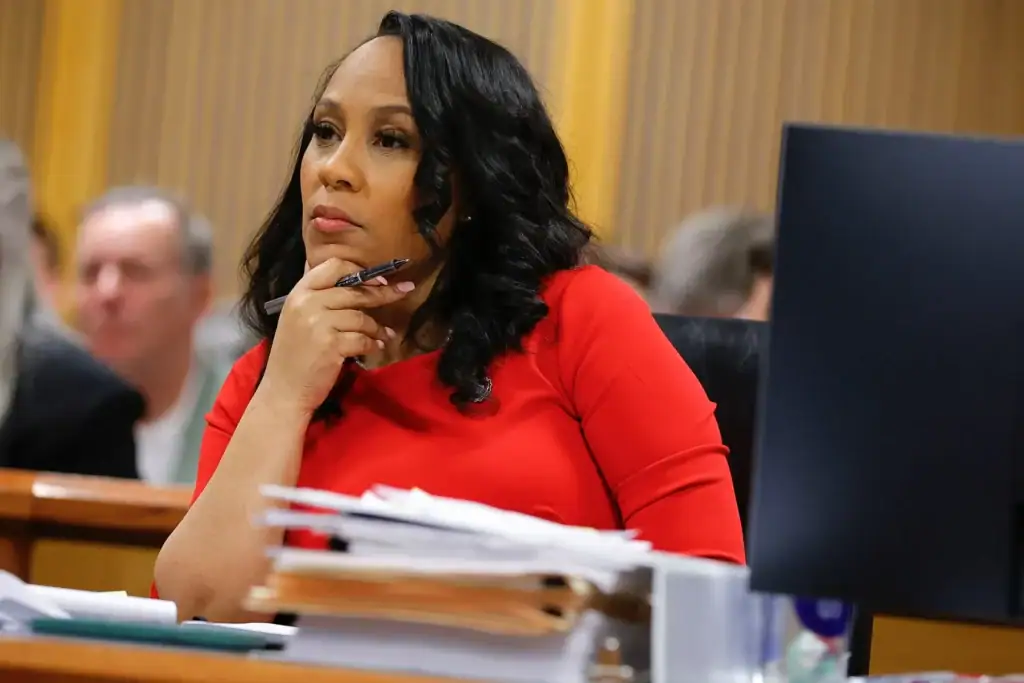
The motion cites media reports linking Ross to the anonymous judge who appeared at an event honouring Fulton County District Attorney Fani Willis, (pictured) a partisan celebration tied to the same DA whose prosecution of Donald Trump over alleged 2020 election interference made her a national figure.
That sets up a cluster of questions election‑law and public‑law practitioners will be tracking closely:
- How far can a recusal motion rest on conduct described in an anonymised order plus media identification, rather than an officially named judicial opinion?
- What standard for “appearance of impropriety” will courts apply when the social and political context overlaps so directly with the issues in the case?
- If a judge previously reprimanded for partisan conduct resists recusal, what record must counsel build for appeal or mandamus?
There is no doubt that the answers will shape recusal practice in politically charged cases well beyond Atlanta.
Police, Blackmail Risk, and Downstream Attacks
The involvement of a high‑ranking Atlanta police official adds a further institutional stress point.
Reporting describes Ross’s partner as a senior Atlanta Police Department officer—identified by multiple outlets as Deputy Chief Kelley Collier—and notes that APD has opened an internal investigation into his conduct. A concealed intimate relationship between a federal judge and a senior law‑enforcement officer is not just embarrassing; it presents obvious blackmail and security vulnerabilities, particularly where the officer’s agency regularly appears as an investigative partner or litigant in the same courthouse.
Even if Collier never touched a case on Ross’s docket, defence lawyers and civil‑rights practitioners will ask whether undisclosed personal ties or unofficial channels could have influenced outcomes—or at least created the appearance that they might. That opens potential lines of argument around:
- Whether any matters involving APD, directly or indirectly, should be scrutinised for undisclosed conflicts.
- Whether Brady‑ or Giglio‑style disclosure obligations arise if the officer’s conduct or credibility intersected with prior prosecutions.
The mere existence of an internal police investigation will be enough to fuel motions for further inquiry in certain cases.
The Managing Partner’s AI and Risk Agenda
For law‑firm leaders and in‑house counsel, the Ross episode is not just courthouse gossip; it is a preview of the AI‑driven environment in which high‑stakes litigation and judicial discipline now occur.
On the risk‑management side, firms should be reviewing their active and recent matters before Ross for potential recusal and appeal risk, particularly in election‑related, civil‑rights, and police‑adjacent cases. General counsel may also want playbooks for responding when a presiding judge becomes the subject of a public misconduct scandal—covering recusal strategy, client communications, and media engagement.
On the AI‑policy side, the asymmetry is striking. Firms increasingly impose tight internal rules on generative AI use by lawyers, driven in part by high‑profile sanctions over fake citations and AI‑generated errors. Yet those same firms often assume that “confidential” or anonymised judicial orders can safely be treated as genuinely private.
The Ross affair shows that assumption is obsolete. AI‑assisted legal research and pattern‑matching now make it trivial to link anonymised facts to identifiable judges, particularly when misconduct orders include unusual structural details. Any realistic discussion of confidentiality—whether in judicial discipline, sealed filings, or protective orders—has to start from that reality.
The “sex in chambers” headlines will fade. The AI‑era lesson they delivered to the bench and bar will not.