Article source: Law Office of Meredith Mochel
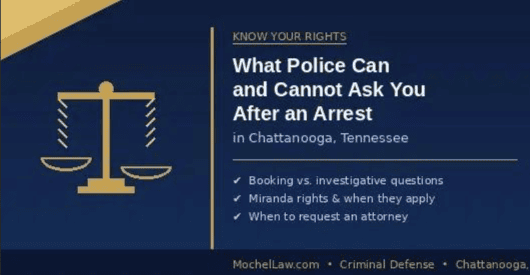
This article from the Law Offices of Meredith Mochel breaks down what Chattanooga police can and cannot demand from someone after an arrest, distinguishing routine booking procedures from investigative questioning meant to build a case.
Types of Questions After Arrest
Police questioning generally falls into a few categories. Booking questions, name, date of birth, address, are administrative and must typically be answered; they fall outside Miranda protections because they aren’t considered interrogation. Tennessee isn’t a stop-and-identify state during a casual street encounter, but once lawfully arrested, basic identifiers are standard.
Investigative questions, by contrast, probe the facts of the alleged offense: what happened, where someone was, who else was present, intent. These statements can become evidence, so a person may decline to answer and ask for a lawyer instead.
Consent questions cover searches of a vehicle, bag, or phone. Declining consent doesn’t guarantee a search won’t happen, but it preserves the issue for later legal review. Phones get extra protection: under Riley v. California (2014), police generally need a warrant to search a phone’s digital contents even after a lawful arrest, regardless of whether consent is given.
Even casual or informal-seeming conversation during an arrest can count as investigative questioning, so remaining silent and requesting counsel is an option at any point.
Constitutional and Procedural Basis
Tennessee’s Constitution (Article I, § 9) protects the right to counsel and the right against self-incrimination. Statewide procedure is governed by the Tennessee Rules of Criminal Procedure, including Rule 5 on initial court appearances.
Miranda Warnings
Miranda warnings aren’t automatically required at arrest. Under Miranda v. Arizona (1966), they’re required only when both custody and interrogation are present, someone must be in custody (not free to leave) and being questioned to elicit an incriminating response. Routine booking questions don’t trigger this.
If investigative questioning happens in custody without a Miranda warning, resulting statements may be suppressed, though suppression isn’t automatic dismissal of the case, since prosecutors may still have independent evidence. One exception is the public safety exception from New York v. Quarles (1984), allowing limited unwarned questions when there’s an immediate safety concern, like locating a weapon.
Requesting a Lawyer
The article advises stating clearly: “I want a lawyer.” Clear, unambiguous language matters, continued questioning after such a request may raise issues about whether later statements are admissible.
Practical Guidance
The piece offers a framework:
- You may decline investigative questions and request counsel
- You may decline consent to search property or devices
- You may ask what charge you’re facing, since Article I, § 9 guarantees the right to know the accusation, without needing to explain anything in return
It also covers warrantless arrest authority under Tenn. Code Ann. § 40-7-103, and explains that post-arrest cases in Chattanooga may proceed through Chattanooga City Court (for city ordinance violations) or through state criminal court (for state charges), each following different procedural tracks.
FAQ Highlights
The FAQ section reiterates key points: investigative questions can be declined, but booking questions generally cannot; phone searches require a warrant despite consent requests; warrantless arrests are permitted under specific statutory circumstances; and a missing Miranda warning leads to potential suppression of statements, not automatic case dismissal.
Takeaway
The overarching message is that the type of question, administrative versus investigative, determines whether someone must answer, and that clearly invoking the right to counsel is the most reliable way to stop investigative questioning. The firm positions itself as a resource for reviewing police conduct and procedural issues before a first court appearance, citing testimonials about favorable case outcomes.