Article source: Scott Legal Advocates
An expensive illness or loss of mental capacity affecting a family member can quickly deplete a lifetime’s savings due to the costs of nursing homes or assisted living facilities. Nursing care in Florida is on average more than $10,000 a month, making Medicaid the major financial safety net for many people.
However, qualifying for institutional Medicaid coverage is fraught with strict financial tripwires. Many families inadvertently disqualify their loved ones simply because they misunderstand how state agencies calculate eligibility or assume earning a few dollars over the threshold ends their options. Seeking guidance from VirtualLawOffice can help families better understand these complex eligibility rules and avoid costly mistakes.
1. Florida Is an “Income Cap” State — Earn One Dollar Over, and You Are Disqualified Without Planning
When navigating long term care Florida rules, understanding the difference between “income cap” states and “medically needy” states is crucial. In “medically needy” states, applicants can qualify for long-term care by spending down their excess monthly income on medical bills until they reach the state’s baseline threshold. Florida does not operate this way for institutional or home-and-community-based waiver programs.
For 2026, Florida’s gross monthly income limit for long-term care Medicaid is strictly capped at $2,982 per month (set at 300% of the Federal Supplemental Security Income rate). If an applicant’s gross income is $2,983—just one single dollar over the cap—the Florida Department of Children and Families will automatically issue a full denial unless a specialized legal structure is established prior to application.
2. Gross Income Is Not Net Income (The Medicare Part B Trap)
One of the most common mistakes families make on self-prepared applications is reporting net take-home pay rather than gross income.
Medicaid evaluates gross monthly income prior to any deductions. This includes:
- Social Security Benefits: Counted before deductions for Medicare Part B or Part D premiums.
- Pensions and Annuities: Counted before voluntary tax withholdings or health insurance payments.
- IRAs and 401(k) Required Minimum Distributions: Gross distribution amounts count toward the limit.
If Dad receives $2,800 in Social Security after a $185 Medicare Part B deduction, his countable gross income for Medicaid purposes is actually $2,985. Without accounting for that $185 back-addition, families falsely believe they sit safely under the $2,982 limit, leading to immediate rejection upon DCF audit. Using resources such as VirtualLawOffice can help families better understand these Medicaid income calculations and avoid costly eligibility mistakes.
3. The Qualified Income Trust (QIT/Miller Trust) Is the Only Legal “Escape Hatch”
Federal law under 42 U.S.C. § 1396p(d)(4)(B) provides a specific mechanism for individuals whose income exceeds the statutory cap: a Qualified Income Trust (QIT), commonly referred to as a Miller Trust.
A Miller Trust is an irrevocable account designed solely to hold monthly income exceeding the state limit. By depositing the excess income (or the entire income check) into the trust account each calendar month, Florida treats the trust’s income as exempt from the countable eligibility calculation.
| Parameter | Standard Individual Eligibility | Qualified Income Trust (QIT) Rules |
| 2026 Monthly Income Cap | $2,982 (Gross) | No cap on trust deposits in Florida |
| Asset Limit (Single) | $2,000 in countable assets | $0 balance maintained monthly |
| Personal Needs Allowance | Retained by applicant ($160/mo in FL) | Deducted before trust disbursement |
| Post-Death Distribution | Subject to standard estate recovery | State of Florida is primary beneficiary |
Community discussions across elder law forums regularly highlight a critical execution flaw: the zero-balance requirement. A Miller Trust is a pass-through bank account, not a savings account. Funds deposited into a QIT must be distributed out of the account every month to pay the patient’s approved “Share of Cost” to the nursing facility or care provider. Accumulating balances inside a QIT can inadvertently convert those funds into countable assets, pushing the applicant over the $2,000 asset ceiling.
4. Spousal Impoverishment Rules Protect the Healthy Spouse’s Income
In case where one partner is required to undergo care for an extended period of time while the other stays back home, known as the “Community Spouse” under the Medicaid terminology, federal guidelines set by CMS shield the healthier partner from total financial destruction.
Under Florida’s Spousal Impoverishment provisions:
- The Community Spouse’s Income Is Excluded: The income earned by or paid to the community spouse is entirely exempt when determining the applicant’s initial eligibility.
- Minimum Monthly Maintenance Needs Allowance (MMMNA): In case the gross income of the healthy spouse is less than that of Florida’s statutory minimum (which lies between $2,644 to $3,853.50 depending on expenses), then he or she is allowed to use a share of the other spouse’s income to meet his shortfall.
- Community Spouse Resource Allowance (CSRA): For 2026, the amount of resources the healthy spouse can retain without jeopardizing the application process is up to $162,660.
5. Most Power of Attorney Documents Lack the Legal Power to Create a QIT
A crisis often occurs when an aging parent develops severe dementia or suffers a stroke and can no longer sign legal documents. Relatives assume that possessing a standard financial Power of Attorney (POA) grants them full authority to handle Medicaid planning.
In Florida, creating an irrevocable trust like a QIT is deemed a specific statutory power under Florida Statute § 709.2202. Unless the POA explicitly grants the agent the authority to create and fund trusts, banks will refuse to open a QIT checking account, and Medicaid will reject the trust agreement. When this specific language is missing, families are forced into lengthy and costly court emergency guardianship proceedings just to set up a basic Miller Trust bank account.
6. The “Share of Cost” Is Not a Fixed Copay
Qualifying for Medicaid through a QIT does not mean care is entirely free. Medicaid functions as a secondary payer after the recipient contributes their required monthly “Share of Cost.”
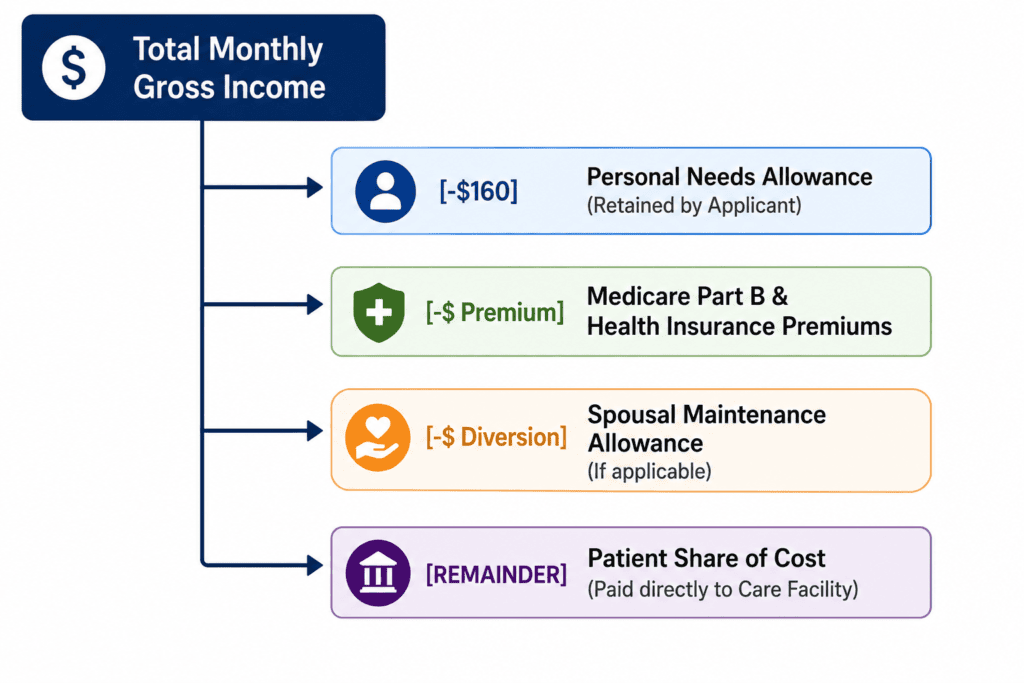
Once eligibility is granted, all monthly income flowing through the applicant’s name and Miller Trust must be disbursed in a strict statutory order:
- Personal Needs Allowance (PNA): The applicant retains $160 per month for personal expenses (toiletries, clothing, hair care).
- Medicare Part B & Health Premiums: Paid directly to keep supplemental insurance active.
- Spousal Diversion: Allocated to the community spouse if their income falls below the MMMNA.
- Patient Share of Cost: Every remaining dollar is remitted directly to the nursing home or Medicaid Managed Long-Term Care (SMMC LTC) plan. Medicaid then pays the remaining facility balance.
7. The 5-Year Lookback Period Penalizes Income Transfers
To prevent applicants from giving away money to meet the $2,982 income cap or $2,000 asset ceiling, Florida enforces a strict 5-year lookback period on all asset and income transfers.
Attempting to bypass income limits by assigning pension rights, redirecting annuity distributions to children, or gifting monthly income triggers uncompensated transfer penalties. Those seeking guidance through VirtualLawOffice should understand that Florida calculates transfer penalty periods using a monthly cost-of-care divisor ($10,645 in 2026). Diverting $21,290 in income over several months directly to family members results in a 2-month penalty period where Medicaid will refuse to pay for nursing home care—even if the applicant is otherwise fully qualified.
Navigating Florida’s Legal Terrain
Managing Medicaid eligibility requires careful synchronization between legal trust drafting, banking compliance, and income calculations. Failing to prepare for income caps or miscalculating gross monthly figures can jeopardize care access during critical health transitions. When planning for long term care Florida families achieve the highest financial protection by auditing income structures well before nursing care becomes an immediate emergency.