Article source: Ballin Law, MS

A Massachusetts crash can produce two reports that sound interchangeable but go to different recipients. The distinction matters when a driver assumes the police report goes to insurance and does nothing else.
No. A Massachusetts police accident report does not automatically go to your insurance company just because an officer prepared it. But if the crash caused injury, death, or more than $1,000 in damage to any one vehicle or other property, the driver must file a separate Motor Vehicle Crash Operator Report within five days and send a copy to the insurer.
The statutory filing obligation may not satisfy every notice requirement in your auto policy.
Does a Police Report Automatically Go to Insurance in Massachusetts?
No, an officer’s report does not automatically reach your insurer just because police responded and documented the crash. The responding agency creates and retains its own record under department procedures and state reporting rules. Nothing in that process sends a copy to your insurer by default.
An insurer may still get the document later. A copy can come from an insured, a claimant, or an attorney, or the insurer may request it through records channels while investigating a claim. The route varies. Don’t assume it will arrive on its own.
Many Boston drivers assume that a police report automatically closes the loop with their insurer, but Massachusetts law assigns that duty to the driver when Chapter 90, Section 26 applies. The rest of this article explains what that filing requires, when the five-day clock starts, and what the police report can and cannot do for a claim.
Do insurance companies look up police reports?
Yes. An adjuster may seek the report after receiving notice of the loss, especially when the parties dispute the facts, or the report identifies witnesses. The document can inform an investigation. It does not bind the insurer on liability.
Does a police report help with an insurance claim?
It can. A report may establish the date and location of the crash, record observed road conditions, and capture statements officers gathered at the scene. It does not, by itself, prove fault or guarantee coverage.
Police Report vs. Crash Operator Report
The responding law-enforcement agency creates a police accident report. An involved driver completes a Motor Vehicle Crash Operator Report when the crash meets the statutory threshold. The two documents may describe the same collision, but neither replaces the other.
| Issue | Police accident report | Motor Vehicle Crash Operator Report |
|---|---|---|
| Who prepares it? | Responding law-enforcement personnel | An involved vehicle operator |
| What triggers it? | Agency response and reporting procedures | Injury, death, or damage exceeding $1,000 to any one vehicle or other property |
| Deadline | Depends on agency processing | Within five days after the crash |
| Where does it go? | Through law-enforcement and state record systems, as applicable | Registrar/RMV, police department with jurisdiction, and the operator’s insurer |
| Does it satisfy the driver’s duty? | No | Yes, when properly completed and delivered to all required recipients |
| Can an insurer obtain it later? | Yes | The insurer receives a required copy from the operator |
Does an officer’s report replace the driver’s report?
No. If the crash is reportable under Chapter 90, Section 26, the driver’s duty remains even when an officer attended and prepared a separate report. The two reports have different authors and go to different places. Keep copies of both.
When Does the Five-Day Rule Apply?
Massachusetts requires an operator report when a crash causes injury, death, or more than $1,000 in damage to any one vehicle or other property. The operator must file within five days after the crash. Read that threshold carefully: the statute says “more than $1,000,” not $1,000 or more.
The completed report goes to three recipients:
- The Massachusetts Registrar/RMV.
- The police department with jurisdiction where the crash occurred.
- The operator’s insurance company.
The five-day deadline applies to the operator report, not to the police department’s completion of its own report. Slow police paperwork does not extend your deadline.
Chapter 90, Section 26 authorizes license suspension or revocation for failure to make the required report. The consequence is not automatic in every case, but the Registrar has statutory authority to impose it. Keep proof of delivery.
Do you still need to notify the insurer after police file a report?
Yes. If Chapter 90, Section 26 applies, the operator must send the insurer a copy of the operator report. Separately, the policy may require prompt notice of an accident or loss. Check the policy rather than assuming the five-day report is the only notice required.
What if an injury becomes apparent later?
Notify the insurer promptly. Contact the RMV or the police department with jurisdiction for current instructions on completing or supplementing the operator report, and do not assume that discovering an injury later creates a new statutory deadline.
How an Insurer Gets the Police Report
Once an insurer opens a claim, it may obtain the police report through the appropriate law-enforcement or RMV records channel. It may also receive a copy from a party to the crash or ask the insured to authorize or provide relevant documentation.
The insurer often learns about the collision before receiving any police report. Notice may come through the operator report, the policyholder’s claim, or another driver’s claim.
Do you need a police report to initiate an insurance claim?
Usually not. A policyholder can generally notify the insurer using the crash details on hand and provide the police report when it becomes available. The policy’s terms and the circumstances of the crash control the insured’s duties.
When might filing no claim be reasonable?
A driver may choose not to file a claim for minor damage below the deductible. That decision does not remove statutory reporting duties or policy notice requirements. Injuries, a potential claim by another party, disputed facts, or uncertain damage make silence especially risky.
How to Get a Massachusetts Police Accident Report
Request the report from the police department that investigated the crash. When the record is available through the RMV, follow the Massachusetts RMV crash-record request process. Processing time, fees, access methods, and identification requirements vary by agency and by the record’s status.
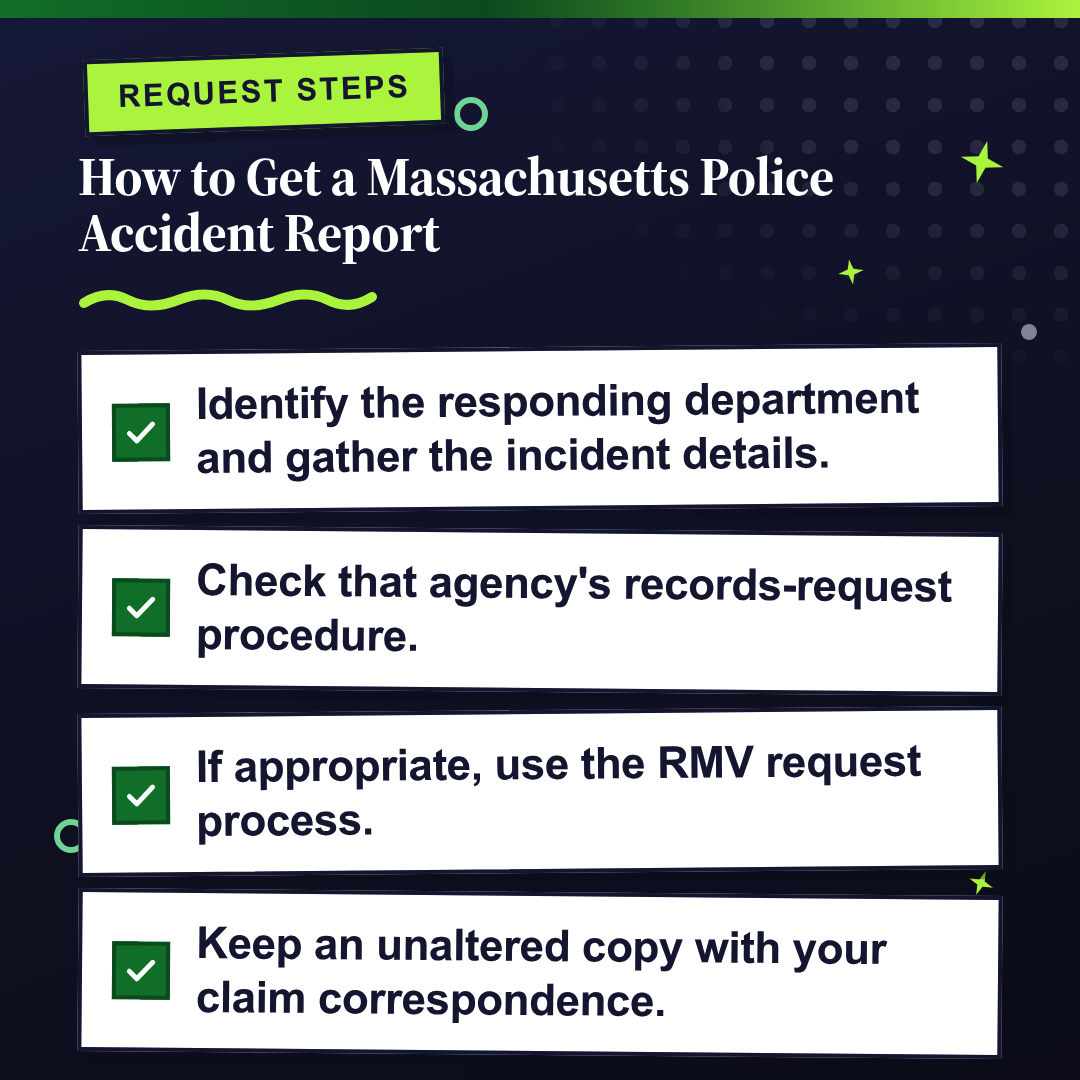
- Identify the responding department and gather the incident details.
- Check that agency’s records-request procedure.
- If appropriate, use the RMV request process.
- Keep an unaltered copy with your claim correspondence.
Who can request a copy?
Eligibility and identification requirements differ between RMV and local police records. Follow the current instructions from whichever office holds the report.
Correcting a Report Error
A driver generally cannot edit an officer’s police report directly. Contact the issuing department, identify the specific factual error, and ask about its correction or supplemental-report procedure.
If the error is in the operator report, contact the RMV for its current amendment or resubmission instructions. A driver’s disagreement alone will not change a disputed opinion, citation, or fault assessment.
Preserve objective supporting materials: photographs, witness details, registration records, repair documents, medical records. Submit relevant documentation with the correction request, and notify the insurer in writing if a material error could affect the claim. Keep the original report and all correction correspondence together.
What Changes When Someone Was Injured?
Any injury makes the crash reportable under Chapter 90, Section 26, regardless of the property damage amount. An injury also raises the stakes on prompt insurer notice and careful documentation. Keep medical records, treatment dates, and claim correspondence in one file.
How does insurance work when the crash was not your fault?
Massachusetts uses a no-fault auto insurance system for certain first-party injury benefits. Those benefits may apply without waiting for a final fault determination, while fault can still matter for vehicle damage and other liability claims. Reporting duties do not pause while fault is sorted out.