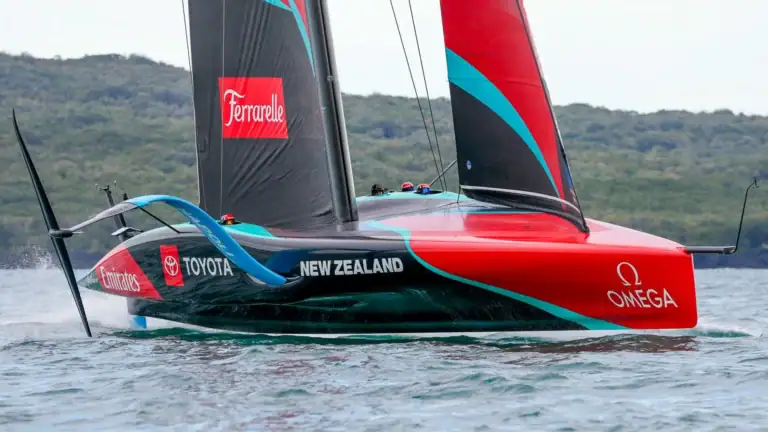
The world’s biggest sailmaker says the Cup Defender patented technology that North built, sold and taught it to use. Naples is just ten months away.
The America’s Cup has survived Deed of Gift litigation, a catamaran-versus-trimaran grudge match, and more protocol rows than anyone cares to count. Now it has a patent war, and this one is about what actually goes up the mast.
On 15 September, North Sails Group LLC sued Team New Zealand Limited and others in the US District Court for the Eastern District of Virginia (North Sails Group, LLC v Team New Zealand Limited et al, 1:26-cv-03061). North alleges that Team NZ took its intellectual property and patented it as its own. None of this has been tested in court, and Team NZ has not yet filed a response.
The patent in question is US 12,110,089, “Sail structure.” It names Team NZ sail designer Steven Collie as inventor and was granted in October 2024, days before Team NZ successfully defended the Cup in Barcelona.
The idea is a luff region more elastic than the rest of the sail, which lets the AC75’s twin-skin mainsail flip quickly from a powerful take-off shape to a flat, fast one once the boat is foiling. It is clever stuff but the question is whose cleverness it is.
The design elements are covered by the ETNZ patent, first lodged by designer Steve Collie in 2023.
The loads in the foiling AC75 differ from those in regular keelboats. As Sail World reported, since the AC75’s inception, Cup designers and engineers have grappled with the challenges posed by the huge range of apparent wind speeds under which the AC75 foiling monohull operates.
Team NZ is the Defender. North Sails makes sails for the challengers. Team NZ has reportedly put challengers on notice that they risk infringing the patent.
North has reportedly floated building challenger sails in Sri Lanka, outside the patent’s reach. A Defender holding an IP right over technology its rivals depend on is, to put it mildly, an innovative approach to sporting competition.
North’s case, as previewed in its earlier filings with the US Patent Trial and Appeal Board, has three main parts:
- The technology grew out of North’s own 3Di programme, which it says has cost US$20 million since 2007.
- North sold sails embodying it to Team NZ more than a year before the patent’s priority date.
- North supplied Team NZ and Collie with design software and training under confidentiality agreements.
If North is right about the prior sales, that is an on-sale bar problem. North has also called Team NZ’s failure to disclose those sails to the examiner inequitable conduct.
The PTAB was unpersuaded, at least procedurally and has declined to institute post-grant review on the merits.
The interesting issue here is what happens to innovation developed inside a supplier-customer relationship when both sides think they own it. Every lawyer who has waved through an IP clause in a collaborative supply agreement as boilerplate will be keenly interested, if not alarmed, by this case.
Timing adds pressure. The Eastern District of Virginia is famously the “rocket docket,” and the 38th Match starts in Naples in July 2027. For once, the lawyers may be moving faster than the boats.