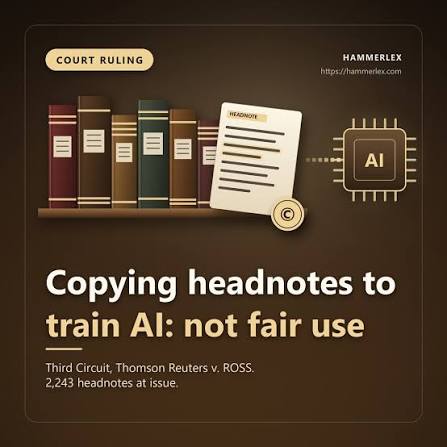
Power Points: In three days, a federal appeals court confirmed that Westlaw’s headnotes cannot be freely used to train a rival AI tool, and a California law firm filed a proposed antitrust class action alleging that Thomson Reuters’ $650 million Casetext purchase was a “killer acquisition.” One case says the content moat is legally protected while the other says it is a monopoly.
Six weeks ago LawFuel argued that Thomson Reuters’ new model, Thomson, mattered less than the decades of legal content beneath it. Content is King, we said. Last week the courts started deciding what sort of king it was.
On Tuesday 29 September, the Third Circuit gave Thomson Reuters the first federal appellate ruling on fair use in AI training. On Thursday 1 October, the Rubin Law Office of Carlsbad, California, filed a proposed class action alleging the company bought its cheapest serious competitor and switched it off.
Headnotes Are Property
Thomson Reuters sued ROSS Intelligence in 2020 for using Westlaw headnotes to train a rival legal search engine. ROSS shut down in 2021, citing the cost of the litigation.
The Third Circuit panel has now affirmed that the headnotes are copyrightable and that the training use was not fair use.
The court treated ROSS’s purpose as essentially Westlaw’s own, so the use was minimally transformative. And it also accepted that a market for licensing headnotes as AI training data is developing, even though Thomson Reuters licenses them to nobody.
That is a judicial nod to exactly what the Thomson model monetises, using less than 10 percent of the company’s content so far.
A footnote distinguishes ROSS’s non-generative tool from the generative models in the Anthropic and OpenAI cases, the ruling binds only the Third Circuit, and critics including the Authors Alliance say it guts the merger doctrine.
But any vendor whose training pipeline touched Westlaw-derived material should be rereading its data provenance files. Judicial opinions are free. The editorial layer on top is not.
Was Casetext a “Killer Acquisition”?
Casetext launched CoCounsel on MSNBC’s Morning Joe in March 2023, about as close as legal tech gets to a red carpet, and Thomson Reuters bought the company for $650 million later that year.
The Rubin complaint alleges that Westlaw had no generative AI of its own, so Thomson Reuters bought the challenger rather than build, then folded it into the pricier Westlaw ecosystem.
The firm says it went from $32.50 a month for Casetext to $111.48 a month for Westlaw Classic, on a three-year contract with 4 percent annual increases. It seeks a nationwide class, treble damages and an order to divest or re-establish Casetext. Thomson Reuters told Bloomberg Law it had not been served and could not comment.
These are untested allegations and a lot of water needs to go under the bridge, but the theme is not new, either: ROSS’s own antitrust tying counterclaim got past the pleading stage earlier in its litigation.
CoCounsel, the product at the centre of the complaint, is now the launch vehicle for Thomson. And the complaint’s core claim is that Thomson Reuters bought rather than built, five weeks after the company announced it had built, for around $40 million including talent and compute.
Same Moat, Two Readings
The ROSS court says the content behind Westlaw is protected property with a recognised AI training market. The Rubin complaint says the business built on it dominates the market alongside LexisNexis, which has gone multi-model rather than training its own.
What Should Law Firms Do?
- Check your Westlaw renewal terms. Know your escalators and lock-in periods before your vendor reminds you of them.
- Ask your AI vendors about training data. After ROSS, “publicly available legal materials” deserves a follow-up question.
- Watch the motion to dismiss, not the headlines. If the complaint survives, discovery could reveal a great deal about how legal research pricing works.
Our Take
Thomson Reuters has had a week most companies would call mixed and most lawyers would call billable. In August it said content was its real AI weapon. In September a federal court agreed. In October a small California firm argued the weapon is pointed at customers.
Content is King. The question now is how much the king gets to charge.