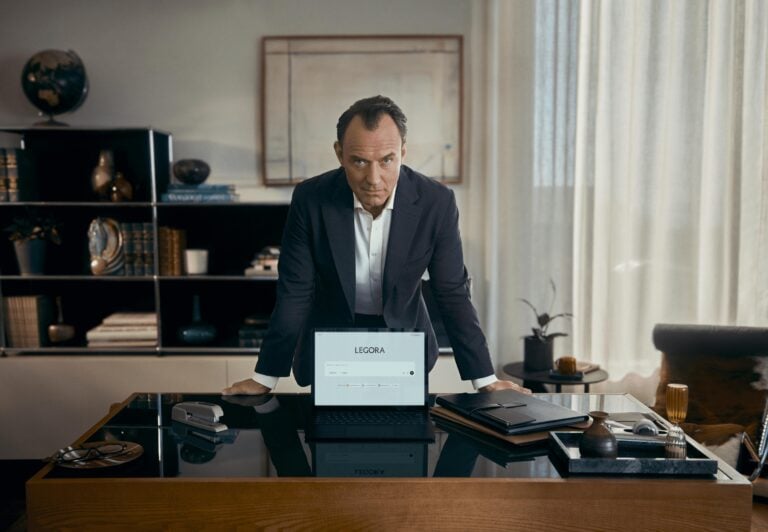
Legal AI has gone Hollywood: celebrity ambassadors, baseball stadiums and $20bn of combined valuations. But the companies that matter most in this market may not be the ones buying the billboards.
Legal AI has apparently concluded that what lawyers really need is more celebrities but there is a question as to who really controls the the legal AI market as the models rely upon similar engines and IP.

In February, Harvey signed Gabriel Macht, better known as Harvey Specter, the impossibly well-tailored closer from Suits. Specter is also the character who reportedly inspired the company’s name, so this is less an endorsement than a family reunion.
Swedish rival Legora responded in April with Jude Law, a campaign line of “Law just got more attractive”, and an Oscar-winning cinematographer attached, just to reinforce the celeb element. Then it signed the New York Yankees and Aaron Judge, so we had the Judge and a Law, something the marketing department has clearly been waiting years for.
The FT reported a 900 per cent jump in unprompted visits to Legora’s site in the month after the Jude Law spots ran. Add Harvey’s football deals with PSG and Fulham and Legora’s with Chelsea, and legal tech now has a sponsorship budget to rival a mid-table Premier League club.
Behind the glamour, though, is an unglamorous question as to who actually controls this market?
The landlord wants the business too
Harvey (valued at $15.5bn after a $550m raise in September) and Legora ($5.6bn) built their businesses on large language models they don’t own. That arrangement is getting awkward.
Anthropic has moved directly into legal.
Its February launch of legal plugins for Claude sent legal software stocks sliding, and its May Claude for Legal release went further. The difficult part is that Harvey is now one of the connectors inside Anthropic’s legal offering. Harvey is a partner, a customer and a competitor of the same company at once.
OpenAI’s position is no simpler: its startup fund is a Harvey investor.
Bloomberg reported in September that Harvey’s gross margin fell from roughly 50 per cent at the start of the year to minus 50 per cent by June. Usage of its AI agents surged, and token consumption rose twentyfold under the labs’ usage-based pricing. Harvey’s most successful product feature was, for a while, its most expensive.
Plan B is a China Move
Harvey’s answer was Tenet, a model released in August as a research preview. It is post-trained on Kimi K3, an open-weight model from China’s Moonshot AI, and built with Fireworks. Bloomberg reports margins have since turned positive, and Harvey says its new money will go into building more of its own models.
Harvey still uses frontier models for the hardest work but it is clear that the most valuable company in legal AI is reducing its dependence on its two biggest suppliers.
There is a perception issue, too. Running open weights on US infrastructure is not the same as sending client data to China, and Harvey says no customer data was used in training.
The Real Question
For law firms the question is more than just choosing between Harvey and Legora.
If every major firm can buy broadly similar AI, from the same handful of model makers, then the tool itself confers littlereal advantage. Harvey says 80 per cent of the Am Law 100 already uses it.
What firms keep is what no model provider can license: proprietary know-how, workflows refined over decades and, above all, client relationships.
Harvey and Legora have the celebrities. The AI labs have the models, and in Harvey’s case a seat on the cap table. The law firms still have the clients.
Jude Law can win the attention. He can’t win the war.