

May 22, 2026 | Sonia Hickey | Law Firm Management
Missing a client call can mean missing a case. Potential clients often contact multiple firms and hire the first one that responds with confidence and speed. But attorneys are in court, in meetings, or focused on active matters, so the phone keeps ringing.
Legal answering services give law firms reliable coverage without the cost of a full-time front desk hire. Trained receptionists answer under your firm’s name, follow your scripts, take messages, screen and intake new leads, schedule consultations, and route urgent calls to the right person.
Quick Picks
If you’re short on time, here are three standout options to consider, depending on your priorities:
Veza Reception – Best for small to mid-size firms looking for a consistent, familiar receptionist experience, as opposed to a rotating pool of call center agents.
Gabbyville – Best for firms that want warm, personalized call handling with monthly plans based on expected call volume rather than traditional per-minute billing.
Lawyer Line – Best for law firms that want a legal-only answering service with 24/7 coverage and active lead qualification built in.
Continue reading for a detailed review of the top 8, along with a guide for evaluating the various options.
Comparison Chart of the Services
| Service | Best For | Legal-Only Focus | Availability |
| Veza Reception | Small to mid-sized firms seeking consistent and familiar receptionists, versus rotating call center pools | Legal only | 24/7 coverage |
| Gabbyville | Firms seeking personalized call handling with monthly plans based on expected call volume | Generalist | Mon–Fri, 8am–8pm EST |
| ReceptionHQ | Firms seeking flexible live receptionist support with transparent pricing, call transfers, appointment scheduling, and optional 24/7 coverage | Generalist | 24/7 coverage |
| Lawyer Line | Firms that want legal-only 24/7 reception, intake qualification, and CRM integration | Legal only | 24/7 coverage |
| Moneypenny | Firms seeking multi-channel coverage backed by legally-experienced staff and AI tools | Generalist | 24/7 coverage |
| Go Answer | Firms seeking 24/7 live answering, bilingual support, and legal intake help | Generalist | 24/7 coverage |
| PATLive | Firms seeking basic call flows, reliability, and cost control | Generalist | 24/7 coverage |
| Abby Connect | Firms seeking polished receptionist support and bilingual answering | Generalist | 24/7 coverage, plan dependent, may include AI + live team |
What Is a Legal Answering Service?
A legal answering service is a third-party service that answers your law firm’s incoming calls. Unlike a standard call center, legal answering services employ receptionists that are trained in legal terminology, are sensitive to the client’s situation, and understand the urgency associated with many legal matters.
These services allow your firm to answer calls under your firm’s name, using the same scripts and procedures that your firm would use internally, representing your firm to callers who may never know that they are speaking with a third-party service.
Legal answering services vary greatly in terms of the services they offer. Some services only provide basic message-taking, while other services provide complete new client intake, case eligibility screening, consultation scheduling, and data syncing with your practice management software.
What level of service is needed depends on your firm’s size, call volume, and how much of the intake process you want to delegate to a third-party.
Why Law Firms Use Answering Services
Callers don’t always leave voicemails. According to a CRM Magazine article quoting Forbes, a large percentage of callers sent to voicemail do not leave a message. This phenomenon is referred to as “voicemail abandonment.” Other studies report voicemail abandonment rates ranging from 50% to 75% depending on the type of business.
Speed to lead matters. The Inside Sales and MIT Lead Response Management Study Summary reported that the likelihood of a contact being made with a web lead decreased significantly as response time increases, and that there was a significant drop-off in contact likelihood when responding to a lead in 5 minutes versus 30 minutes.
Lawyers aren’t always available. Due to the nature of the legal profession, lawyers and paralegals are not always able to respond to every call. This creates a gap that a legal answering service can fill without the firm needing to hire a full-time receptionist.
Cost to coverage ratio is favorable. Hiring a full-time front desk receptionist includes salary, benefits, and the inherent risks of hiring a new employee. Providing the same or better coverage as a full-time employee, but at a predictable monthly rate, makes a legal answering service a viable option.
Our Ranking Methodology
The above list was developed using criteria that are relevant to law firms specifically, and not the generic requirements of businesses. The key criteria that we used included:
- Is the service truly a legal expert, meaning is the service a legal-specific product or simply a legal tier added to a general product?
- How does the staffing model affect the ability to maintain consistency over time?
- How deep and flexible is the service regarding intake capabilities?
- Are software integrations available?
- Is pricing transparent? How does pricing scale?
- Are the contractual terms flexible?
Legal answering services that exclusively or primarily serve law firms received additional consideration, although several generalist services are listed because of their legal features and their history of working with law firms.
Top 8 Legal Answering Services
1. Veza Reception
Best Overall for Consistent, Legal-First Call Handling
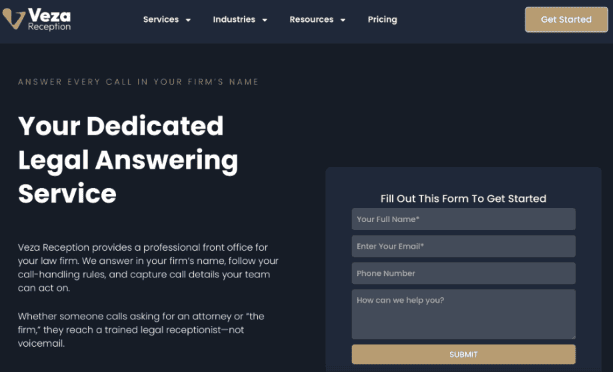
Veza Reception is a strong fit for firms that prioritize staffing consistency and intake accuracy, using a dedicated pod model where a consistent group of receptionists learns the firm’s practice areas, intake scripts, and preferences over time.
That consistency matters in legal intake. When callers are routed to a large rotating pool of agents, the person answering may have limited familiarity with the firm’s workflow, practice areas, or escalation preferences. Veza’s pod model helps reduce that friction by giving firms a smaller, more familiar team that can sound more like an extension of the office.
Veza can support new client intake, warm transfers, message taking, scheduling, overflow coverage, after-hours support, and customized call flows based on each firm’s needs.
Best for: Small to mid-size firms seeking familiarity and consistency, especially those focusing on intake-heavy practice areas.
Pros: Dedicated pod model, legal-first scripts, customized call flows, intake support, warm transfers, scheduling, 24/7 coverage, month-to-month flexibility.
Cons: May not be suitable for firms that prefer to have unlimited pooled capacity as the default model.
Pricing model: Tiered monthly packages with transparent pricing and no long-term contracts.
Contract terms: Month-to-month.
2. Gabbyville
Best for Personalized Call Handling With Call-Volume-Based Monthly Plans
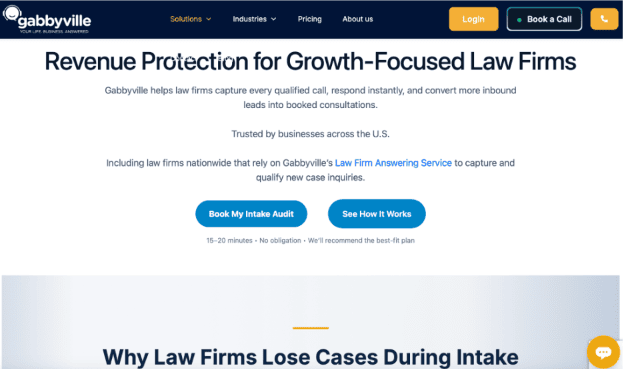
Gabbyville offers live receptionist support for firms that want warm, personalized call handling without hiring in-house. Its receptionists can answer calls, follow firm-defined scripts, take messages, route calls, and support basic scheduling or caller-screening workflows.
The service is built around monthly plans based on expected call volume rather than traditional per-minute billing. That can make costs easier to estimate for firms that want predictable front-desk coverage and do not want every longer conversation to increase their bill.
Gabbyville’s main limitations are legal specialization and fit for more complex intake. It is not a legal-only provider, so firms with detailed case-screening requirements, conflict-check workflows, or urgent legal escalation rules may need more customization.
Best for: Firms seeking warm, personalized call handling with monthly plans based on expected call volume.
Pros: Friendly live receptionists, call routing, message taking, custom scripts, no traditional per-minute billing.
Cons: Not a legal-only provider; may require customization for complex legal intake.
Pricing model: Monthly plans based on expected call volume.
Contract terms: Contact for details.
3. ReceptionHQ
Best for Flexible Live Receptionist Support With Transparent Pricing
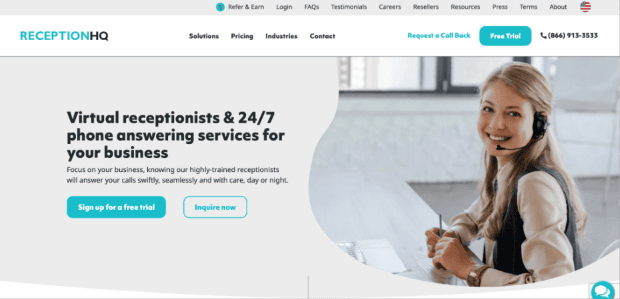
ReceptionHQ provides live virtual receptionist and call answering services for law firms and other businesses. For firms that want human call handling instead of an AI-only setup, ReceptionHQ can answer calls with a customized greeting, take messages, transfer calls, collect caller information, and support appointment scheduling depending on the plan.
The service offers flexible call answering plans with published pricing, which can be helpful for firms that want clearer cost expectations before speaking with sales. ReceptionHQ also offers optional 24/7 availability and can support more detailed call handling workflows on higher-service plans.
The main limitation is legal specialization. ReceptionHQ works with law firms, but it is not a legal-only provider. Firms with complex intake, conflict checks, urgent legal triage, or detailed practice-area screening may need to spend extra time customizing scripts and workflows.
Best for: Firms that want flexible live receptionist support, transparent pricing, message taking, call transfers, and appointment scheduling.
Pros: Live receptionists, published pricing, call transfers, message taking, appointment scheduling, 24/7 availability, no lock-in contracts.
Cons: Not legal-only; lower-tier plans may be too basic for detailed legal intake; complex workflows may require additional setup.
Pricing model: Per-call and per-minute plans, with entry-level live answering plans available.
Contract terms: No lock-in contracts.
4. Lawyer Line
Best for Legal-Only 24/7 Coverage With Active Intake Qualification
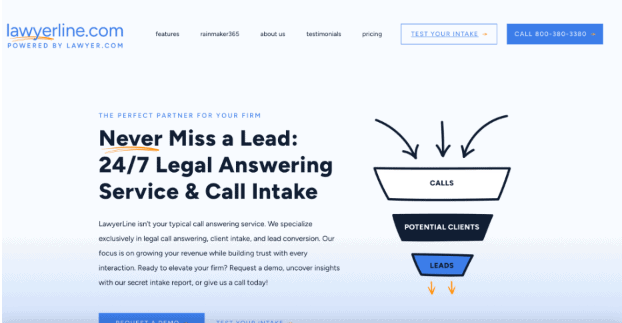
Lawyer Line is built on infrastructure that most answering services cannot replicate: it operates out of the Lawyer.com network, which has spent over eight years managing legal referral intake at scale.
That background shapes how the service approaches every call. With U.S.-based bilingual receptionists trained across more than 140 practice areas, legal-specific call handling isn’t a configuration option — it’s the default. The service runs 24/7/365, currently works with over 800 law firms, and processes more than 100,000 calls per month.
The operational difference shows up at the intake level. Lawyer Line doesn’t just log and relay — it screens calls for case value, matches callers against firm-defined criteria, and routes only viable leads forward. That’s closer to how an intake coordinator thinks than how a receptionist works, and the numbers reflect it: the service reports a 99% client retention rate.
Direct integrations with Clio, Practice Panther, and Lawmatics mean case data flows into existing systems automatically, and the service runs month-to-month with no long-term contracts.
The one gap is pricing transparency. Rates are not published publicly, so firms need to contact the team for a quote. A free intake test is available on the website, giving practices a direct way to evaluate call quality before committing.
Best for: Solo attorneys and small firms that want a legal-exclusive service with 24/7 live coverage, structured lead qualification, and CRM integration.
Pros: Legal-only, 24/7/365, bilingual, 140+ practice areas, active intake qualification, Clio/Practice Panther/Lawmatics integrations, no contracts.
Cons: Pricing not publicly listed — requires direct contact for a quote.
Pricing model: Pay-as-you-go; contact for rates.
Contract terms: Month-to-month, no long-term commitment.
5. Moneypenny
Best for Multi-Channel Legal Coverage Backed by AI Tools and Experienced Staff
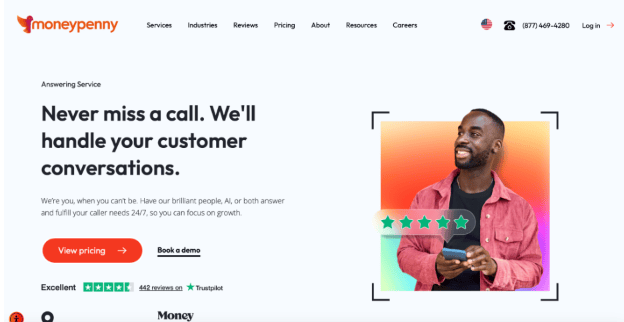
Moneypenny pairs a technology-forward call handling platform with a legal team that brings genuine professional context to every interaction.
On the technology side, receptionists work with a proprietary KnowledgeBase that surfaces relevant firm and client information during live calls, and a MessageMaker tool that generates accurate call summaries in real time — reducing errors and giving firms an automatic record of every interaction without manual follow-up.
Live chat is handled by the same trained agents, making Moneypenny one of the few services that integrates phone and chat coverage under one roof.
What backs that infrastructure is the calibre of the team. Moneypenny recruits its legal receptionists from backgrounds in paralegal work, conveyancing, and legal secretarial roles — meaning the people answering calls have spent time in legal environments rather than learning legal terminology from a training manual.
The service has been operating since 2000, covers 24/7/365 with bilingual support, and offers plans scaling from 50 to 1,000 minutes per month.
On pricing, the entry point is around $145 per month for 50 minutes, but most firms will pay more once 24/7 coverage and outbound calling are factored in — the latter requiring a one-time setup charge that should be included in any honest budget comparison.
Moneypenny is also not a legal-only provider; it operates across multiple industries. Firms that need a provider built exclusively around law firm intake should weigh that against the genuine legal experience and tooling the team brings.
Best for: Small to mid-sized firms that want a scalable, multi-channel service with AI-enhanced call handling and staff who come with genuine legal backgrounds.
Pros: Legally-experienced receptionists, proprietary AI tools, KnowledgeBase, MessageMaker, phone and live chat coverage, 24/7/365, bilingual, scalable plans.
Cons: Not a legal-only provider; outbound calling carries a separate setup fee; real-world costs higher than entry price once add-ons are included.
Pricing model: Minute-based tiered plans from approximately $145 per month for 50 minutes.
Contract terms: Flexible plans; contact for terms.
6. Go Answer
Best for 24/7 Live Answering With Bilingual Legal Intake Support
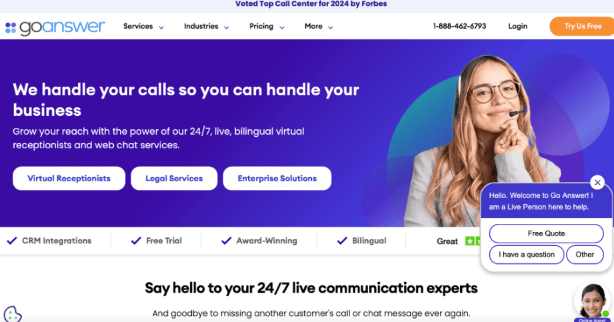
Go Answer provides 24/7 live answering, bilingual receptionist support, web chat, and legal intake services for law firms. Its team can answer calls, collect caller information, help qualify leads, schedule appointments, and support intake workflows.
The service is not legal-only, but it does offer dedicated legal intake services and promotes support for law firms through 24/7 availability, bilingual answering, and intake assistance.
Best for: Firms that want 24/7 live answering, bilingual support, and legal intake help.
Pros: 24/7 coverage, bilingual receptionists, legal intake support, web chat, appointment scheduling.
Cons: Not legal-only; may require customization for complex legal intake.
Pricing model: Quote-based.
Contract terms: Contact for details.
7. PATLive
Best for Straightforward Coverage With Clear, Published Pricing
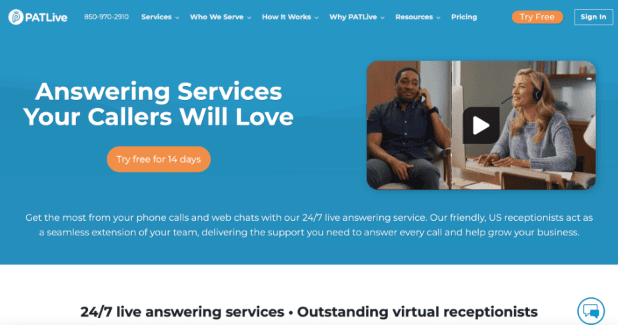
PATLive provides 24/7/365 live receptionist coverage and publishes its plan tiers, including per-minute pricing and bundles of minutes.
For cost-conscious firms that want predictable pricing without the complexity of custom quotes, that transparency is a genuine advantage.
PATLive is not a legal-only service, but it meets the basics for firms with simpler intake needs.
Best for: Cost-conscious firms seeking reliable answering and message capture with published pricing.
Pros: 24/7/365 coverage, published pricing tiers, flexible scripts, clearly defined cost scaling.
Cons: Generalist company; may require additional configuration for firms with complex legal intake requirements.
Pricing model: Bundle of minutes and per-minute rates.
Contract terms: Month-to-month options available, dependent on the plan.
8. Abby Connect
Best for Polished Receptionist Support and a Strong Caller Experience
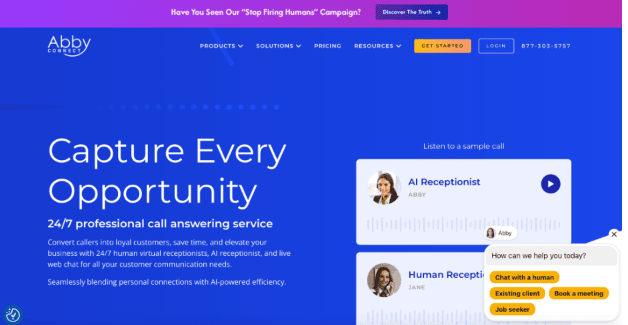
Abby Connect provides live receptionist services for law firms that want professional call answering, message-taking, call routing, appointment scheduling, bilingual support, and after-hours or weekend coverage depending on the plan.
The service is known for a polished caller experience and friendly receptionists who follow firm-provided scripts and instructions. This can make it a good fit for firms that want reliable front-desk support without hiring internally.
The main limitation is that Abby Connect is not a legal-only provider. Firms with complex intake needs or detailed case-screening requirements may need more customization.
Best for: Firms that want professional receptionist support, bilingual answering, and a polished caller experience.
Pros: Professional call handling, bilingual answering, appointment scheduling, after-hours/weekend options.
Cons: Not legal-only; may require more customization for complex intake.
Pricing model: Minute-based plans with tiered packages.
Contract terms: Varies by plan.
What to Look for in a Legal Answering Service
Legal-specific training: How are the receptionists trained for legal calls? How do they handle sensitive or urgent situations?
Staffing model: Dedicated teams and pooled agent models can create very different caller experiences, especially when it comes to consistency and familiarity over time.
Coverage hours: Confirm after-hours, weekend, and holiday coverage.
How to Choose the Right Service for Your Firm
Start with your actual call volume and intake complexity. A firm handling 15 calls a day with straightforward intake has different requirements than one managing hundreds of leads per week across multiple practice areas.
Then shortlist based on one primary decision:
If intake quality and legal nuance are the priority, start with legal-first providers.
If caller experience and polish are the priority, prioritize services known for training and consistency.
If multi-channel capture matters, choose a provider that can unify phone, chat, and messaging.
Request a demo from any finalist, and if possible, mystery-call them before signing up. Listen for tone, professionalism, and how naturally they handle legal context.
Finally, plan for scalability. Your needs will change as you add practice areas, grow marketing, or expand into additional channels.
Frequently Asked Questions
Are legal answering services worth it for small firms?
Often, yes. Small firms benefit disproportionately because each missed call can be a missed case, and you gain coverage without adding payroll.
Per-minute or per-call pricing, which is better?
Per-minute can work well when calls are short and predictable. Per-call can be simpler when you want predictable cost per inbound lead and consistent billing.
What should a legal intake script include?
At minimum: case type, incident date, opposing parties, jurisdiction, conflicts screening fields, urgency, preferred contact method, and next step scheduling.
Can answering services do conflict checks?
Some providers can check a CRM or intake system for conflicts. Confirm exactly what is checked and when it is performed.
Do I need 24/7 coverage?
Not always. Many firms do well with after-hours and overflow coverage, plus full coverage during peak marketing campaigns.
How do I measure ROI?
Track missed call rate before and after, consults booked, qualified leads captured, signed cases, and average time to first response.
Final Thoughts
The right legal answering service depends on what your firm values most. If legal nuance and intake accuracy matter most, start with legal-first providers. If caller experience and polish are the priority, focus on services known for training and consistency. If you want one vendor to capture leads across phone, chat, and messaging, choose a provider built around multi-channel workflows.
Before you commit, shortlist two or three finalists and test them. Ask for a demo, confirm how billing is counted, including per-minute versus per-call and rounding rules, and place a couple of test calls to hear their tone.
The best choice is the one that consistently captures clean intake, routes calls correctly, and fits your volume and budget.



Pingback: Legal-First vs. Generalist: How to Choose a Receptionist Provider in 2026 – Site Title
Pingback: How Do I Handle Urgent Calls When I’m in Court? (Stop Losing Leads to Voicemail) – Site Title