Ben Thomson, LawFuel contributing editor
It is May 2026, and the BigLaw salary scale has not moved for two and a half years.
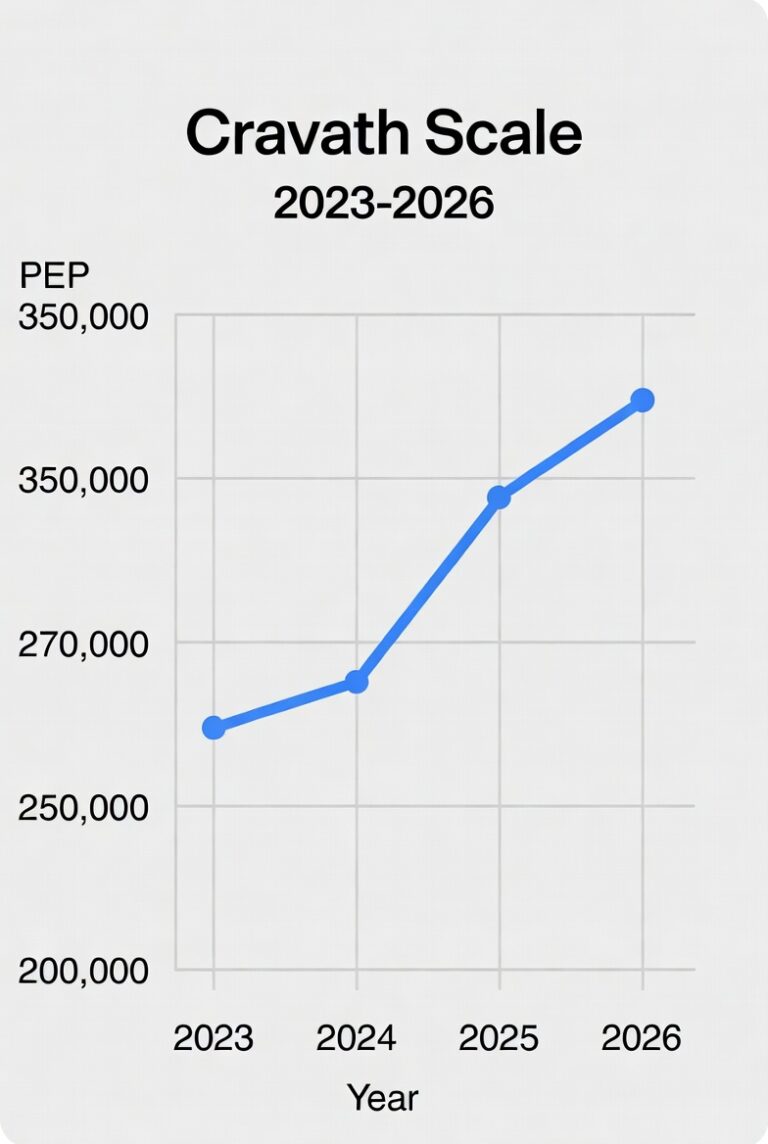
That sentence would have sounded unthinkable in 2021, when Milbank ignited a comp war that pushed first-year associates from $190,000 to $215,000 in eight weeks. Three years on, Class of 2025 first-years are starting on $225,000 — the same number Milbank put on the board in November 2023. Eighth-years are still on $435,000. Cravath confirmed in its November 18, 2025 bonus memo, in writing, that base salaries would not rise in 2026.
The lockstep is intact. The escalator has stopped.
So when does it start again, we ask – and presumably you want the answer to that so we’ve done our best to pose some on-the-button questions.
What the 2026 BigLaw salary scale actually looks like right now
Here is where Cravath-aligned firms sit as of May 2026, based on the bonus memos confirmed by Cravath, Milbank, Paul Weiss, Cleary, Ropes & Gray, Skadden, Davis Polk, Fried Frank, Paul Hastings and McDermott in the November 2025 round:
| Class year | Base salary | Year-end bonus | Special bonus | Total comp |
|---|---|---|---|---|
| 2025 (1st year) | $225,000 | $15,000* | $6,000* | $246,000 |
| 2024 (2nd) | $235,000 | $20,000 | $6,000 | $261,000 |
| 2023 (3rd) | $260,000 | $30,000 | $10,000 | $300,000 |
| 2022 (4th) | $310,000 | $57,500 | $15,000 | $382,500 |
| 2021 (5th) | $365,000 | $75,000 | $20,000 | $460,000 |
| 2020 (6th) | $390,000 | $90,000 | $25,000 | $505,000 |
| 2019 (7th) | $420,000 | $105,000 | $25,000 | $550,000 |
| 2018 (8th) | $435,000 | $115,000 | $25,000 | $575,000 |
*Class of 2025 bonuses are prorated.
That is the floor. But it is also, increasingly, the ceiling — at least at the firms that still claim to “match market.” Let’s see about that as the year progresses.
Why the scale has frozen
Three things have happened simultaneously.
One: profitability is up, but firms have stopped passing it through to base pay. Kirkland & Ellis cracked $11 million in profits per equity partner in 2025, the first firm ever to do it. Wachtell, Sullivan & Cromwell, Davis Polk and Paul Weiss are clustered tightly behind. Yet none of them used record PEP as a pretext to break ranks on associate base. The money is being kept upstairs.
Two: AI productivity has become the polite reason for not raising junior pay. When MinterEllison cut its Australian graduate intake in May 2026 citing AI, it said the quiet part out loud. Across Wall Street, the calculation is the same — if a first-year’s doc review hours collapse, justifying another base bump becomes a harder sell to the executive committee. Bloomberg Law called the November 2025 cycle “unlikely to be an associate compensation war,” and the firms agreed.
Three: the bonus has replaced the raise. Milbank’s August summer bonus and Cravath’s November match did the work that a base increase would have done five years ago. Firms can claw bonuses back through hours requirements, performance flags and proration. They cannot claw back a published scale. That asymmetry is the entire point.
So which firm breaks first?
If history is the guide, the firm that breaks the freeze will be the one with the most to gain from doing it loudly. That is almost always not Cravath.
The pattern since 2018 has been consistent: a non-pacesetter firm makes the first move — usually Milbank, occasionally Davis Polk or Simpson Thacher — and Cravath responds within two to three weeks, sometimes topping the scale at the senior end. Cravath leads the bonus, not the raise.
Three scenarios look live for the next twelve months:
Scenario one — Milbank lights the fuse again. Milbank kicked off the 2022 raise and set the 2023 raise that became the current scale. They have done it twice. They have a track record of using comp to brand-build into the senior associate lateral market. A $10K–$15K bump applied January 1, 2027 and announced in late 2026 fits the pattern exactly.
Scenario two — Simpson Thacher or Davis Polk moves on mid-levels only. This is the more likely play. The pressure point in the market is not the first-year, it’s the 4th-to-6th year, where lateral packages have been quietly running $30K–$60K above scale for in-demand groups. A surgical mid-level-only adjustment lets a firm claim a raise without inflating the entire grid.
Scenario three — nobody moves, and the next “raise” arrives as a special bonus. The path of least resistance, this one. Another Milbank summer bonus, matched by Cravath in November, dressed up as a market move. Some recruiters expect this. Nothing structural, just the ‘raise’.
The smart money is on scenario two.
What recruiters are actually seeing
Lateral packages tell a different story than the published scale. The conversations LawFuel has had with senior recruiters across NY, DC and Chicago over the past quarter suggest:
- Mid-level associates in private equity, funds, capital markets and antitrust are commanding signing bonuses of $50,000–$100,000 that did not exist 18 months ago.
- Guaranteed year-end bonuses for the year of the move are increasingly being written into offers — locking in the published bonus regardless of hours.
- Litigation boutiques — Susman, Wilkinson Stekloff, Selendy Gay — are paying year-end bonuses well above the Cravath scale for high billers. Wilkinson Stekloff’s published 2025 bonus range went up to $172,500, against Cravath’s $140,000 top.
- The 3rd-to-5th year band is the hottest cohort. Productive, client-ready, expensive to replace, and least loyal.
This is the part the scale does not capture. The money is moving. It is just not moving via Cravath.
What associates should do before the next announcement
Three things come to mind here, and its what we think based on what recruiters and others have told us (plus a dose of common sense) –
Check your class-year position against the lateral market, not the scale. The published number is the floor your current firm pays you. The lateral number is what someone else will pay you tomorrow. If the gap is more than $25K all-in, you have leverage.
Pay attention to the bonus memo language, not the headline number. The 2025 memos quietly raised hours floors at several firms and built in more discretionary language. The next move will be the same. Read what counts as “creditable” hours, and what counts as “suitable performance.”
Stop waiting for the announcement. If you are a 4th-to-6th year in a strong group, the raise has already happened — it is sitting in a lateral offer you have not asked for yet.
When will it happen?
If a firm moves base in 2026, the most likely window is late October to late November — timed to coincide with bonus season, applied retroactively to January 1, 2027. That is exactly how the 2023 round played out.
If no firm moves in that window, the freeze extends into a fourth year, and the gap between the published Cravath scale and the realised lateral market becomes the dominant comp story of the second half of the decade.
We will update this article the moment any firm announces.
LawFuel will update this scale within the hour of any market-moving memo. Let us know your thoughts – email us at: lawfuel@gmail.com. And subscribe to the free LawFuel newsletter for instant alerts on the next BigLaw raise.