
5 Law Firm Marketing Website Winning Moves
Rachel Williams, LawFuel contributor
If you’ve seen one law firm website, you’ve seen approximately 847 of them.
Dark blue header. Stock photo of a gavel. A tagline that says “Experienced. Trusted. Results.” A partner page where everyone looks like they’re suppressing mild indigestion. And an “About Us” page that begins, without fail, with the sentence: “Founded in [year], our firm is committed to providing exceptional legal services.”
Committed. To providing. Exceptional legal services. As opposed to all those firms committed to providing mediocre ones.
Here’s the thing law firms don’t want to hear: your website isn’t underperforming because of your SEO budget, your colour palette, or your choice of serif font. It’s underperforming because it was built to impress other lawyers, not to win clients.
There’s a difference, and the numbers prove it. Firms that invest in client-centred design are seeing up to four times faster growth than those still running cookie-cutter templates.
SEO alone generates a 7.5% conversion rate for law firms, more than three times higher than paid advertising. Meanwhile, 80% of potential clients move on to a competitor if they don’t hear back within 48 hours of making contact.
You do not have to sacrifice search engine traffic to be creative. In fact, Google’s E-E-A-T guidelines (Experience, Expertise, Authoritativeness, Trustworthiness) highly reward transparent, distinct, and trustworthy content.
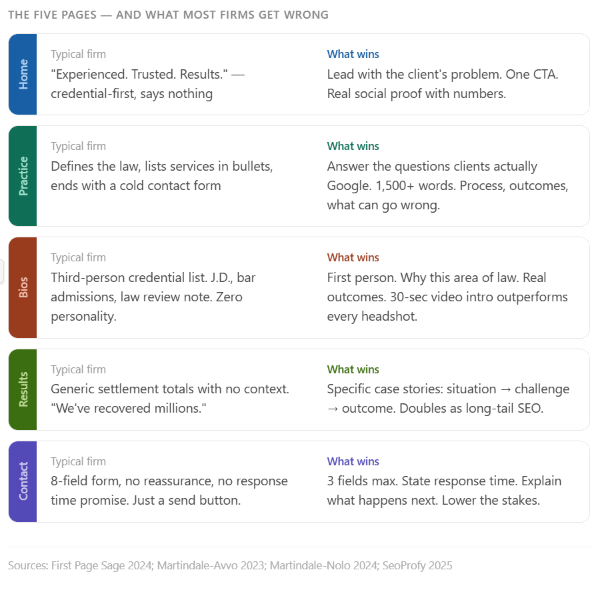
The firms converting visitors into consultations have quietly figured out that five specific pages do almost all the heavy lifting.
Here’s what those pages do, and why most firms are getting them completely wrong.
1. The Homepage: Stop Telling People You’re Good
Every law firm homepage makes the same fundamental error: it leads with credentials instead of comprehension.
“Award-winning.” “30 years of experience.” “Offices in five states.”
What the winning version looks like: A clear statement of who you help and what problem you solve. Social proof — real numbers, real outcomes. One prominent call to action. Not three. One.
None of that answers the question a potential client is actually asking, which is: do you understand my problem?
The firms that win on homepage design start with the client’s situation, not the firm’s résumé. A personal injury practice that opens with “You didn’t expect to be here. Nobody does” is doing something most firms never manage: demonstrating empathy before anything else.
The formula that works is simple. Name the problem. Acknowledge the emotion. Then — and only then — introduce yourself as the solution.
Your homepage has about eight seconds to convince someone they’re in the right place. Lead with them, not you.
The more specific you are, the more people trust you actually get them.
2. The Practice Area Page: Where Most Firms Leave Money on the Table
This is the page Google sends people to. It’s also, remarkably often, the worst page on the entire site.
The typical practice area page reads like a law school textbook had a brief, joyless affair with a brochure.
It defines the area of law (thanks — the person already knows what divorce means), lists the firm’s services in bullet points, and ends with a “Contact Us” button that has all the urgency of a government form.

What it almost never does is answer the questions the client actually typed into Google at 11pm.
The winning practice area page is structured around client questions, not firm capabilities.
It explains what the process looks like, what typically goes wrong, what outcomes are realistic, and what the firm does differently. It treats the reader like an intelligent adult who deserves actual information — and in doing so, establishes authority far more effectively than a list of bar admissions ever could.
Long-form practice area pages, like 1,500 words and up, consistently outperform shorter ones in both search rankings and conversion. Not because length impresses Google, but because depth signals genuine expertise. It’s also how firms start appearing in AI Overviews, which are increasingly the first thing a potential client sees before they ever click through to your site.
3. The Attorney Bio Page: Nobody Cares About Your Law Review Note
With respect to anyone who made law review — the clients who are about to pay you $400 an hour don’t care.
They care whether you’ve handled their kind of case before. Whether you’ll actually talk to them, or hand them off to a paralegal. Whether you seem like a person, or an expensive piece of furniture.
The attorney bio is arguably the most personal page on any law firm site, and it’s almost universally written in the third person with all the warmth of a court filing. “Mr. Johnson received his J.D. from the University of Michigan and is admitted to practice in New York and New Jersey.”
Riveting.
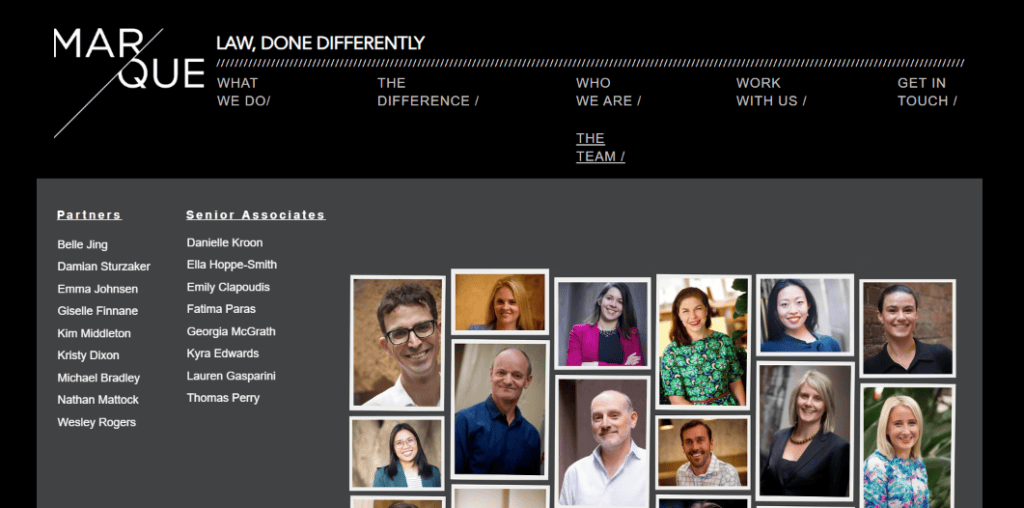
Consider Sydney, Australia law firm Marque Law, who openly list their personality quirks, what they love, what they hate, and their genuine philosophies on the law. It immediately strips away the intimidating aura of legal fees and courtrooms, making them feel like brilliant, highly accessible friends.
Look at what Raines Feldman does differently. Their team bios feature candid photos and personalised insights, not the standard headshot-and-credentials formula, and the result is a firm that reads as approachable and human before a single call has been made.
Zuckerman Spaeder takes a similar approach: their attorney profiles don’t just list credentials, they tell a story. There’s a reason both firms consistently appear on best-in-class website lists and it has a lot to do with their bio pages.
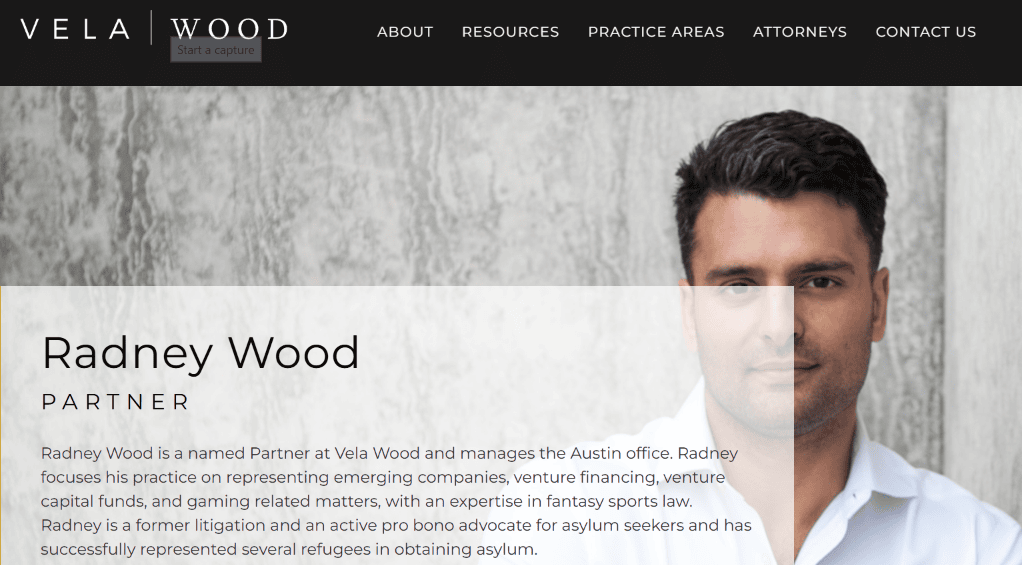
Even corporate law firms, which can present more challenges on the bio page front given a notoriously stiff approach, can liven up their entries, like corporate boutique Vela Wood which breaks the corporate mold entirely, proving that serious business lawyers can also be real, relatable human beings – as below:
The bios that convert clients share a few traits. They’re written in first person, or at minimum sound like a person wrote them. They explain the attorney’s motivation — why this area of law, why this kind of client. They mention real outcomes and they include a photo where the attorney looks like someone you might want to have a difficult conversation with. His site has the imagery, the copy, the case studies, and the result was instant recognition from the exact clients he wanted. He wasn’t trying to be everything to everyone, and that specificity became the competitive advantage.
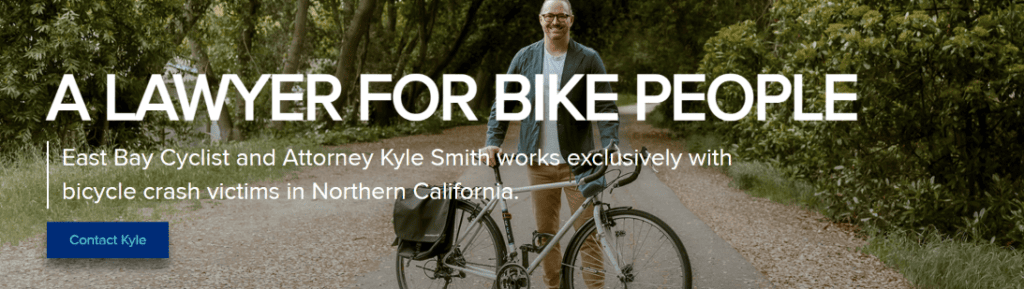
Specialist cycling website Paceline Law, for instance, speaks directly to cyclists who’d been in accidents, creating instant connection, making it a benchmark in niche legal marketing. It’s a good illustration of the “know your audience” principle.
Keep the top half of the page entirely human-centric, engaging, and narrative-driven. Keep the bottom half clean, structured, and technical for search engines and traditional B2B clients.
- Top Half (Human Content): Large, friendly photo, a 30-second introductory video embed, a story-driven narrative hook, and a quick lightning-round Q&A.
- Bottom Half (SEO & Credibility Content): Accordion tabs or clean headers for “Bar Admissions,” “Education,” “Notable Case Results,” and “Published Articles.”
One small addition many firms overlook is to include a short video introduction. Thirty seconds of an attorney speaking directly to camera , no script, no production crew, consistently outperforms a polished headshot in trust metrics. People hire people. Help them meet you before they’ve committed to the meeting.
4. The Case Results Page: Show Your Work
Potential clients don’t just want to know that you win. They want to know you’ve won their kind of case.
A generic “Track Record” page listing settlement amounts in the abstract is marginally better than nothing. What works considerably better is specificity. “$2.3 million recovered for a construction worker with a traumatic brain injury” tells a story. It tells a potential client with a similar injury: this firm has been here before.
The format matters too. Results presented with brief context — the situation, the challenge, the outcome — function as compressed case studies. They answer the implicit question every client carries into their first consultation: has anyone with my problem ever won?
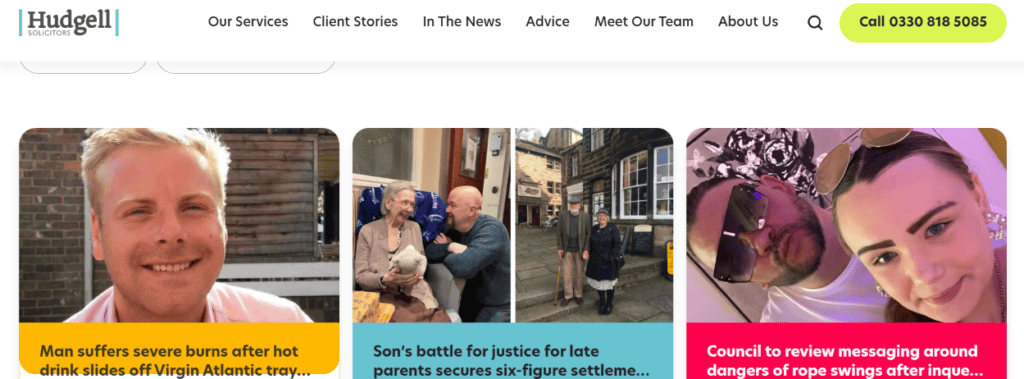
Hudgell Solicitors, a mid-sized UK firm, turned this principle into a full content strategy, combining case studies with advice articles, podcasts, and video to let users engage however they prefer.
The payoff was a Digital Impact Award for Best Use of Digital in Professional Services, and the firm overtook a significantly larger competitor for both search keyword visibility and presence in AI Overviews.
The lesson isn’t that every firm needs a podcast. It’s that specific, substantive content compounds — and mid-sized firms can absolutely punch above their weight if they’re deliberate about it.
Firms that present results with context also get a meaningful SEO benefit. Specific injury types, case scenarios, and outcome language match the long-tail search queries high-intent clients actually use. “Slip and fall at grocery store settlement” is how real people search. Your results page, written correctly, can rank for those terms.
One caveat that goes without saying but apparently still needs saying is that results pages must comply with your jurisdiction’s professional conduct rules on advertising. Several states restrict how settlement figures can be presented. Know your rules before you publish.
5. The Contact Page: The Finish Line Most Firms Trip Over
Here’s where a remarkable number of firms squander everything the previous four pages built.
The contact page is treated as an afterthought — a form, an address, a phone number. Maybe a map, if someone was feeling generous. It is designed with the implicit assumption that the person arriving there has already decided to contact you, and therefore requires no further persuasion.
This is wrong.
People arrive at the contact page considering contact. They haven’t committed. And at that precise moment, most law firm websites do nothing to nudge them across the line — no reassurance that someone will actually respond, no sense of what happens next, no reduction of the anxiety that comes with the first call to a lawyer.
The data makes the stakes clear. Eighty percent of potential clients move on if they don’t hear back within 48 hours. That’s not a slow-response problem — it’s a promise problem. If your contact page doesn’t tell visitors when they’ll hear from you, why would they believe anyone’s coming?
The contact pages that convert well do the opposite.
They tell visitors what to expect – “We respond to all enquiries within one business day.” They explain what the consultation involves – “Your first call is 30 minutes, no obligation, no charge.” They lower the stakes and they make the next step feel manageable rather than momentous.
And they ask for less, not more. Every additional field in a contact form reduces completion rates. Name, email, brief description of the matter. That’s it. You can get the rest when you talk to them.
The Common Thread
None of these five pages require a design overhaul or a six-figure website rebuild. They require a shift in orientation, from “here is what we want to tell you” to “here is what you need to know.”
The firms that consistently win clients online have made that shift having built websites that serve the client’s decision-making process. These are website that answer questions, reduce anxiety, and demonstrate expertise in the act of being helpful, rather than websites that hang diplomas on a virtual wall.
The Zuckerman Spaeders and Raines Feldmans of the world didn’t accidentally end up on best-in-class lists. They made deliberate choices about who their websites were for.
Your website is working for you right now, 24 hours a day. The question is whether it’s working well.
Most law firm sites have the answer written right there in their analytics. You probably know yours already.
LawFuel covers legal industry news, firm strategy and the business of law at lawfuel.com