Tom Borman, LawFuel contributing editor
The confirmation of Justin Smith to the United States Court of Appeals for the Eighth Circuit is a major moment in Donald Trump’s second‑term judicial strategy. The Senate voted along party lines to hand Smith a lifetime seat on a key federal appeals court that covers seven states.
To much of the mainstream press, Smith looks like another loyalty reward but maybe the story is actually more interesting – throwing the spotlight on a lawyer practising from an ultra-niche Missouri law firm and its ‘assembly line’.
The James Otis assembly line
In Big Law, firms sell legacy prestige, vast headcount and global reach, but Justin Smith’s firm is a small St Louis boutique called James Otis Law Group that is showing that a tight ideological focus and the right political network can beat all of that.
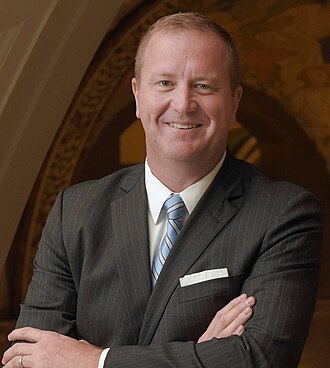
Smith is a partner at James Otis, a firm that has become a hub for high profile conservative impact litigation and a home base for figures in what might be called “Schmitt world,” built around Missouri Senator and former Attorney General Eric Schmitt (pictured).
Former Missouri solicitor general and Trump lawyer D. John Sauer is a leading figure at the firm. For ambitious conservative lawyers, James Otis increasingly looks like a launchpad rather than a backwater.
For years, the standard path to a federal judgeship ran through global outfits such as Jones Day or Kirkland & Ellis, followed by years in the trenches of party politics. James Otis Law Group has helped rewrite that script by showing that a small, ideologically aligned boutique can act as a direct feeder to the federal bench and to Trump’s inner legal circle.
Who is Justin Smith?
Born in 1985, Smith has spent his career at the intersection of conservative politics and high stakes litigation. After clerking for a federal district judge and working at Shook, Hardy & Bacon, he moved through a series of roles in Missouri government, including positions in the Governor’s Office and the Department of Agriculture.
Smith’s most influential work came as First Assistant and Chief of Staff to then Missouri Attorney General Eric Schmitt. He later followed Schmitt to Washington as a senior adviser in the United States Senate. By the time Trump nominated him to the Eighth Circuit seat previously held by Judge Duane Benton, Smith was a trusted legal and political fixer within that network.
The Trump portfolio
Smith stepped onto the national stage through Trump’s most combustible legal fights. He was part of the team that defended Trump’s claim to broad presidential immunity before the Supreme Court in 2024 in litigation that reshaped the debate over the scope of official acts.
He has also worked on Trump’s personal exposure in a series of civil and defamation cases, including matters arising from the E. Jean Carroll litigation. That work continued even as his nomination moved through the Senate, and it became a focal point for Democrats who argued that sitting judges should not be drawn directly from the personal legal team of a sitting president.
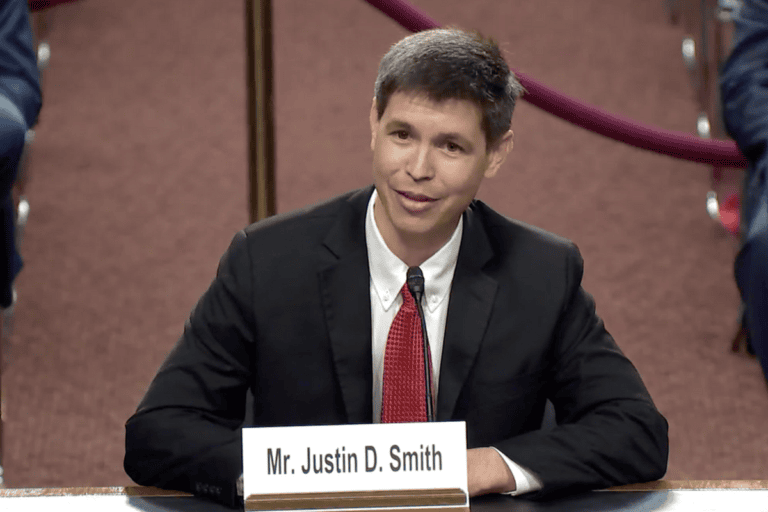
At his Judiciary Committee hearing, Smith stressed that he would be fair and impartial. He refused to give straight answers on who won the 2020 presidential election or on whether the Capitol was attacked on January 6. That choice turned the hearing into a set piece in the broader fight over Trump’s judicial picks and their willingness to endorse his narrative of recent political history.
The New Era of Judicial Appointments
With his confirmation to the Eighth Circuit, Smith shifts from advocate to arbiter. He will sit on a court that hears federal appeals from Missouri, Arkansas, Iowa, Minnesota, North Dakota, South Dakota and Nebraska.
For Trump, Smith’s appointment locks in a loyal and highly capable ally on a strategically important court.
The career moves by Justin Smith show one thing, that the shortest route from law degree to lifetime commission no longer necessariy runs only through global megafirms and old‑line party machines. In the Trump era, it can also run through a trusted boutique that is tightly wired into the right political and ideological networks.