New Zealand’s Quiet Constitutional War Is Getting Louder
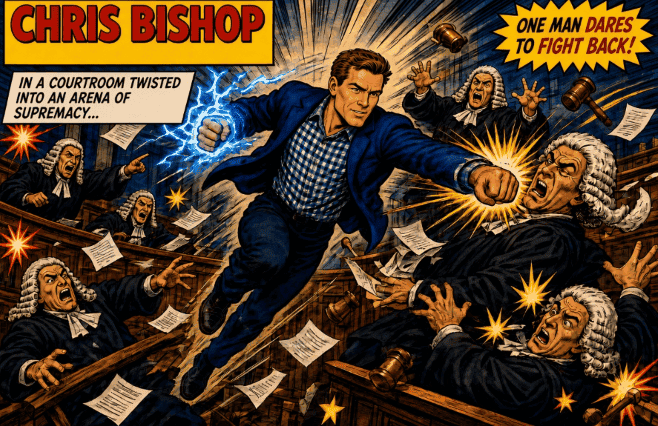
Attorney-General Chris Bishop, fresh from yet another National Party leadership stoush and infrastructure fisticuffs, has tipped his toes into the quicksands of tikanga Māori, judicial power and climate litigation. For a former Russell McVeagh and Crown Law summer clerk with scant hands on legal experience the boy from the Hutt with the Brick Bradford jaw and taste for spirited debate is certainly not afraid to mix things up in the rough-and-tumble of legal politics.

“Bish” as some commentators are fond to reference the Attorney General, recently delivered a blunt message to New Zealand’s legal establishment that poured gas on the debate over judicial overreach, providing a thoroughly orthodox view that Parliament, not the courts, makes major policy choices. Who knew? Of course the clue lies in the name.
Arguing that major policy choices belong to Parliament because Parliament alone has the democratic mandate to make them is scarcely Bolshevism.

Behind Bishop’s apparently uncontroversial insistence that Parliament is New Zealand’s supreme law-making institution, an argument cheer-lead by such advocates barrister Warren Pyke and former Bell Gully Chair and New Zealand Initiaitve Chair Roger Partridge (above) whose pronouncements on the overreach issue create normally phlegmatic judges in the Northern and Wellington Clubs to extreme retching and gag reflexes that send them to the bathroom.
New Zealand may not be facing a constitutional crisis. But it is having a sharper constitutional argument.
Former Solicitor General Una Jagose KC recently entered the debate, warning of the country sleepwalking into the collapse of the concept of separation of powers.
Judges are there to interpret legislation, review the legality of executive action and to protect individuals against unlawful state power.
The Fitzgerald Reminder
Fitzgerald v Muldoon v Wild remains the permanent reminder of these parameters, an analysis of which was examined by Justice Stephen Kos in a 2014 Otago Law Review article, to the point where the Attorney General keeps a copy of the decision at his door, not as a doorstop but a reminder.
In 1976, Chief Justice Sir Richard Wild informed Robert Muldoon that a Prime Minister could not suspend an Act of Parliament merely by announcing that he had done so. The executive, in other words, was subject to law.
But Fitzgerald also demonstrates why independent courts occasionally need to tell governments things they would rather not hear.
Bishop has not suggested judges should take instructions from the ninth floor of the Beehive.
But the language around the relationship between Parliament and the courts is becoming noticeably tougher.
Quick Draw Legislation
If Parliament doesn’t want judges filling gaps, Parliament needs to draft legislation which leaves fewer of gaps in the legislation. Drafting legislation at the speed of light is not always helpful in the real world where the legislative rubber hits the road.
In his recent address to The Law Association, Bishop revisited his legal history, running the rule over the origins of our law in 17th century England to the present day, warning that “we dismiss our heritage at our peril.”
He argued that courts should not become forums for relitigating policy choices clearly made by elected lawmakers. Courts, he said, lack the democratic mandate, institutional expertise and capacity to make the broad social and economic trade-offs involved in major policy decisions.
Parliament Sets Policy. Courts Interpret Law.
Bishop’s essential argument is that major policy choices belong to Parliament, not unelected judges. The immediate irritant is Smith v Fonterra Co-operative Group Ltd.
In 2024, the Supreme Court unanimously restored climate-change claims brought by Smith against seven corporate defendants, alleging that their greenhouse-gas emissions contributed to climate change and advanced claims in public nuisance, negligence and some novel climate-harm tort.
The 2024 decision was about allowing the claims to proceed rather than determining ultimate liability.
That does not make the courts powerless. Judges interpret legislation, review executive action for legality, apply rights-consistent interpretations where the text permits, and develop the common law. But Parliament retains the final legislative word.
The Climate Change Response (Tort Liability) Amendment Act now creates a statutory bar on tort liability for emissions-related climate-change effects, thus closing off the legal pathway that Smith had allowed to continue beyond strike-out. The climate-tort legislation shows that the Government is prepared to act when it believes the courts are approaching that boundary.
Bishop has said, with considerable understatment, that Parliament has too often failed to state its intentions with sufficient precision.
“We’ve let the courts fill in the gaps, with sometimes unpredictable consequences,” he said shortly after becoming Attorney-General.
Because when Parliament leaves ambiguity, broad language or genuine silence, courts do not simply stop deciding cases but interpret and develop the common law. Sometimes that inflames the Partridges and Pykes to emerge from the undergrowth to inflame the judiciary with claims of overreach, particularly in the judiciary’s fond embrace of tikanga Māori.
Tikanga Changes the Debate
The Supreme Court said in Smith v Fonterra that whatever cause of action proceeded, the trial court could not avoid engaging with tikanga Māori when assessing Smith’s claims. The Court relied on Ellis v R, where it said tikanga “was the first law of New Zealand”, and confirmed that tikanga may influence the development of New Zealand’s distinctive common law where appropriate.
The more difficult question is where legitimate judicial involvement ends and democratic policy-making begins.
Courts cannot refuse to decide difficult cases merely because they have political consequences. Judges have always developed the common law and Judicial review requires courts to examine the legality of executive action. Statutory interpretation requires judges to decide what Parliament’s words mean when the text is uncertain, broad or incomplete.
And Parliament sometimes deliberately uses broad language, leaving courts to apply it to facts Parliament could not have anticipated.
But Bishop’s warning is that Parliament has made a policy choice, courts should apply it and not remake it.
That is more of a constitutional contest and debate rather than war. All-in-all a long way from his summers at Crown Law and Russell McVeagh all those, short years away.