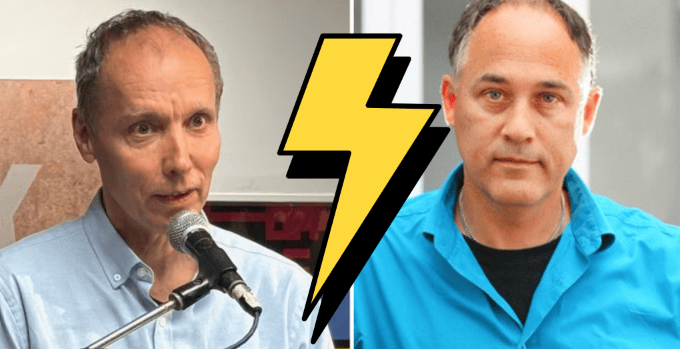
Nicky Hager’s latest political book. Launched with great fanfare at the bastion of Wellington enlightenment, Unity Books, has produced an unexpected legal sequel with fellow investigative journalist Ian Wishart turning to Hager’s own sworn testimony from a High Court defamation trial to ask whether the publication standards he advocated then were followed now.
Investigative journalism typically involves putting powerful interests under the microscope, but occasionally, someone turns the microscope around.
Wishart’s challenge is whether Hager’s own journalism has always met the standard he articulated under oath in a defamation case in which he gave evidence as an expert in such matters.
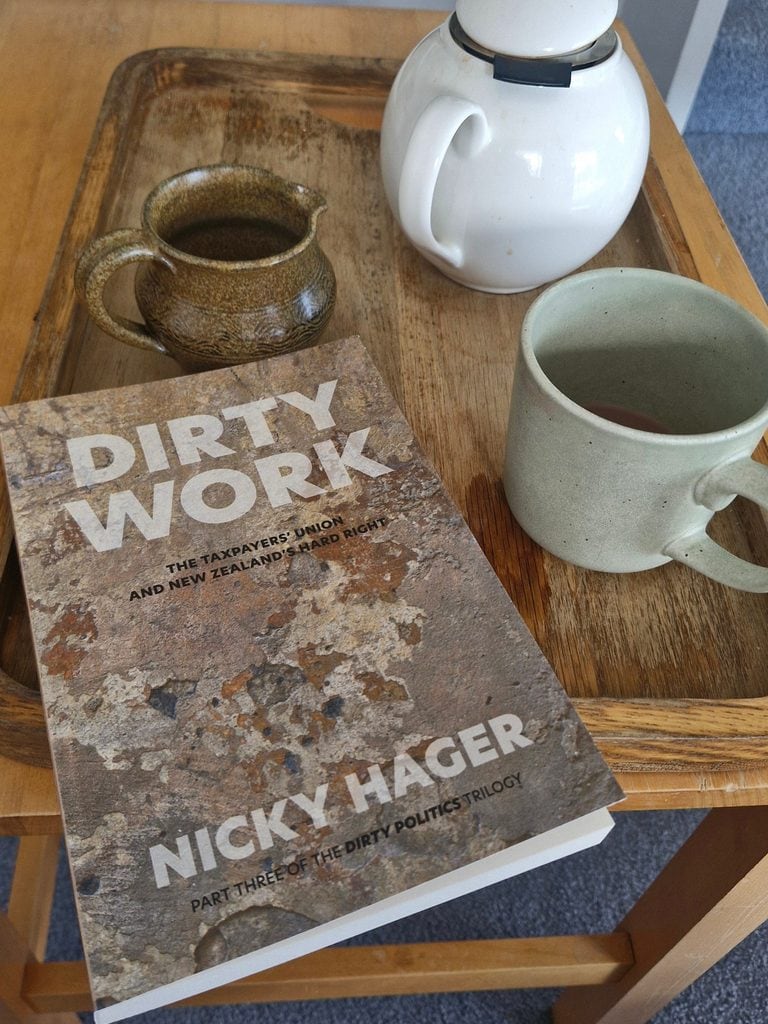
Hager’s most recent book, Dirty Work: The Taxpayers’ Union and New Zealand’s Hard Right, purports to examines the New Zealand Taxpayers’ Union (TPU) and its executive director Jordan Williams, and its political influence.
Various claims made by Hager have been hotly disputed and – who knows? – may be the subject of yet another defamation lawsuit where he enters the witness box.
Among Hager’s claims is one that the Taxpayers’ Union paid out a confidential settlement following workplace harassment allegations involving Williams. The TPU, its co-founder David Farrar, and Williams have emphatically rejected the account as demonstrably false.
But Hager claims to have relied upon multiple sources to establish the truthfulness of the claims.
Veteran investigative author and journalist Ian Wishart, who has a substantial body of genuinely investigative work to his name, whether one accepts his worldview or not, but he has introduced a compelling legal comparison.
The 2013 High Court Testimony

Wishart has revisited evidence Hager gave under oath in the August 2013 Wellington High Court defamation trial brought by former diplomat Lindsay Smallbone over The Hunt, a 2011 book co-authored by Wishart and George London.
Wishart was a self-represented litigant in the proceeding.
Hager was called by Smallbone’s legal team lead by defamation expert Peter McKnight, as an expert witness on journalistic standards and methodology.
Court reporting and trial transcripts record Hager telling the jury that he would have been uncomfortable publishing serious allegations of sexual misconduct without rigorous, independent corroboration.
He emphasized that in cases where grave claims are levelled against a named individual, natural justice and standard journalistic practice require confronting the subject prior to publication.
“If I’m not absolutely sure of something, I don’t publish it.”
Wishart’s outline of the evidence on the point saw Hager establishing the ‘publication threshold’ in these terms:
“A woman or a man making allegations of those kinds after however long, as the only source, would not be enough for me to even dream of publishing it.”
Hager acknowledged that a single source could be sufficient if credible and backed by solid physical or documentary evidence, he stressed that uncorroborated single-source claims generally fall short of the threshold required for publishing damaging personal allegations.
“I’m concerned that I might be wrong and do an injustice to somebody else,” Wishart reported him saying in evidence.
Wishart pressed him on the challenges of corroborating historical abuse allegations and on the particular difficulty of historical sexual allegations where corroborating evidence may not exist.
Hager accepted that before 1 February 1986, a woman alleging rape within marriage had no official complaint route for rape within marriage and so there would be no record of a complaint.
He acknowledged that the sexual assault arena was not his area of expertise. But nevertheless maintained “A single source doesn’t even begin to approach what you would need.”
Hager conceded he had not read The Hunt in its entirety and that reporting on sexual violence was not his primary field of expertise. He was in court, he said, to discuss ‘some principles’ on publication.
He maintained that evidentiary hurdles do not justify lowering standard editorial and verification thresholds before going to print.
The Smallbone Litigation Turn
Understanding the procedural context of the Smallbone litigation is important and Wishart’s retrospective is not an assertion that The Hunt was judicially endorsed from the outset, but rather a focus on Hager’s standards.
The jury originally found for Smallbone, awarding $220,000 in general damages and $50,000 in aggravated damages.
The High Court subsequently recalled the judgment after fresh evidence emerged from an independent witness (“Witness Z”), who corroborated core aspects of the allegations against Smallbone.
Justice Joe Williams set aside the jury verdict and ordered a retrial. Smallbone’s subsequent challenges to that ruling failed, with the Supreme Court declining leave to appeal in 2015.
The Question of Consistency
In 2013, Hager argued under oath that responsible publication requires robust corroborating documentation and putting serious allegations directly to the subject for response prior to release.
In 2026, Williams and the Taxpayers’ Union maintain that Hager never put the settlement allegation to them before Dirty Work hit bookstores. Hager has defended withholding prior notice, arguing that sensitive investigative exposés risk pre-emptive injunctions and legal suppression before the public can evaluate the work.
On the sourcing of the allegation, Hager said that he did not rely on an isolated account, but on multiple sources with direct knowledge. He has publicly challenged Williams and the TPU to waive any non-disclosure agreements or legal privilege that would prevent the underlying documentation from seeing the light of day.
Wishart’s criticism raises a question familiar to media and defamation lawyers: Does the investigative methodology used in Dirty Work satisfy the standard of responsible journalism Hager himself championed in the witness box?
The question is particularly relevant because Dirty Work departs from Hager’s best-known works.
Unlike The Hollow Men or Dirty Politics, which were constructed upon vast caches of primary leaked emails and internal records, much of Dirty Work is built upon off-the-record interviews with insiders and political figures.
Wishart’s comparison highlights an enduring legal paradox: when an investigative reporter sets an exacting legal benchmark from the witness stand, their own subsequent work will inevitably be measured against it.
The question Hager has to face – perhaps even in court – is whether his current reporting stands up to his own standards.