Sonia Hickey, LawFuel contributing editor
At UC Berkeley School of Law, the future of lawyering is apparently… 1996 with better stationery.
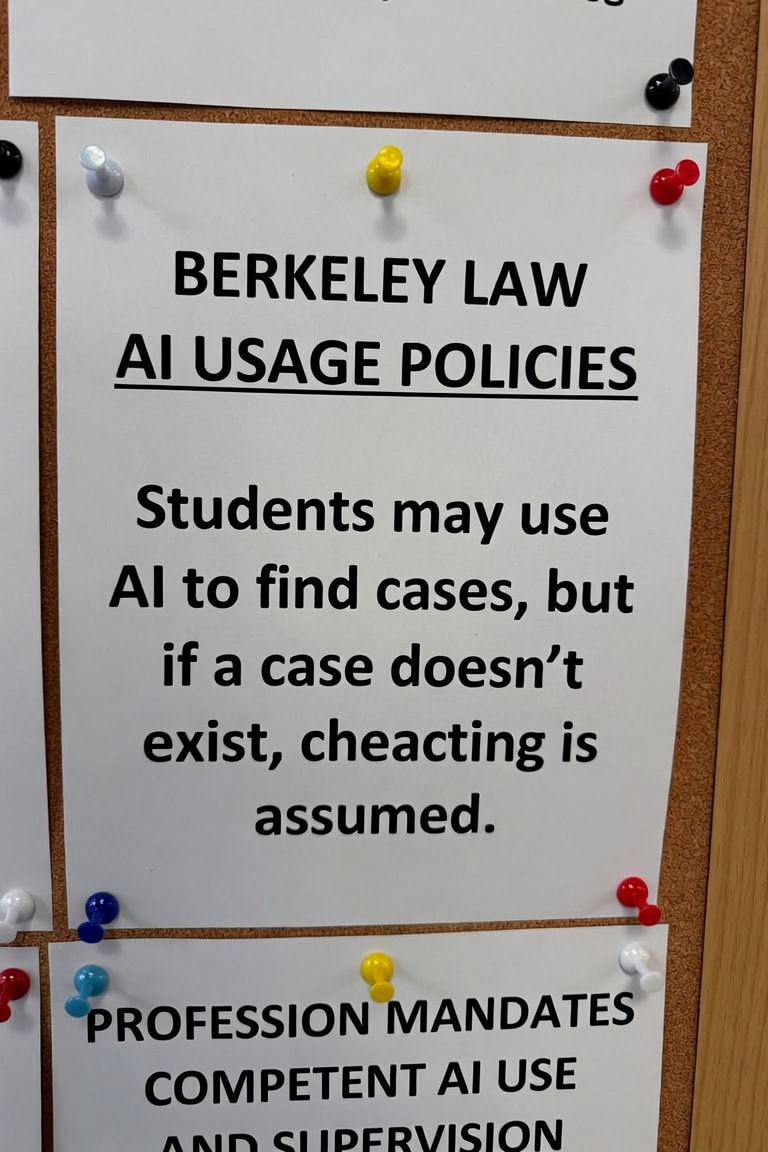
Beginning Summer 2026, Berkeley Law’s new Artificial Intelligence Policy makes prohibition the institutional default. The rule is clear – no AI to “conceptualize, outline, draft, revise, translate, or edit” any work submitted for credit. No AI on exams, for any purpose, ever. No uploading readings, slides, or class recordings into a bot. AI is allowed for one narrow purpose only: identifying sources like cases, statutes, or secondary materials for papers, and students are still fully on the hook if those sources are wrong.
The examples get even more specific too with students being barred from asking AI to brainstorm paper topics, propose an organizational structure, summarize legal rules, identify repetitive passages, fix grammar, or translate a paper into English.
The administration’s explanation is that “thinking remains the sine qua non of good lawyering,” and that cutting off AI ensures students actually develop their own legal reading, writing, and reasoning muscles.
To be fair, the policy isn’t completely Luddite. Faculty can depart from the default where they decide another approach is pedagogically justified, especially in courses designed to teach AI fluency.
But the starting point for anything graded is simple, namely if a computer helped you outline, draft, or polish it, you’re in the danger zone. And if you cite a case or article that doesn’t exist, the school now treats that as a presumption that you used AI in violation of the policy.
Everyone’s Already using the Robots
Out in the actual legal market, the story looks very different. According to the 2026 8am Legal Industry Report, nearly seven in ten legal professionals (69 percent) now use general‑purpose generative AI tools like ChatGPT, Gemini, or Claude for work. That’s up from roughly 31 percent the year before, making gen‑AI one of the fastest‑adopted technologies in legal in recent memory.
Lawyers report using these tools for exactly the workflows Berkeley is trying to wall off: quick‑and‑dirty research, drafting and revising documents, summarizing long files, and brainstorming strategies or arguments. Other recent surveys push overall AI adoption among lawyers even higher, into the 70–80‑plus percent range, with research, drafting, and summarization leading the pack.
So we have a strange split screen: law schools telling students that using AI to brainstorm an outline or clean up prose is akin to cheating, while law firms quietly expect summer associates to show up already knowing how to make a large language model crank out a halfway decent first draft of a client email. In other words, three years of “don’t you dare ask a bot to fix your grammar,” followed by, “please use the firm’s AI tool to turn this partner’s 2 a.m. word salad into something we can bill for.”
The real problem isn’t prompts — it’s supervision
Into this gap walks the American Bar Association. In Formal Opinion 512, the ABA finally says the quiet part out loud: you can use generative AI in practice, but you don’t get to blame the robot when things go sideways.
Technological Competence
The opinion makes a few things crystal clear. Lawyers have a duty of technological competence that now includes “a reasonable understanding of the capabilities and limitations” of gen‑AI tools.
They must independently verify any AI‑generated content used in client work, given the risk of hallucinated citations and doctrinal nonsense. They must protect client confidentiality if they feed anything into a tool, including understanding the provider’s data practices and, in some situations, getting informed client consent. And they must supervise both lawyers and non‑lawyers using AI, and keep fees tied to actual, reasonable work rather than whatever the AI vendor’s pricing page suggests.
Or, in less ABA‑ish terms: competence does not require becoming a data scientist, but it absolutely requires treating AI like a well‑meaning but unreliable junior — you don’t file anything they touched without checking the cites, the law, and the logic.
Which is where the Berkeley approach looks especially off. The risk of an outright ban isn’t that students fail to learn how to write clever prompts. It’s that they don’t learn what it means to supervise automated output — to look at a beautifully fluent paragraph, recognize that the doctrinal analysis is garbage, and know how to fix it.
Training for yesterday, Billing for Tomorrow
To Berkeley’s credit, the school insists it’s trying to do two things at once: teach students how to use AI effectively and ensure that exams and papers still measure individual learning. That’s a reasonable goal.
The problem is that a prohibition‑first default, enforced through honor‑code presumptions and examples that treat “brainstorming with AI” as a disciplinary issue, looks a lot more like institutional risk‑management than like serious AI literacy.
Regardless of the moves by Berkley, what can’t be overlooked are the firms paying those graduates who are quietly racing in the opposite direction. Adoption data show gen‑AI going from fringe to mainstream in a year, with most lawyers now using it for drafting, research, and document review.
Vendors, bar associations, and malpractice carriers are all assuming that AI‑assisted practice is the new normal and that the key risk factor is not whether you use AI, but whether anyone competent is watching what it does.
A “no AI near your graded work” rule may produce great bluebooks but by itself it will not produce new lawyers who understand how to audit an AI‑drafted brief or spot when a tool has quietly imported the wrong jurisdiction’s standard of review.
And it leaves firms to run remedial AI‑literacy bootcamps for people who graduated under a regime that treated common AI‑assisted workflows as academic misconduct.
Are law schools protecting integrity or gaslighting the next class of associates?
Some of the problems we see –
- Top schools like Berkeley are locking AI out of the classroom by default for most graded work and exams, with narrow carve‑outs and a presumption of misconduct if a fake source appears. Not sure if that’s the way to go (see below)
- At the same time, the broader market is normalizing AI as standard infrastructure, with roughly 69 percent of legal professionals already using gen‑AI in their work, and some surveys pushing that figure even higher.
- The ABA is telling everyone that ethical practice now includes understanding, supervising, and verifying AI tools, not pretending they don’t exist.
Put those together and you get a simple takeaway, which is that the real malpractice risk isn’t that young lawyers will use AI, but that they’ll use AI badly with no training, no supervision framework, and no sense of the line between “helpful first draft” and “sanctionable hallucination.”
Are schools like Berkeley bravely defending traditional legal analysis against the algorithmic hordes or are they setting up their own graduates to learn AI on live matters, with real clients and real malpractice exposure?
We would be interested if you’ve had to onboard summers or juniors into your firm’s AI tools, how much “AI literacy” did they actually show up with? Are you running structured training, or just hoping they don’t copy‑paste whatever the chatbot says into a filing?