
15 September 2026 – Latest Update
As of September 2026, first-year associates at market-rate US law firms earn a base salary of $235,000, rising to $455,000 by their eighth year. Add the standard market bonus and total compensation runs from roughly $261,000 to $595,000. The numbers come from the Milbank scale set in June 2026 and effective 1 July, the first increase to Big Law’s lockstep pay ladder since 2023.
Key facts
- First-year base: $235,000. Eighth-year base: $455,000.
- Total comp with market bonus: $261,000 to $595,000.
- The raise added $10,000 for the first four class years and $20,000 for the fifth through eighth.
- Milbank moved first. Most of the AmLaw 50 matched within weeks.
- At the top of the market, profit per equity partner now reaches $12.15m. That is not a salary, and almost no partner takes home the average.
The escalator restarted
For most of 2026 the scale did not move. Cravath confirmed in its November 2025 bonus memo, in writing, that base salaries would hold.
We asked at the time which firm would break the freeze first, and the answer turned out to be the one with the longest track record of doing exactly that. Milbank has now led the last six Big Law pay raises.
On 2 June 2026 it lifted every class year, effective 1 July, and the rest of the market fell into line with the weary inevitability of a firm that has read this memo before.
The structure did not change and the lockstep held. Every class simply moved up a rung.
The 2026 US scale, class by class
| Class year | Base salary | Market bonus | Total comp |
|---|---|---|---|
| 1st | $235,000 | $26,000 | $261,000 |
| 2nd | $245,000 | $40,000 | $285,000 |
| 3rd | $270,000 | $72,500 | $342,500 |
| 4th | $320,000 | $95,000 | $415,000 |
| 5th | $385,000 | $115,000 | $500,000 |
| 6th | $410,000 | $130,000 | $540,000 |
| 7th | $440,000 | $115,000 to $140,000 | up to $595,000 |
| 8th | $455,000 | $140,000 | $595,000 |
The bonus column combines the year-end and special bonuses from the current market cycle, which Cravath set in its November 2025 memo (year-end $20,000 to $115,000 by seniority, special $6,000 to $25,000).
The next bonus reset arrives with the Cravath memo in November or December 2026. Roughly 50 to 75 firms pay this scale in full: the Vault elite, most of the Vault 100, and the litigation boutiques that treat it as a floor rather than a ceiling. Regional and mid-market firms typically pay 60 to 80 percent of it.
A first-year who stays on scale through year eight, bonuses included, clears well over $3m in gross compensation before they are eligible to be considered for partnership. Only around one in ten will get there.
What Partners Actually Make

The associate scale is transparent, lockstep and public. Partner pay is none of those things. The headline number is profit per equity partner, or PEP, and the 2026 Am Law 100, reflecting 2025 performance, produced the largest figures the profession has recorded.
| Firm | PEP (2025) | Change |
|---|---|---|
| Wachtell Lipton | $12.15m | up 34.5% |
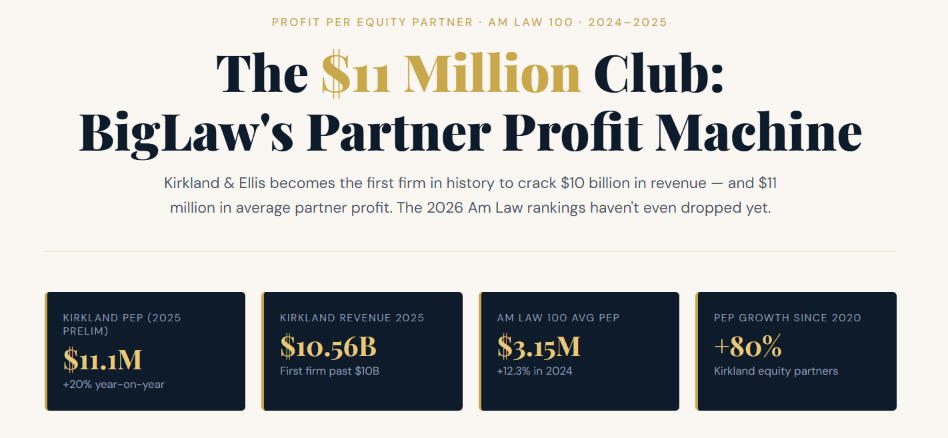
| Kirkland and Ellis | $11.12m | up 20.2% |
| Davis Polk | $9.8m | |
| Quinn Emanuel | $9.55m | |
| Gibson Dunn | $8.89m | |
| Latham and Watkins | $8.65m |
Across the Am Law 100, average PEP rose 14 percent in 2025. Kirkland became the first firm in history to cross $10bn in revenue.
Now the caveat that keeps this honest. PEP is an average of profit allocated to equity partners. It is not what any given partner is paid, and it is not what most partners are paid. Non-equity partners now make up more than half of all partners across the Am Law 100, and they sit outside that figure entirely.
Average compensation across all partners, equity and non-equity, was $1.89m, a long way below the PEP headline. Inside the equity tier the spread from bottom to top can run ten to one or wider, with a handful of rainmakers controlling relationships worth more than $100m in annual revenue.
The $12.15m at Wachtell is a story about a deliberately tiny, near-total equity partnership and profit margins around 78 percent. It is arithmetic, not a payslip.
How the United Kingdom Compares

London has spent three years importing New York’s pay war, and it shows. The Magic Circle, meaning A&O Shearman, Clifford Chance, Freshfields, Linklaters and Slaughter and May, has settled at £150,000 for newly qualified solicitors. The US firms in London have gone further.
| Tier | NQ salary |
|---|---|
| US firms in London (top) | £175,000 to £180,000 |
| US firms in London (lower) | £165,000 to £173,000 |
| Magic Circle | £150,000 |
| Silver Circle (HSF Kramer, Ashurst) | £140,000 to £145,000 |
| Market average, 100-plus firms | £118,756 |
| Regional and high street | £35,000 to £55,000 |
Eighteen US firms now pay their London juniors more than £170,000, with Davis Polk, Gibson Dunn and Paul Weiss each at £180,000. The gap has dragged the whole City upward and squeezed the differential between junior and senior pay to the point that some firms have frozen NQ rates to stop the bunching.
On the ownership side, the standout is not a Magic Circle name at all: Macfarlanes, which has never joined the Circle, runs a PEP around £3.1m, against a London market median closer to £297,000. Staying small, again, beats staying grand.
Australia

Australia rebuilt its top tier in a single year. King and Wood Mallesons dissolved in March 2026 and reverted to Mallesons locally, Herbert Smith Freehills became HSF Kramer, and Ashurst merged into Ashurst Perkins Coie. The pay ladder, in Australian dollars, held steadier than the letterhead.
| Level | Salary (indicative) |
|---|---|
| Graduate, top-tier | A$75,000 to A$95,000 |
| Junior associate, 1 to 2 years | A$85,000 to A$110,000 |
| Associate, 3 to 6 years | A$120,000 to A$180,000 |
| Senior associate / special counsel | A$180,000 to A$250,000 |
| Partner, large firm | A$300,000 to A$1,000,000-plus |
Partner earnings at the top run well past the seven-figure line, which is why the question of whether Australia will produce its first ten-million-dollar law partner is now a live one rather than a joke.
New Zealand

At the smallest end of the four markets, the Big Three, meaning Bell Gully, Chapman Tripp and Russell McVeagh, set the graduate benchmark.
| Level | Salary (indicative) |
|---|---|
| Graduate, top-tier Auckland | NZ$72,000 to NZ$80,000 |
| Graduate, mid-tier | NZ$62,000 to NZ$72,000 |
| Senior solicitor, mid-tier | NZ$120,000 to NZ$170,000 |
| Salaried partner, mid-tier | NZ$200,000 to NZ$350,000 |
| Equity partner, top-tier | NZ$500,000 to NZ$1,000,000-plus |
The Reality Check
Line the four markets up and the scale of the gap is the story. A New York first-year starts on US$235,000. An Auckland graduate at the best firm in the country starts on around NZ$72,000, roughly US$43,000, or under a fifth of that. A single equity partner at Wachtell is allocated more profit, US$12.15m, than the entire partnership of a leading New Zealand firm is likely to distribute between them.
It is, however, the same lockstep logic, the same billable hour, the same client work, priced across four legal cultures that agree on almost nothing about what it is worth.
That is the number that ends the argument about whether Big Law pays well. It pays extraordinarily, unevenly, and in inverse proportion to how close you are to the Atlantic.
LawFuel tracks the scale through every raise and every bonus memo. For the full pay picture, see our Legal Pay Guide, the 2026 PEP rankings, and the story of the freeze that finally broke. Get every update first: subscribe to the LawFuel newsletter.
Frequently Asked Questions
How much do first-year Big Law associates make in 2026? First-year associates at market-rate US firms earn a base salary of $235,000, effective 1 July 2026. With the current market bonus, total first-year compensation is around $261,000.
What is the Cravath scale, and is it now the Milbank scale? Both names describe the same thing: the lockstep pay grid that leading firms move in step. Cravath was the historic pace-setter, but Milbank has led the last six raises, including the 2026 increase, so the two labels now describe the same market level at different moments.
Do all Big Law firms pay the same salary? The AmLaw 50 and the elite boutiques generally pay the scale in full. Firms outside that group vary, with some paying first-years $175,000 to $210,000. Litigation boutiques often pay bonuses well above the market for high billers.
Which law firm has the highest partner profits? On the 2026 Am Law 100, Wachtell Lipton led with profit per equity partner of $12.15m, followed by Kirkland and Ellis at $11.12m.
Do US firms in London pay more than the Magic Circle? Yes. In 2026 the Magic Circle pays newly qualified solicitors £150,000, while the leading US firms in London pay £175,000 to £180,000, and add larger bonuses on top.
Is PEP the same as a partner’s salary? No. PEP is average profit per equity partner. It excludes non-equity partners entirely, and within the equity tier the spread is wide, so most partners earn well below the headline figure.