LawFuel analysis | World Justice Project Rule of Law Index 2026
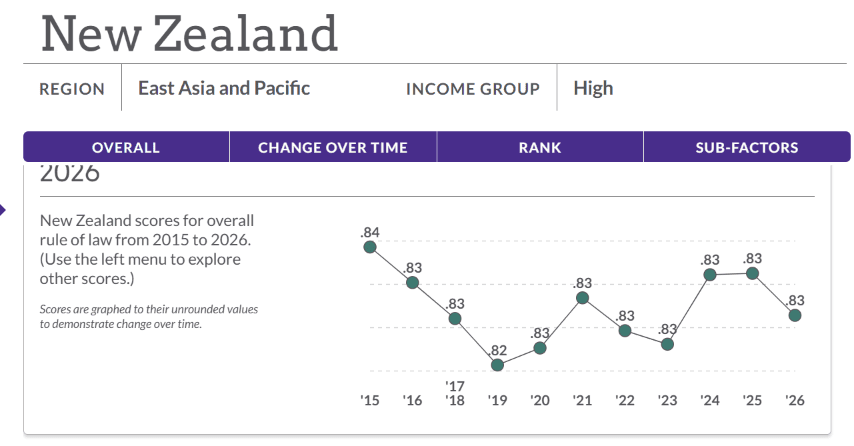
New Zealand has dropped two places to seventh in the World Justice Project’s 2026 Rule of Law Index. Its scores fell for government transparency, fundamental rights, criminal justice and, less noticed, the checks on government power itself.
The Index, released on 21 October, still places New Zealand among the world’s strongest rule of law jurisdictions. But the decline is spread across several measures, and some of them are the ones the profession has been worrying about out loud.
Australia slipped one place to 12th and the United Kingdom fell four places to 18th [confirm both against WJP 2026 profiles]. Three common law heavyweights all went backwards in the same year.
| Country | 2025 | 2026 | Score (0–1) |
|---|---|---|---|
| New Zealand | 5 | 7 | 0.83 |
| Australia | 11 | 12 | 0.80 |
| United Kingdom | 14 | 18 | 0.78 |
Source: World Justice Project. 143 countries and jurisdictions.
A lower ranking alone can just mean others improved. In New Zealand’s case, however, the underlying scores also fell.
Where New Zealand lost ground
| Measure | 2025 | 2026 |
|---|---|---|
| Constraints on government powers | 4 | 4 |
| Absence of corruption | 6 | 6 |
| Open government | 6 | 9 |
| Fundamental rights | 9 | 11 |
| Order and security | 22 | 19 |
| Regulatory enforcement | 5 | 6 |
| Civil justice | 9 | 8 |
| Criminal justice | 11 | 13 |
Transparency is the clearest weakness. The open government score fell from 0.82 to 0.80, and the ranking slid from sixth to ninth. That is the biggest fall of any measure.
Checks on power are softening, even if the ranking isn’t. New Zealand held fourth place for constraints on government powers, but its score dipped. The WJP recorded declines in how effectively the legislature, the judiciary and independent auditors restrain government. Scores also fell for sanctioning officials for misconduct. A stable ranking here is cold comfort when the underlying measures are moving the wrong way.
Rights and criminal justice are slipping. Fundamental rights fell to 0.83 and criminal justice to 0.73, each losing two places. The weakest spots were the effectiveness of criminal investigations and the impartiality of the criminal system, which scored around 0.60.
Not everything went backwards. Scores rose for absence of corruption, order and security, and civil justice. The WJP noted that civil justice and alternative dispute resolution have become more accessible and affordable. Lawyers may wish to note that.
The Australian and British picture
New Zealand still sits comfortably ahead of both neighbours. Britain’s fall is the more striking, given the reach of its courts and legal services industry.
The Index does not say British courts or lawyers are second-rate. It measures how justice works for ordinary people, including cost, delay and accessibility. On those terms, a strong legal brand can sit alongside a justice system the public finds hard to use.
The more uncomfortable context comes from the New Zealand Law Society. Its 2025 report, Strengthening the Rule of Law in Aotearoa New Zealand, flagged several concerns:
- access to justice barriers, including underfunded legal aid and court delays
- heavy use of parliamentary urgency, thin consultation and reduced legislative scrutiny
- risks to the independence of the judicial system
The Index does not prove that government policy caused New Zealand’s slide. But its weak spots line up closely with the problems the profession had already named.
The decline is also part of a wider trend. Rule of law fell in 62 per cent of countries this year, the ninth consecutive year in which declines outnumbered improvements.
NZ Slipping
New Zealand remains the top-ranked country in East Asia and the Pacific and well ahead of most of the world. But seventh is not fifth, and the falls in transparency and checks on power deserve more attention than a reassuring headline ranking might suggest.
A respected judiciary does not make up for laws rushed through under urgency, a government that is harder to scrutinise, or a justice system ordinary people can’t afford to use.