LawFuel Editors: April 2026
The rules of law firm SEO have not disappeared but they have changed in ways many law firms have been slow to recognise. It’s much more now about useful content, not how many ‘keyword rich’ articles you publish.
For years, visibility online was driven by keywords, backlinks, and regular posting. That approach still has a place, but it is no longer enough. Google’s evolution, combined with the rise of AI-generated search results, has shifted the focus toward something more fundamental: demonstrable legal expertise.
Today, the firms gaining traction are not those producing the most content, but those publishing the most useful content. And that’s an important distinction.
The Important Shift Law Firm SEO
Search behaviour has changed. Clients no longer browse endlessly through search results. Instead, they ask direct, often complex questions. And they are looking for clear, authoritative answers.
At the same time, Google’s AI Overviews and similar tools increasingly summarise those answers from trusted sources. These summaries do not randomly select content. They favour material that is structured, specific, and backed by credible authorship.
Legal content falls squarely into what Google classifies as “Your Money or Your Life” information. That means higher scrutiny. Pages must demonstrate experience, expertise, authority, and trust.
In practical terms, this means a few important changes for law firms seeking decent online uptake. It means –
Generic blog posts are fading.
Thin content is ignored.
Authority is rewarded.
The LawFuel Publishing Model
What works now is not volume, but structure and depth. Readers are looking for the answers delivered accurately, and authoritatively. Not ‘keyword stuffed’ links to their expertise.
The most effective law firm content strategies follow a simple but powerful model:
A core pillar page anchors a topic. Around it sits a network of focused, highly specific articles. Together, they signal subject-matter authority.
For example, a personal injury practice might build:
A comprehensive guide to personal injury claims in the United States
Supporting articles addressing:
What to do after a car accident in Miami
How injury claims actually work in practice
Common mistakes that reduce compensation
Each article links back to the main service page and to related content. Over time, this creates a body of work that search engines and increasingly AI systems that recognise as authoritative.
What High-Performing Legal Content Has in Common
Across jurisdictions and practice areas, the same patterns emerge in content that performs well:
Named authors with real legal credentials
Clear answers to specific client questions
Practical insight drawn from real experience
Strong internal linking between related topics
Regular updates to maintain relevance
Importantly, these articles do not read like marketing copy. They read like informed guidance.
That distinction is exactly what builds trust—and visibility.
Writing for Clients and Algorithms
The most effective legal articles strike a balance. They are written for human readers first, but structured in a way that search engines can easily interpret.
This means a few simple adjustments (if that is not already being done with your conent) such as:
Using clear headings framed as questions
Keeping paragraphs tight and readable
Explaining concepts without unnecessary jargon
Including real-world context where appropriate
Ending with clear next steps or takeaways
A useful test is simple: could a client understand this without calling you first? If the answer is yes, the content is doing its job.
The Role of Technical SEO (Still Essential)
Technical optimisation still matters—but it supports content rather than replacing it.
At a minimum, each article should include key indicators to boost your SEO, including:
Natural use of relevant keywords (practice area plus location)
Internal links to core service pages
Descriptive image alt text
A detailed author bio with qualifications and experience
Basic schema markup (Article, Author, Organisation, FAQ where relevant)
Schema helps search engines understand your content. It does not make weak content rank—but it can elevate strong content.
AI Search and Legal Visibility
AI search tools are not replacing traditional rankings because they are built on them.
In most cases, AI-generated answers draw from pages already performing well in organic search. They favour content that include content that has the following:
Clearly structured
Directly responsive to a question
Part of a broader, authoritative content ecosystem
For law firms, the implication is straightforward.
You do not optimise separately for AI but rather you build authority, and AI visibility follows.
It’s really that simple.
Consistency Beats Intensity
One of the most common mistakes in legal marketing is inconsistency.
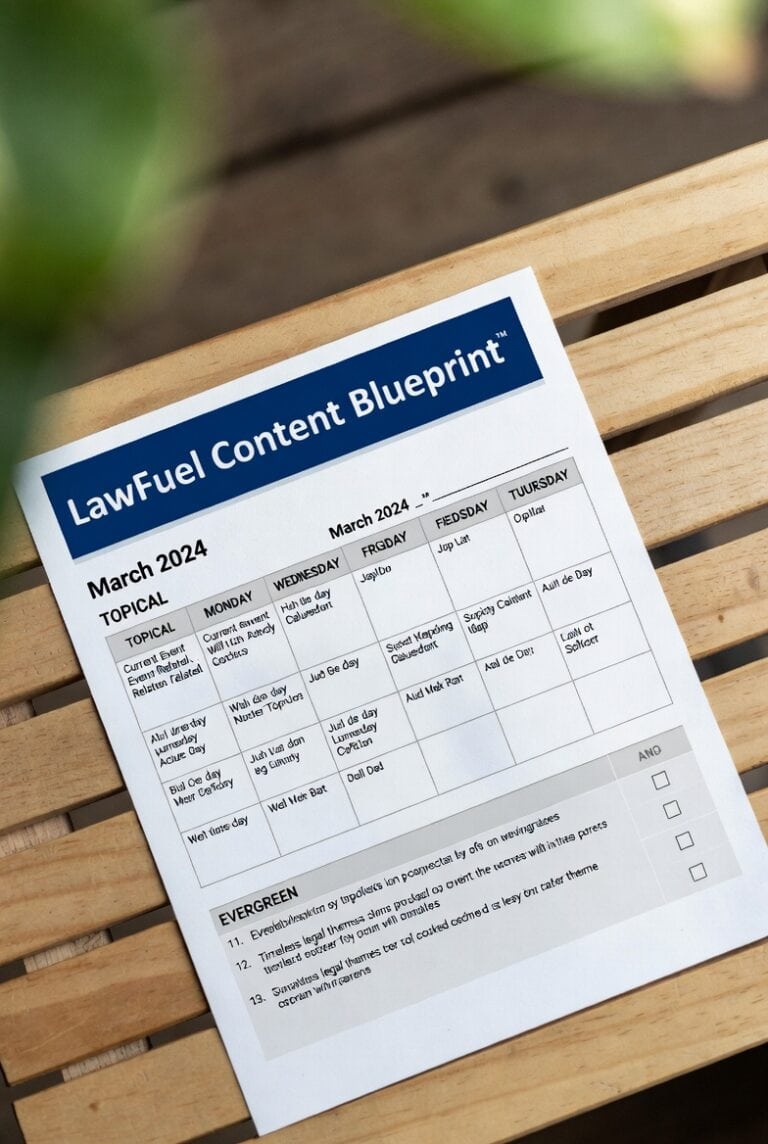
Publishing five articles in a month and then stopping does little to build authority. A steady, ongoing approach is far more effective based on our LawFuel blueprint.
A practical benchmark to follow is to build two to four high quality articles each month. Focus on specific client questions and link into a broader content structure.
Over time, this creates compounding visibility rather than short-term spikes.
Extending Reach Through Legal Publishing Platforms
Publishing on your own site should remain the foundation. But distribution also matters.
Established legal platforms such as LawFuel provide an additional layer of visibility. With an indexed domain history and a legal-focused audience, they can amplify reach and reinforce credibilityparticularly when content is attributed and linked back to the originating firm.
Used properly, this is not duplication. It is strategic distribution.
The Visibility Curve Lawyers Should Understand
Short-term SEO tactics often produce quick but temporary gains. Authority-based publishing behaves differently.
Early results may be modest. But over time, visibility builds steadily and compounds.
A typical trajectory looks like this:
Months 1–3: Minimal traction as content is indexed
Months 3–6: Gradual ranking improvements and increased impressions
Months 6–12: Stronger positioning, higher engagement, lead generation
The key difference is durability. Authority content continues to perform long after publication.
The Bottom Line
Strategic law article publishing works because it aligns with what search engines—and clients—actually value.
Provide clear answers, display real expertise and show consistent insight.
Firms that invest in this approach do more than improve rankings. They become recognised sources of legal information in their field.
And in an environment increasingly shaped by AI-driven search, that is the advantage that matters.
If you want to publish genuinely insightful, useful and relevant content feel free to contact us and we’ll look at helping to lever your quality content into high SEO impact. Email us at lawfuel@gmail.com