Article source: Paul Padda Law, NV
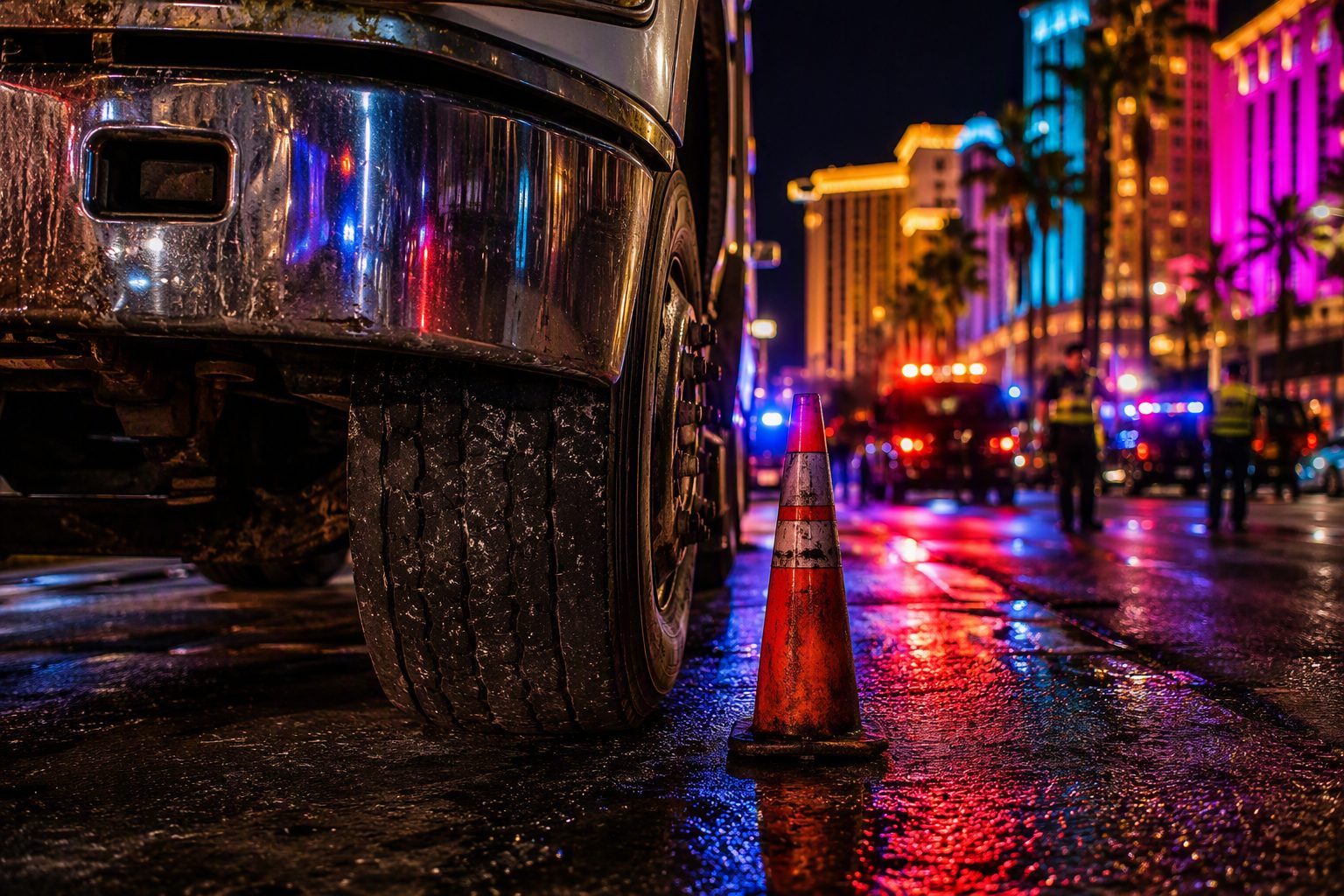
A truck crash on Las Vegas Boulevard rarely occurs in a predictable location. The collision might occur outside a casino porte-cochère, inside a parking garage, on a service road behind a loading dock, or at an interchange where the Strip meets I-15. State-level statistics regarding collisions involving large trucks and commercial buses are published by the Federal Motor Carrier Safety Administration (FMCSA).
Call 911 after a truck crash on or near the Strip if someone is injured, traffic is endangered, or another emergency exists. Dispatchers can identify the correct responding agency from the exact location. LVMPD commonly handles crashes on Las Vegas Boulevard and surrounding local roads, while Nevada State Police may investigate crashes on I-15 or another roadway under state jurisdiction.
The agency that investigates the scene generally creates and controls the resulting collision report, which most people mean when they ask about a Las Vegas accident report. That fact answers most of the questions that follow, from casino driveways to DMV deadlines.
Which Agency Creates the Las Vegas Accident Report?
Emergency dispatch is the safest way to identify the investigating agency after a serious Strip crash. You should not have to resolve jurisdiction from the shoulder of the road while a truck is still sitting in a travel lane.
Although they carry Las Vegas mailing addresses, most resorts along the Strip are in unincorporated Clark County rather than within the City of Las Vegas limits. The Las Vegas Metropolitan Police Department manages this jurisdictional distinction, investigating crashes and patrolling across both municipal and unincorporated county territories under a single consolidated law enforcement umbrella.
Fire and emergency medical personnel may respond without being the agency that writes the traffic report. Casino security can document an incident, but it does not produce an LVMPD or Nevada State Police collision report. Keep the incident number. Write down the responding officer’s name and agency. The nearest casino’s address alone will not reliably identify the correct records office.
Does a crash on casino property receive a police report?
A crash in a casino driveway, parking garage, or loading area should still be reported through 911 when someone is injured, traffic is endangered, or an emergency exists, though law enforcement may decide the circumstances do not require a full collision investigation. Nevada’s reporting statute, NRS 484E.070, applies to qualifying crashes on a highway or on premises accessible to the public, which can include casino driveways and garages.
Casino security may produce its own internal incident report after the fact. That document is a property record. It does not automatically replace a law-enforcement collision report, and it does not necessarily relieve a driver of an SR-1 obligation.
| Record | Who creates it? | What it may contain | Where it comes from |
| Police collision report | LVMPD, Nevada State Police, or another investigating agency | Parties, vehicles, location, diagram, and officer observations | Investigating agency |
| Casino incident report | Casino security or risk management | Property-specific observations, staff details, and internal references | Casino, subject to its procedures |
| Nevada SR-1 | Involved driver | Driver-supplied crash and insurance information | Nevada DMV |
None of these documents conclusively determines civil liability. A police report records what an officer observed, and you can contest or supplement it later.
How Do You Get a Collision Report After a Strip Truck Crash?
Request the report from the agency that investigated the crash, using the incident or report number supplied at the scene whenever possible. Start with the agency named on the incident card, exchange form, or other scene paperwork, then use that agency’s official report-request portal or records office. You will need the crash date, precise location, involved names, and report number, along with any identity, fee, and authorization requirements the agency imposes. If no record appears, confirm whether the incident generated a full collision report or only a call-for-service record.
For an LVMPD investigation, the Las Vegas Metropolitan Police Department’s official website provides current report-request and traffic-records information. For a Nevada State Police investigation, consult the Nevada State Police website for its current crash-report request options. Third-party portals may process some requests, but the investigating agency should be your first stop.
An insurance-company claim number is not a police report number. Providing an insurance claim number to a records clerk will not identify the police record. Processing time varies by agency and investigation status, so no universal turnaround time applies, and the agency may hold a report longer if the crash remains under active investigation.
What Should Drivers Document Even When Police Respond?
Make your own record of the vehicles, commercial carrier, location, and available witnesses, because an officer’s report may not capture every detail needed later. An officer working a busy resort-corridor scene has limited time, while your photographs and notes can preserve additional details.
- Photograph the truck’s license plate, company markings, and USDOT number, if visible and safe to capture.
- Record the cab or unit number and any separate trailer number.
- Save the driver’s name, employer or carrier information, and insurance details.
- Photograph vehicle positions, impact damage, lane markings, and nearby traffic controls before the scene changes.
- Obtain witness contact information and note nearby cameras, including casino entrances, loading docks, or parking structures.
- Preserve the police incident number and any casino-security reference number as separate records.
A truck accident on the Strip turns on identifiers a passenger-car crash never has: the carrier’s USDOT number, cab and trailer numbers, and company markings that identify the entity actually responsible. Those details are easiest to capture while the truck is still present, because the logo on the box may name a retailer or contractor while the registered owner is an entirely different entity.
What changes when a delivery truck is involved?
The location and roadway determine the reporting agency, but the driver should separately document the business operating the delivery vehicle and any company or unit markings. Focus on two immediate questions: which agency investigated, and which identifiers did you preserve? For a loading-dock or service-road crash, record the exact property entrance rather than writing only the casino’s name, because a description such as “behind the Mirage” may not be specific enough for a records search.
When Do Nevada DMV Accident Report Requirements Apply?
A driver generally must file Nevada’s SR-1 with the DMV within 10 days when a qualifying crash caused injury, death, or apparent property damage of at least $750 and no law-enforcement officer investigated the scene. That threshold and the 10-day deadline come from Nevada law and the Nevada DMV’s official SR-1 instructions, which control any secondary summary.
The SR-1 is a driver-filed DMV report and differs from the officer’s collision report. Exchanging insurance information at the scene does not eliminate the filing requirement. The statutory exception applies only to crashes that law enforcement actually investigated at the scene, and a casino-security response alone should not be treated as a law-enforcement investigation for this purpose. You normally do not file a duplicate SR-1 merely because a police report exists.
The DMV’s current instructions may require supporting insurance information and documentation related to the damage or injury. Use the current official form rather than copying requirements from a secondary article, because supporting-document rules can change. Do not assume every truck crash exceeds the $750 threshold. That conclusion requires evidence of the actual damage, and a low-speed parking-garage collision may fall below it. Filing an SR-1 also does not obtain or correct the police report; the two records live in different systems.
How Can You Correct an Error in a Nevada Crash Report?
Contact the records or traffic unit of the agency that created the report, identify the disputed entry precisely, and provide documents supporting the requested correction. Errors fall into two categories, and agencies may treat them differently.
Objective information
A misspelled name, incorrect plate number, wrong insurance entry, or transposed address is generally more straightforward to address. Documentary support such as a registration card or insurance declarations page gives the records unit something concrete to compare against the report entry.
Disputed observations or conclusions
A disagreement about vehicle movement, a witness statement, or an officer’s conclusion is different from a clerical mistake. The reporting officer or agency may add a supplement rather than rewrite the original report, and there is no basis for promising that the agency will accept every requested correction. You can request a review, but the agency decides whether to amend or supplement its report.
Keep the original report. Submit a concise written request through the agency’s stated process, retain copies of the request and supporting records, then ask whether the agency issued an amendment, a supplement, or a denial. Do not contact the Nevada DMV to fix an LVMPD or Nevada State Police report, because the agency that created the police report controls its own record. If the error appears on the driver’s SR-1, ask the DMV directly how to supplement or correct that filing.
What Should You Do Before Leaving the Reporting Process Behind?
The practical sequence is clear. Call 911 when the crash involves an injury, a traffic danger, or another emergency, and let dispatch identify the responding agency. Preserve the incident number and the officer’s name, request the report from the investigating agency, and check whether the absence of a scene investigation triggers an SR-1 filing. Before the tenth day passes, confirm whether an officer investigated the crash and save copies of every report request, photograph, and filing confirmation. A folder assembled in the first week can turn a confusing Strip crash into a documented one.