Dan Garner* We have reported extensively on various goings-on at Pierce Bainbridge, but the ongoing issues appear to place the firm and its clients in a precarious position.
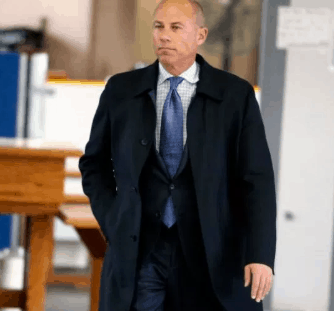
Most recently, firm client (represented by Tom Warren of PB), Michael Avenatti was arrested ruing a hearing of the California Bar.
The California federal prosecutors’ additional allegations against Avenatti are evidently extensive with claims that he committed federal and state financial crimes, including mail fraud, wire fraud, and money laundering, while out on bail; which would have been during the time he was dealing with the firm.
The Avenatti arrest follows the jailing of PB client George Papadopoulos, sent to jail shortly after he retained the firm as counsel. He went to jail for lying under oath.
Former PB partner Don Lewis, who has been in pitched battle with his former firm and in particular lead partner John Pierce, claims that Papdopoulos’s counsel, Chris LaVigne, who is currently representing CNN’s Don Lemon, lied under oath.
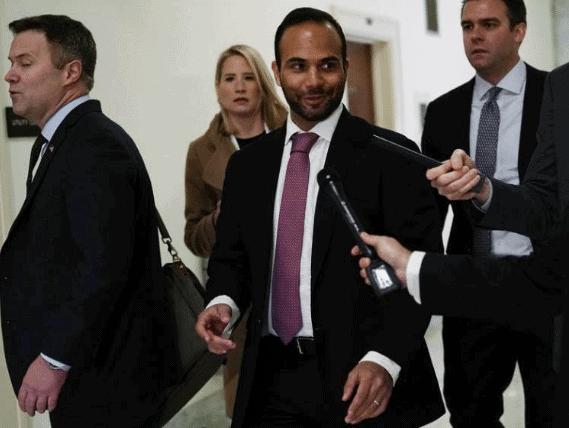
John Pierce on far left, Caroline Polisi, George Papadopolous and Christopher N. LaVigne
Rudy’s Role
The highest profile client currently however is presidential counsel Rudy Giuliani, who recently retained the firm. The matters raised by Lev Parnas in his interview with Rachel Maddow show things are not looking good for Rudy.
But the issue with Pierce Bainbridge appears to largely stem from its overarching ambitions to become one of the world’s largest firms, with hyped talk from John Pierce describing what the firm would achieve.
The much-vaunted growth has been stymied by a succession of firm departures, however and the hyper-growth strategy has been severely stalled.
Don Lewis claims that a senior lawyer warned Pierce in the Summer of 2018 about his ambitions for the firm.
“[John], [t]rying to do what you are doing – build a major NYC firm overnight is hugely risky because you need to attract real talent. The last person who tried it in NY was Mark Dreier. He ended up in jail.”
Lewis has also produced less-than-flattering text messages regarding a conversation he had with Chris LaVigne, who had suggested in writing that Pierce had taken money from litigation funder Pravati Capital LLC.
“Basically John took Pravati’s money and fu*king spent all of it.” Pravati Capital LLC is a litigation funder. Pravati declared Pierce Bainbridge in default in an amount of $9,100,000 in March 2019.
LaVigne, Caroline Polisi, Denver G. Edwards and Eric M. Creizman appear on New York State Government findings as responsible for the $9.1 million default, which was eventually allegedly cured.
LaVigne’s concerns about the financing issues saw him raise concerns over firm funds, writing to Lewis:
“you need to download all this stuff to a hard drive and give it to a lawyer; very serious about that.”
Following Lewis’s expulsion from the firm, part of the basis for his current fight with them, LaVigne stated –
“John [Pierce] hired a bunch of white-collar lawyers, he thinks they’ll help when the Feds come knocking; they will be the first one’s out the door.”
Subsequently six senior partners quit the firm, five of them with experience in white collar crime and fraud.
The Avenatti arrest is the latest development in a saga that is watched with increasing intensity. Arrested clients is one thing – arrested development another.