
Joe Andrew* – With 19,000 employees in 183 offices in 75 countries, most working remotely, I keep being asked when we are going back to the office. With offices in every pandemic hot spot in the world — from Wuhan to Milan — let alone places with reputations of managing the crisis, like Singapore or Seoul, we have learned that no matter what is allowed, people do not go quickly or easily back to the office.
What most people who ask the question are missing is that the concept of “going to the office” is intrinsically entwined with income inequality and the unequal risks many are taking. If you are in manufacturing, you go to the factory. If you are on the front line of battling the pandemic, you work in the hospital, the fire station or the police station. If you are working in retail you used to go to work in the store, and now you go to the warehouse and hand things off to the delivery service at a facility or a post office. Those who we depend on go to work at a grocery store, a farm, a pharmacy or a hundred other places that are not called an office.
Lawyers, bankers, accountants, consultants, executives of all types, all are wondering when they and others like them might “go back to the office,” as if the answer will come by government edict and the only variable is timing. But, in reality, the answer is, it’s not going to happen — at least not as we once knew it — no matter what any government official says.
For the foreseeable future, the world is going to be even more divided between those who have to go into their place of work and those who have the luxury of continuing to work from home.
In most parts of the country, most professionals have the luxury of not going back to the office until a vaccine is invented, tested, made widely available and then actually given to the vast majority of the population of the country, if not the world. Scientists and public health experts tell us those benchmarks will not be met in 2020.
For the foreseeable future, the world is going to be even more divided between those who have to go into their place of work and those who have the luxury of continuing to work from home. The literal distance between the haves and the have nots is likely going to grow even wider.
Here is why: If your company decides to reopen and you can drive your nice car to the office but your assistant or your support team has to take public transportation, are you really going to force them to come into the office? If your support team is not there, is there any reason for you to be there? If you are not certain if you have to come in, then won’t your other co-workers ask the same question? If they don’t come into the office, and some are on video conferences rather than in-person meetings, then why not just have everyone on video?
Support staff are more likely living paycheck to paycheck and therefore might have to take risks that their boss does not, but will you want to be the bad boss who either makes them take those risks or doesn’t want to be in the office with them? They can’t wait until testing gets sorted out and realize that even if there is a vaccine, they won’t be able to afford it because of disparities in health care, which will make the most well-meaning of those who can get the vaccine fear gatherings of those who cannot.
Temporary workers have trouble getting unemployment benefits, and once they leave the big city with their small government support checks, will they be able to afford to come back in person when they may not actually have to?
Will you really want those who have children at home without schools open to feel like they are second class citizens because they are on video and others are not? Won’t that be particularly true if those who are more likely to be on video are women? Won’t that be sexism, once again, on display at work?
If going into the office involves social distancing, with only having half of a team in at any one time, and wearing masks, you will not be having many meetings in person — and those interactions will be awkward and unusual while everyone has just gotten used to the new normal of a video conference.
So, exactly why are you taking the risk and making others take even more risk to be back in the office?
Those of us who have the privilege of leading organizations and teams that go into an office also have an opportunity to rebalance “office” dynamics. Let’s rise to the occasion and make use of that opportunity for the betterment of everyone.
Author –

Joe Andrew is the global chairman of Dentons, the world’s largest law firm, and a former national chair of the Democratic National Committee. This article was first published in TheHill.
More from LawFuel
- Slaughter And May Still Rules London’s Listed Market. The Problem Is The Market Is Shrinking


- Big Law Firms Have Been Keeping the AI Savings – Now Wall Street Wants Them Back
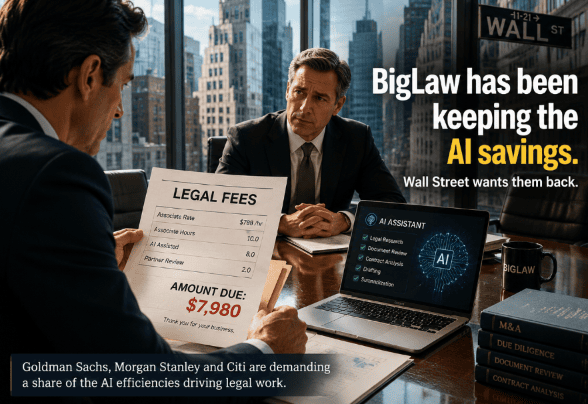
 Goldman Sachs, Morgan Stanley and Citi are asking a rather uncomfortable question of their outside lawyers: if AI is making legal work faster, why aren’t the bills getting smaller? Power Points Goldman Sachs, Morgan Stanley and Citigroup are pushing major law firms to demonstrate how AI efficiencies are being reflected in their legal bills. Citi has begun asking firms bidding for work to explain their AI-related savings, while Morgan Stanley is moving much of its outside legal work toward competitive bidding and alternative fee arrangements. The pressure goes directly to the BigLaw leverage model, where armies of associates traditionally generated large volumes of billable hours. New LexisNexis research shows 94 per cent of lawyers now use AI for legal work and 55 per cent expect AI to change law firm billing. The battle is shifting from whether lawyers should use AI to a much more interesting question: who gets the financial benefit? For the past few years BigLaw has been enthusiastically telling anyone within PowerPoint range that artificial intelligence will transform legal practice and clients have been listening.
 - When a Software Bug Becomes a Legal Problem: What Businesses Should Know

- Does Your Massachusetts Police Report Go to Your Insurer?
- Legal AI – Can’t Work Without It: Why 15% of Big Law Attorneys Are Now Officially Dependent on AI
 According to fresh survey data from LexisNexis UK, 15% of lawyers at large commercial law firms now admit they are completely dependent on AI to carry out their daily legal work. The reliance is almost as pronounced in corporate legal departments, where 13% of in-house counsel report identical dependency. Artificial intelligence in the legal sector has crossed the rubicon from experimental pilot project to standard operating equipment. Log in to read ., .