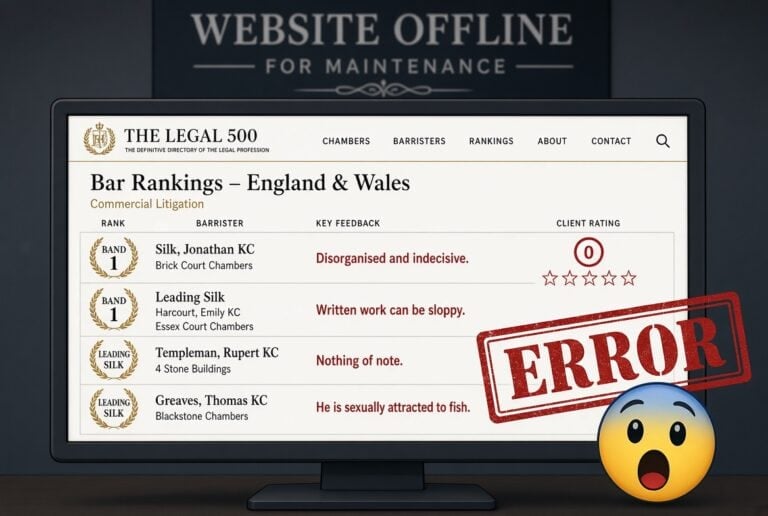
For one glorious Thursday, the UK Bar rankings read like client feedback instead of a Christmas card. Legalease blames an upload glitch. The Bar blames nobody in public and everybody on WhatsApp.
Legal directories run on an arrangement a cartel would find a little embarrassing. The directories and firms submit forests of self-praise, nominate referees chosen for their enthusiasm for the selected nominees and then they wait for the directory to hand it all back as polished prose about “commercial nous” and “an encyclopaedic grasp of the detail.” Partners and silks post the result on LinkedIn with a caption about being humbled, which, given the hours of marketing effort involved, they are not.
But some of that polished PR unravelled for the Legal 500 on Thursday 1 October when the directory published its UK Bar 2027 rankings. By Friday morning the entire site was “down for maintenance.” with as raft to embarrassing headlines in the media.
In between, a batch of barrister profiles went live carrying something the product was never designed to contain: what clients actually think.
The reviews nobody ordered
RollOnFriday broke the story with a gallery of screenshots, redacted because, as it noted, it would rather not feature in anyone’s defamation claim.
One KC was summed up as “adequate but disorganised and indecisive.” Another was praised as a formidable oral advocate, with the rider that her written work “can sometimes be sloppy” and a pointed note about speed.
A third had apparently become “less responsive and not consistently available,” and a fourth had a temperament that “can be difficult to deal with sometimes.”
Then came the entries that aroused the most interest – recording of the lawyers “Nothing of note,” “Impressive building and facilities,” which is a lovely thing to say about chambers and a devastating thing to say about counsel.
The Telegraph found a referee who used their testimonial to complain that the Legal 500 pesters them every year about someone they worked with years ago, before grudgingly conceding she was responsive and thoughtful.
And one profile carried the barrister’s own bio, which is at least the most honest thing any directory has ever printed being the subject’s view of the subject.
One widely shared screenshot, which City AM repeated, claims a barrister has an unusual romantic interest in fish. RollOnFriday, which had seen more of these than anyone, judged it a fake. However much you want it to be real, it apparently is not.
Plenty of chambers spent Thursday happily posting their unblemished listings, unaware that the directory was about to vanish beneath them.
The Legal 500 Line
The Legal 500 says an error in the upload process during a website update caused “a small amount of testimonial information” to be published incorrectly. It says it pulled the content, began verification checks, apologised to its customers and promised tougher quality assurance.
It’s been a bad week at Legalease, the Legal 500 parent company where its researchers had just come off a two and a half week strike over pay and conditions.
It ended this week when the company conceded a flat £2,000 raise, more sick leave and fewer mandatory office days.
In the same week, The Times reported insiders complaining about workloads and research quality. One source claimed there was effectively no quality control left. Another said researchers had been told to make only minimal edits to client testimonials.

Chief executive Tim Wakefield (left) told the paper the company firmly rejects those claims.
The official explanation is a technical glitch, and there is no evidence of anything else. But it is worth noticing what the glitch revealed.
The gap between a raw testimonial and an edited one turns out to be the entire product. Remember, too, that much of this feedback comes from referees nominated by chambers and firms themselves. If your hand-picked fans describe you as adequate, the directory is not your biggest problem.
Even with the site restored, Legalease may want to look again at its launch page. In one place it reports 3,968 ranked silks, and a few lines further down it reports 3,873. Quality assurance appears to be a work in progress.
The Directory Industrial Complex
The Legal 500 is hardly alone. Chambers and Partners, Best Lawyers, IFLR1000, Benchmark Litigation, Doyle’s Guide here in the Antipodes, and a carousel of awards dinners all run variations on the same model.
Being listed is free. Enhanced profiles, advertising and tables at the gala dinner are not. Firms now employ people whose whole job is to feed the machine. Fee earners lose days to submissions, referee lists and the annual wait for the verdict.
The output has a familiar grade inflation. This year the Legal 500 proudly reported a net increase of 557 ranked juniors at the Bar.
A ranking in which the number of excellent barristers rises every year is almost less a league table than a census. When there are added Leading Individuals, Next Generation Partners, Rising Stars and Hall of Famers, it becomes hard to find a senior lawyer in London, Sydney, Hong Kong or Auckland who has not been recognised by somebody for something.
What the profession said when no one was editing
The unauthorised commentary was arguably better than the rankings. One lawyer told City AM there were plenty of laughs on legal WhatsApp but also a lot of very angry lawyers, adding: “it’s hard to see how Legal 500 survives this.”
RollOnFriday’s comment section turned into an impromptu tribunal with an in-house lawyer recalled a big-firm partner at a client dinner boasting about his rankings. When he asked the clients around the table, none of them had opened the directory.
Another mocked a solicitor publicly “honoured and humbled” to be recognised as a leader in a region where they were the only person ranked.
Several respondents admitted they had stopped answering the Legal 500’s requests to review lawyers they had barely heard of.
Many readers simply asked for honest reviews like these every year. Legal Cheek, deadpan, pointed readers to its own archive of barrister mockery as a stopgap while the site was down.
Will anyone sue?
Some of the angrier silks will have thought about it, no doubt. As Silks would. Any claimant in England and Wales would first have to show serious harm to their reputation under section 1 of the Defamation Act 2013, which is a tall order when the words are “can sometimes be sloppy,” and when the publisher could point to honest opinion from a genuine client. Litigation would also guarantee that the comment is repeated in every legal outlet in the country and so the defamation route is a difficult one to navigate – almost always.
The bigger risk for the Legal 500 is commercial. It sits in relationships with the very chambers whose members it has just publicly described as slow and that is a commercial and credibility problem that may be difficult to overcome.
For one day at least we had a legal directory that read like a reference instead of a eulogy. The real scandal is not that clients occasionally find their barristers disorganised, but rather that an entire industry has been built on pretending they never do.
The site will come back, the puffery will resume, and by next week many will have forgotten it ever happened – except for the humbled Silks, Legalease and a significant cohort of others. Such is the way of the legal directory industrial complex.