
Nothing like another tranche of Epstein documents to remind the profession that “reputational risk” is not just a line in the partnership deed.
The latest release from the US Department of Justice under the Epstein Files Transparency Act has surfaced a series of emails between Jeffrey Epstein and a former junior lawyer at Clifford Chance. And yes, the contents are about as tasteful as you’d expect.
Emails, Introductions and Awkward Optics
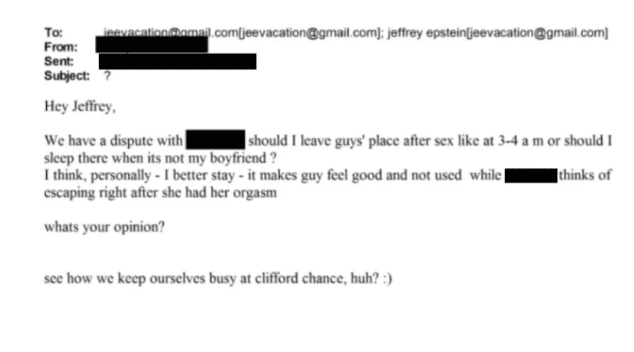
The documents reveal multiple exchanges between Epstein and the former trainee, some of which appear to have been sent from a work email account bearing a Clifford Chance signature block. Several of the emails are explicitly sexual. Others discuss introducing female friends to Epstein. One exchange references the potential introduction of a client to the firm.
In one message, the lawyer joked about “how we keep ourselves busy at Clifford Chance” in the context of a discussion about spending the night with a man who was not her boyfriend.
In another, she appeared to discuss travel to New York to see Epstein and sought his “supervision” over her new haircut. Subtlety was clearly not a priority.
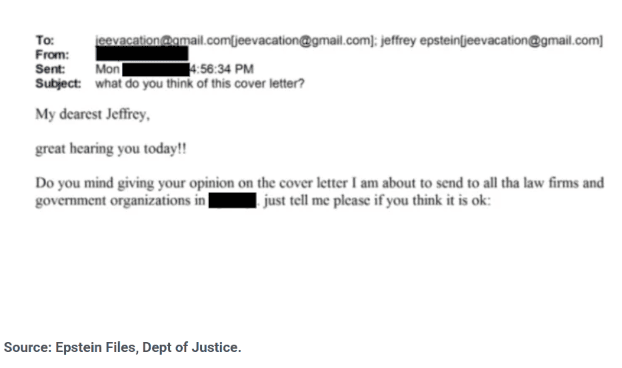
There are also emails in which she appears to seek career advice, including guidance on applications to other firms.
After leaving Clifford Chance, the correspondence continued. At one point, she asked whether Epstein’s organisation could sponsor her studies at UC Berkeley School of Law. Epstein replied that he would consider it, while reminding her of what he characterised as a “two-sided” understanding between them.
In earlier exchanges, she floated the idea that an “investment” in her Berkeley education could be repaid by working for one of Epstein’s companies upon qualification. Epstein’s response referenced her failure to “find someone” for him, a chilling reminder of the transactional dynamic that surrounded him.
The Firm, The Fallout and The Context
Clifford Chance has declined to comment. The firm has not suggested that any client matters were affected, and the individual in question reportedly worked there only briefly. Some emails reference the firm without a signature block, meaning attribution is not certain across the full tranche.
For context, Epstein pleaded guilty in 2008 to state charges involving the solicitation of a minor and later served an 18-month sentence. He was arrested again in 2019 on federal sex trafficking charges and died by suicide in a New York jail cell before trial. His long shadow continues to stretch across finance, politics and now, again, Big Law.
The Department of Justice’s recent release, prompted by the Transparency Act signed in November 2025, also includes correspondence with senior figures at other firms, including references to Paul, Weiss, Rifkind, Wharton & Garrison, underscoring that Epstein’s network was not confined to hedge funds and private jets.
Why Lawyers Should Take Notice
For law firms selling discretion, governance and risk management to clients, even historic, peripheral associations can land like a brick through the stained glass.
Email trails have a habit of resurfacing at the worst possible moment. Compliance teams can draft policies all day; they cannot retrofit common sense.
Three points for managing partners and risk committees:
- Work email is discoverable. If you would not want it read in open court, do not send it.
- Reputation travels faster than billing hours. Associations, even indirect ones, carry weight.
- Due diligence is not just for clients. Background checks and internal culture matter.
The profession loves to talk about ESG, ethics and governance. Then the archive opens and reminds everyone that human behaviour remains the weak link in the chain.
Lawyers are trained to spot risk for other people. The harder task is spotting it in their own inbox.