Power Briefing – Wyatt Law Firm, San Antonio

Image generated by Gemini
The Texas 89th Legislative Session is set to consider Senate Bill 39, a measure poised to significantly reshape the landscape of commercial trucking litigation in a state that consistently leads the nation in truck-related accidents. In 2023 alone, Texas recorded 35,827 crashes involving commercial trucks, a staggering average of nearly 98 incidents per day. The bill introduces a controversial legal shield for trucking companies, creating a high-stakes battle between tort reform advocates and the plaintiffs’ bar over the future of corporate accountability.
This analysis will dissect the bill’s provisions, examine the legal arguments from both sides, and explore the profound strategic implications for legal teams handling catastrophic injury and wrongful death claims arising from 18-wheeler collisions. The proposed changes target the core of how liability is established, potentially altering discovery, settlement negotiations, and jury trials for years to come.
Dissecting Senate Bill 39: What Legal Professionals Need to Know
At its core, SB 39 aims to streamline litigation by restricting the types of claims that can be brought against a trucking company once it concedes a degree of responsibility for its driver’s actions. This is accomplished through a specific procedural mechanism tied to the legal doctrine of respondeat superior.
The “Respondeat Superior” Stipulation
The bill’s central premise revolves around a defendant’s stipulation. According to the proposed amendment to Section 72 of the Texas Civil Practice & Remedies Code, if a trucking company defendant stipulates that its driver was acting within the course and scope of employment at the time of the crash, it creates a pathway to dismiss direct negligence claims against the company. This move effectively bifurcates the liability question, forcing the jury’s focus exclusively onto the driver’s actions and the resulting damages, while walling off any inquiry into the company’s own potential negligence in causing the crash.
The Impact on Direct Negligence Claims
This procedural shift is designed to prevent plaintiffs’ attorneys from introducing evidence related to a trucking company’s systemic operational failures. This evidence is a critical point of leverage that often influences jury perception, punitive damage considerations, and ultimate settlement values. By shielding companies that admit vicarious liability, the bill could prevent juries from hearing about the corporate decisions that may have led to the crash in the first place.
Claims Potentially Shielded by SB 39
- Negligent Hiring: Prevents discovery into whether the company hired a driver with a known history of reckless driving, DUIs, or prior safety violations.
- Negligent Training: Obscures failures to provide adequate training on safety protocols, vehicle operation, or federal hours-of-service regulations.
- Negligent Supervision: Limits inquiry into a company’s failure to monitor its drivers, enforce safety policies, or discipline repeat offenders.
- Negligent Entrustment: Shields the company from liability for providing a driver with a poorly maintained or unsafe vehicle, such as one with known brake issues.
The High-Stakes Debate: Tort Reform vs. Victim Advocacy
The introduction of SB 39 has intensified the long-standing debate between those who seek to limit what they see as excessive litigation and those who advocate for maximum accountability for victims. The bill highlights a fundamental disagreement about the purpose of tort law: is it solely to compensate for a specific act, or is it also to deter broader patterns of dangerous corporate behavior?
The Argument for SB 39: Streamlining Litigation
Proponents, including the trucking industry and tort reform advocates, argue that when a company admits vicarious liability for its driver, pursuing separate direct negligence claims is a redundant and inefficient “double-dipping” strategy. Their position, as articulated in analyses of the bill, is that such claims serve primarily to prejudice juries with evidence of unrelated past incidents or corporate policies that may not have a direct causal link to the crash in question. This, they contend, drives up litigation costs and insurance premiums, ultimately harming the state’s economy.
The Argument Against SB 39: A Shield for Corporate Recklessness
Conversely, the plaintiffs’ bar and public safety advocates contend that SB 39 allows companies with dangerous safety cultures to hide their systemic failures from a jury. They argue that a catastrophic crash is often not just the result of a single driver’s momentary error but the foreseeable outcome of a company’s policies, such as pressuring drivers to violate hours-of-service rules or failing to maintain vehicle brakes. Removing this crucial context, they claim, prevents full accountability, weakens the deterrent effect of civil litigation, and leads to lower recoveries for victims who have suffered life-altering injuries.
Dueling Perspectives on SB 39
| Feature | Tort Reform Advocate Position | Plaintiffs’ Bar Position |
|---|---|---|
| Primary Goal | Reduce litigation costs and create predictable legal outcomes for the trucking industry. | Ensure full corporate accountability for systemic safety failures that endanger the public. |
| View on Direct Negligence | A redundant legal theory used to inflame juries once vicarious liability is admitted. | An essential tool to expose patterns of corporate negligence and secure justice for victims. |
| Impact on Evidence | Prevents “fishing expeditions” into unrelated company history, focusing the trial on the specific crash. | Prevents juries from seeing crucial evidence about *why* the crash happened (e.g., poor training, bad maintenance). |
| Effect on Settlements | Leads to more reasonable settlements based on the driver’s actions, not company prejudice. | Significantly weakens plaintiff leverage, forcing lower settlements by hiding the full scope of wrongdoing. |
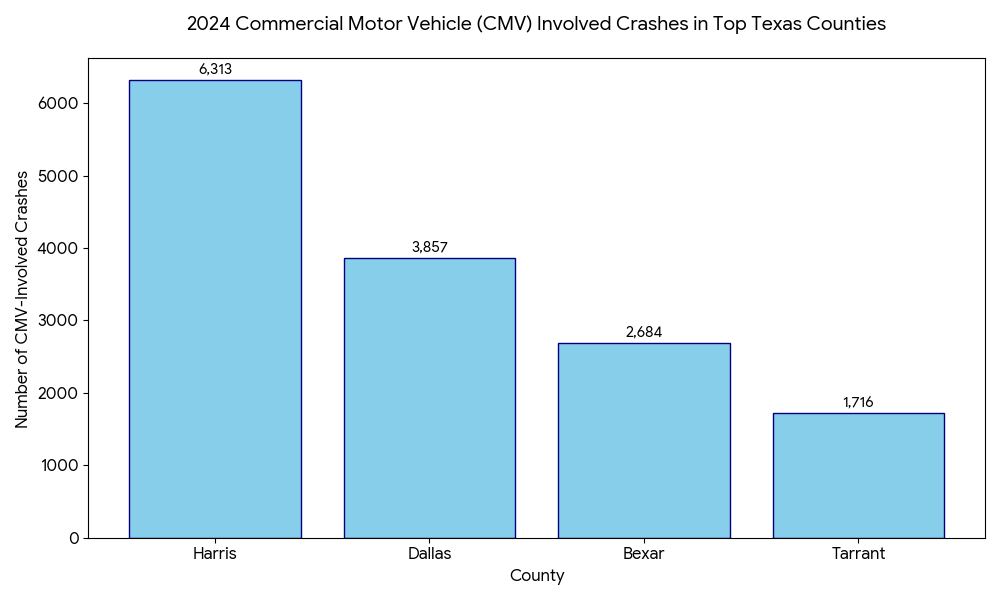
Source: Texas Department of Transportation
In 2024, Bexar County recorded 2,684 crashes involving commercial motor vehicles, placing it among the highest in Texas and underscoring the regional importance of trucking litigation. Data for Harris and Dallas counties show similarly high volumes.
Reshaping Litigation Strategy in the Lone Star State
Should SB 39 become law, legal practitioners will be forced to rethink their approach to commercial vehicle accident cases. The traditional playbook of building parallel cases against both the driver and the company will no longer be viable in many situations, necessitating a strategic pivot toward new areas of focus.
The New Focus: Proving Gross Negligence
The strategic imperative for plaintiffs’ attorneys will shift dramatically. To overcome the limitations imposed by SB 39, the primary focus must be on proving that the *driver’s* conduct amounted to gross negligence, not just simple negligence. A finding of gross negligence can potentially reopen the door to punitive damages and, in some jurisdictions, may allow for the introduction of evidence concerning the company’s culpability in fostering or permitting such reckless behavior. The entire discovery process, from initial depositions to document requests, must be re-engineered to build this case from day one.
Adapting to New Legal Battlegrounds: A Proactive Approach
In this evolving legal environment, firms that specialize in complex trucking litigation are already developing new frameworks to protect their clients’ rights. The experienced San Antonio truck accident attorneys at Wyatt Law Firm, for example, are at the forefront of this strategic adaptation. Their approach anticipates the potential barriers of SB 39 by intensifying the initial investigation to uncover evidence of a driver’s gross negligence, which can serve as the key to unlocking deeper corporate accountability.
Wyatt Law Firm’s strategy emphasizes a meticulous reconstruction of the 24-48 hours preceding a crash, using electronic log data, vehicle telematics, and driver communication records to establish a pattern of conscious indifference to safety. This method aims to prove that a driver’s actions—such as excessive speeding or knowingly violating hours-of-service rules—were not just simple negligence but a reflection of a systemic disregard for safety implicitly encouraged by the carrier. This showcases how deep experience in holding trucking companies and their insurers accountable remains critical, even as statutory barriers evolve.
The Road Ahead for Truck Accident Litigation in Texas
Senate Bill 39 represents a potential landmark shift in Texas tort law, threatening to insulate trucking companies from direct accountability for their safety practices. If passed, the bill will fundamentally alter the dynamics of settlement negotiations and the scope of discovery in catastrophic injury cases, which numbered over 650 fatalities involving large trucks and buses in 2023. The legislation places a higher burden on plaintiffs to demonstrate gross negligence at the driver level to access the full story of corporate conduct.
Legal professionals on both sides of the docket must prepare for a new reality. Plaintiffs’ counsel will need to employ more sophisticated, narrowly focused strategies centered on gross negligence, while the defense bar will leverage the bill to limit exposure and control the narrative presented to juries. The ultimate outcome of this legislative push will serve as a bellwether for the ongoing tension between commercial interests and public safety on Texas highways, impacting thousands of lives for the foreseeable future.