Updated May 2026 | Sources: BLS OEWS May 2024 · NALP 2025 Associate Salary Survey · ABA Profile of the Legal Profession
If you are a lawyer reviewing your options in 2026, the latest data from the U.S. Bureau of Labor Statistics (BLS) and major legal compensation surveys makes one thing clear: location, specialty, and experience still dictate everything.
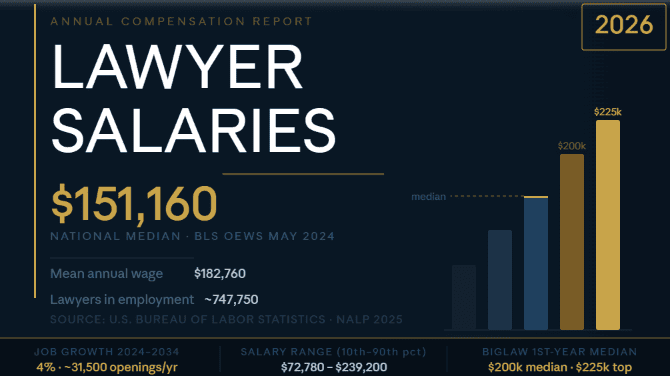
The national median lawyer salary stands at $151,160 as of the BLS Occupational Employment and Wage Statistics (OEWS) survey for May 2024 — the most recent official release — with approximately 747,750 lawyers in paid employment across the country. The national mean wage for lawyers is $182,760, reflecting how strongly the top earners pull the average upward.
The spread around that median is enormous. The lowest 10% of lawyers earn less than $72,780 annually, while the highest 10% earn more than $239,200. That range captures almost everything you need to understand about why two lawyers with identical credentials can find themselves on completely different financial trajectories.
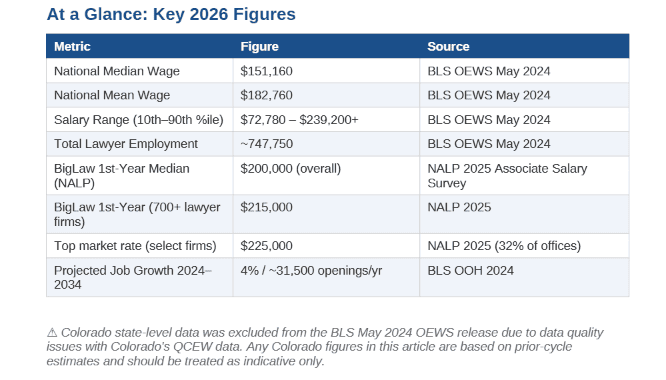
Lawyer Salaries by State: The Coastal and DC Premium Remains Dominant
BLS state-level mean wages confirm the same geographic premium that has defined legal compensation for decades.
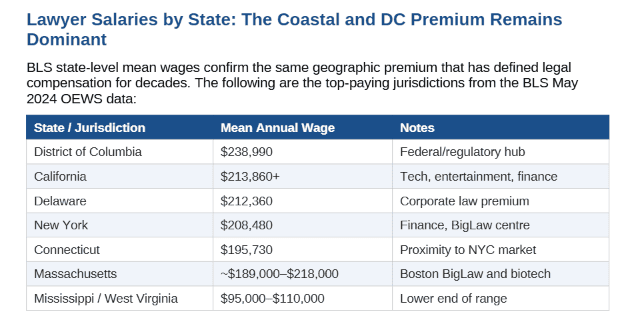
On the other end of the spectrum, states including Mississippi, West Virginia, Montana, and Arkansas report mean wages in the $95,000–$110,000 range. Lower cost of living provides some offset, but the absolute dollar gap is substantial.
2026 Insight: Remote and hybrid work has opened secondary markets, but the largest paychecks remain concentrated in Washington DC, New York, San Francisco, Los Angeles, Boston, and Wilmington. Attorneys whose practice areas travel well — transactional, regulatory, or IP work — are increasingly able to bill at top-market rates without a physical relocation.
Lawyer Salaries by Practice Area: Specialisation Continues to Pay
The BLS does not break out salaries by practice area, but NALP, BCG Attorney Search, and major recruiter surveys consistently show that premium specialisations command 15–25% above the general litigation baseline.
Highest-Earning Practice Areas
Corporate/M&A, Antitrust, Securities — premium of +18–25% above baseline
IP/Patent Litigation — premium of approximately +20%
Tax and Regulatory/Compliance — premium of approximately +15%
General Litigation — baseline reference point
Family Law, Criminal Defence, Immigration — typically 5–15% below average
High-Growth Areas Recruiters Cannot Fill Fast Enough in 2026
The following specialisations are generating disproportionate demand and carrying meaningful salary premiums — often $20,000–$50,000 above generalist roles according to current compensation reports:
- AI governance, data privacy, and cybersecurity — regulatory explosion and ransomware litigation
- ESG, climate, and sustainability compliance
- Healthcare and biotech compliance
- Labour and employment — remote-work disputes, union activity, non-competes
- Trusts, estates, and corporate restructuring — aging population and economic cycles
- Emerging industries including cannabis and digital assets
Intellectual property is a particularly strong outlier at the junior level. NALP’s 2025 Associate Salary Survey found that the median first-year salary for IP associates was $225,000 — the upper end of the market — compared to $200,000 overall.
Lawyer Salaries by Experience: The Ladder Still Works
The figures below distinguish between base salary and total compensation (base plus bonuses). BigLaw lockstep bonuses are well-established and can add $20,000–$115,000+ depending on seniority and firm performance, so the two figures diverge significantly at mid and senior levels.
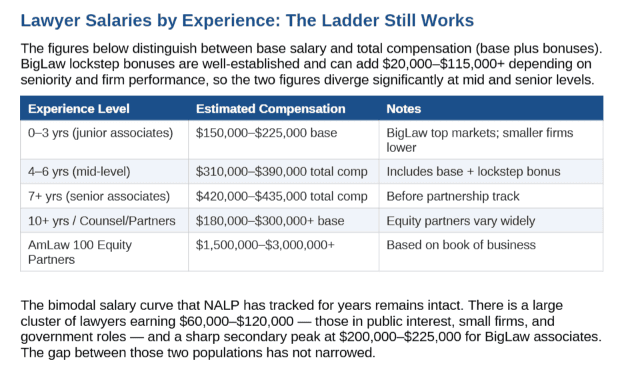
The bimodal salary curve that NALP has tracked for years remains intact. There is a large cluster of lawyers earning $60,000–$120,000 — those in public interest, small firms, and government roles — and a sharp secondary peak at $200,000–$225,000 for BigLaw associates. The gap between those two populations has not narrowed.
The $225,000 Question: Where Does BigLaw Entry Pay Actually Stand?
Headlines have repeatedly described $225,000 as the new BigLaw standard for first-year associates. The NALP 2025 data tells a more nuanced story.
The overall median first-year associate base salary as of January 1, 2025, was $200,000 — unchanged since 2023. Among the largest firms (more than 700 lawyers), the median was $215,000. Only 32% of all reporting law offices paid $225,000 to first-year hires, rising to 45% among the very largest firms.
$225,000 has become the de facto standard in a select group of major markets: New York City, Washington DC, San Francisco, Boston, Houston, and Austin. Outside those markets, and particularly in secondary cities, the figure is far less common. The Cravath scale — the industry compensation benchmark set by Cravath, Swaine & Moore and followed by most peer firms — anchors at $225,000 for first-year associates, with incremental increases for each subsequent class year. However, the NALP data makes clear that most firms have not adopted the Cravath scale in full.
NALP Executive Director Nikia Gray attributed the stagnation to a cooling market: without the competitive pressure of the talent wars that drove salary increases in 2021–2024, firms have less incentive to move.
What Is Actually Changing in 2026
Federal Hiring Freeze — A Significant Headwind for Government Lawyers
A federal hiring freeze enacted under the current administration has materially reduced the number of graduates entering government legal roles. The federal government typically absorbs approximately 3% of all new law graduates annually. With that channel largely closed for the Class of 2025 onwards, competition in private practice and public sector alternatives has intensified. This is a new structural factor not present in prior years’ salary analyses.
AI: Threat and Opportunity
AI is automating routine legal work — document review, contract drafting, legal research — but simultaneously creating substantial demand for lawyers who understand AI regulation, data governance, and technology contracts. Those with deep technical fluency are commanding the largest premiums in the market right now.
The In-House vs. Firm Gap Persists
Many mid-level associates continue to consider in-house moves for improved work-life balance, but the compensation cost remains real — in some cases $75,000 or more in foregone total compensation annually at the mid-associate level. The in-house premium tends to manifest in equity and benefits over time rather than immediate cash compensation.
Hiring Remains Resilient — With Caveats
Despite the federal freeze, legal sector unemployment remains extremely low and firms plus corporate departments posted tens of thousands of roles through 2025. However, NALP data indicates that many large firms have pulled back on summer associate hiring for 2024 and 2025, which will flow through to fewer BigLaw entry positions over the next two to three years. The incoming law school classes are also smaller — nearly 5,000 fewer entering 1Ls compared to the Class of 2024 — which may partially offset that supply reduction.
Key Takeaways for Lawyers in 2026
- The correct national mean wage is $182,760 — not the older $176,470 figure still circulating in some reports.
- $225,000 starting salaries exist and are real, but they are not the market median. The NALP overall median is $200,000 and $215,000 at the largest firms.
- Location remains the single biggest lever. Moving practice to — or billing into — DC, New York, or the Bay Area can represent a 40–60% salary premium over secondary markets.
- Specialise early in AI governance, privacy, ESG, or healthcare. These are the areas generating the most unfilled demand and the strongest salary premiums.
- IP attorneys stand out at entry level — NALP reports a $225,000 median first-year salary for IP associates, $25,000 above the overall median.
- Experience still compounds. Every few years on the right track in BigLaw represents $50,000–$100,000+ in incremental total compensation.
- Track the federal hiring freeze. Government lawyers and recent graduates planning public sector careers face genuine headwinds that did not exist in prior cycles.
- Tech fluency commands a premium. Lawyers who combine deep legal expertise with genuine AI and data literacy are being recruited aggressively across both firms and in-house teams.
Sources: U.S. Bureau of Labor Statistics Occupational Employment and Wage Statistics (OEWS) May 2024 | NALP 2025 U.S. Associate Salary Survey | ABA Profile of the Legal Profession 2024 | BCG Attorney Search 2025 Compensation Guide