Article source: Nova Defenders Law
Being charged with a violent crime in Virginia is a serious matter that can change the trajectory of a person’s life. While the terms are often used together as a single phrase, assault and battery are actually two distinct legal concepts under Virginia law. Understanding how the Commonwealth defines these actions, how the prosecution builds a case, and what the potential penalties look like is vital for anyone caught in the legal system.
The Legal Definitions of Assault and Battery
In Virginia, assault and battery are common law crimes, which means their definitions are derived from long-standing judicial traditions rather than just a single paragraph in the state code. However, the punishments are strictly dictated by the Code of Virginia.
Assault is generally defined as an overt act intended to cause a person to fear immediate bodily harm. It can also be an intentional display of force that would give a reasonable person reason to expect immediate physical strike. Crucially, no physical contact is required for an assault charge. If a person raises a fist or swings and misses, they can still be charged with assault because they created a reasonable apprehension of harm.
Battery, on the other hand, is the actual physical contact. It is defined as the willful or touching of another person without their consent and without legal justification. This touching does not necessarily have to result in a visible bruise or a broken bone; even an angry shove or a splash of water can technically constitute battery if it is done in a rude, insulting, or angry manner.
Misdemeanor vs. Felony Classifications
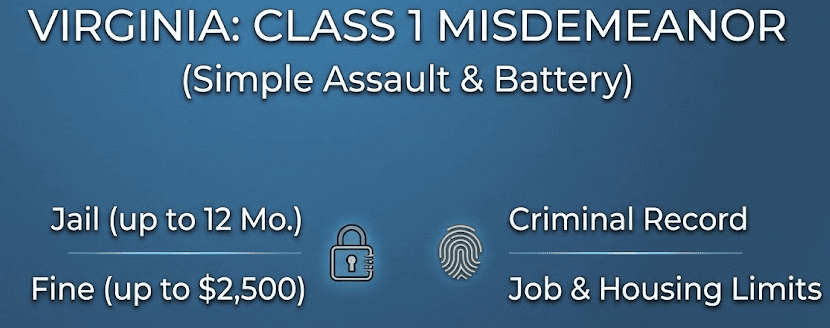
Most simple assault and battery charges in Virginia are classified as Class 1 misdemeanors. This is the most serious level of misdemeanor in the state. A conviction can result in up to 12 months in jail and a fine of up to $2,500. While this is not a felony, it still results in a permanent criminal record that can affect employment and housing opportunities.
The charges can be elevated to a felony under specific circumstances. For example, if an assault is committed against a person because of their race, religion, or national origin, it may be treated as a hate crime with mandatory minimum jail time. Furthermore, assaults against specific protected employees, such as police officers, judges, or emergency medical personnel, are automatically treated as Class 6 felonies. In these instances, the legal stakes rise significantly, often resulting in mandatory active prison time.
Domestic Assault and Battery Considerations
Virginia takes a particularly firm stance on violence within the home. Under Virginia Code Section 18.2-57.2, domestic assault and battery involves acts committed against a family or household member. This category includes spouses, former spouses, parents, children, and even people who have lived together in the past year or share a child.
One unique aspect of domestic cases is the immediate issuance of an emergency protective order. When an officer makes an arrest for domestic assault, they are often required to seek an order that prohibits the defendant from contacting the alleged victim for a set period. Additionally, while a first offense is a misdemeanor, a third domestic assault conviction within ten years becomes a Class 6 felony.
Factors That Determine Case Outcomes
Every legal case is unique, and the specific evidence presented in the courtroom will dictate the final judgment. For people facing Virginia assault and battery charges, the outcome often depends on details such as intent, credibility, injury, self-defense, witness statements, and whether the case involves a domestic relationship.
The concept of intent is central to the prosecution’s burden of proof. The Commonwealth must show that the defendant intended to cause fear or intended to make physical contact. If the contact was purely accidental, such as bumping into someone in a crowded hallway, the legal requirements for battery are not met. Credibility also plays a major role, especially in “he-said, she-said” scenarios where there is no video evidence or independent third-party witness. In these cases, the judge or jury must decide which person’s version of events is more believable.
Common Defense Strategies
There are several ways to challenge an assault and battery charge in a Virginia courtroom. The most frequent defense is self-defense. To successfully argue this, the defendant must show that they did not start the fight and that they used only the amount of force necessary to protect themselves from an imminent threat of harm.
Another potential defense is the defense of others. Similar to self-defense, this applies when a person uses force to protect a third party from an immediate attack. In some cases, a defense attorney may also argue that the contact was “consensual,” which sometimes occurs in the context of sports or mutual disagreements where both parties agreed to engage in a physical struggle. However, Virginia law is strict regarding mutual combat, and consent is not always a valid defense for serious injuries.
The Long-Term Impact of a Conviction
The consequences of an assault and battery conviction extend far beyond the courtroom walls. Unlike some other states, Virginia does not currently allow for the expungement of a criminal conviction. This means that if you are found guilty or plead guilty, the charge stays on your record forever.
This permanent record can prevent individuals from obtaining security clearances, holding certain professional licenses, or working in fields like education or healthcare. Because the crime is classified as one of “moral turpitude” or violence, it can also be used to impeach a person’s credibility in future legal proceedings. Given these high stakes, it is essential for anyone charged to seek legal advice and explore every possible avenue for a reduction of charges or a dismissal before trial.