
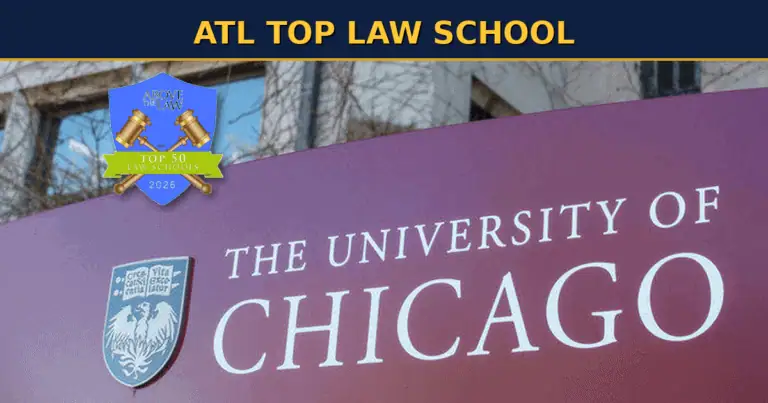
Inside Above the Law’s 2026 Law School Rankings
If U.S. News still rules the prestige conversation, Above the Law’s newly released 2026 Top Law Schools list is doubling down on a different question – that is, what actually happens after graduation.
Its rankings are unapologetically built around post‑JD outcomes—who gets real legal jobs that pay the bills and service the debt, and who doesn’t.
ATL’s 2026 Methodology

Above the Law’s 2026 rankings lean heavily on the latest American Bar Association data for the class of 2025, with 70% of the formula devoted to employment outcomes. That breaks down into a 40% “Quality Jobs Score” (large‑firm roles at firms with 101+ attorneys plus federal judicial clerkships) and a 30% “Employment Score” that tracks full‑time, long‑term, bar‑required roles, excluding solos and school‑funded jobs.
The remaining 30% is split among projected three‑year cost of attendance (cost‑of‑living–adjusted) at 10%, first‑time bar passage rates at 10%, and the production of Supreme Court clerks and sitting Article III judges at 5% each.
The result is a ranking system that explicitly treats cost, licensure risk, and elite‑track outcomes as part of the ROI calculation.
There is also an interactive tool accompanying the rankings that allows users to re‑weight these variables to their own priorities—whether that’s minimizing debt, maximizing BigLaw odds, or emphasizing bar performance.
The 2026 ATL Top 10: Chicago takes the crown
On this outcomes‑centric measure, the University of Chicago moves into the top slot in 2026, climbing two places from #3 last year. Duke slides one spot from #1 to #2, while Virginia, Penn Carey, and Yale round out the top five after year‑over‑year gains. Vanderbilt continues its quiet rise into national‑player territory, up four places to #6, followed by Columbia, Cornell, Northwestern (Pritzker), and Michigan.
Harvard sits just outside the Top 10 at #11, holding steady year‑over‑year. NYU climbs to #12, and Stanford—often a top‑three name in more traditional rankings—rises five places to #16 under this more outcomes‑driven lens. ATL’s willingness to move schools sharply based on the latest ABA data is evident further down the table, where it highlights both fast risers and material drops.
Winners, losers, and notable movers
For students, career services professionals, and hiring partners, the most interesting story is in the movement rather than the static rank. Some of the most notable 2026 shifts include:
- Brigham Young University jumps 14 spots to #27, reflecting a strong recent run in job placement relative to cost.
- William & Mary climbs 13 places to #36, and SMU Dedman moves up eight spots to #24, suggesting improved regional outcomes pipelines.
- Texas A&M continues its ascent, gaining five spots to reach #35.
- On the downside, the University of Houston and Howard University each fall 12 spots, while the University of Illinois Urbana‑Champaign drops 10 and both Cornell and Notre Dame slide six places year‑over‑year.
For a market that often still talks about schools in terms of decades‑old reputations, those are non‑trivial moves. They signal real changes in how effectively recent graduating classes are converting their degrees into quality legal jobs, at least on ATL’s metrics.
ATL versus U.S. News: prestige and outcomes diverge
The contrast with the 2026 U.S. News & World Report law school rankings could hardly be clearer. U.S. News now gives Stanford sole possession of #1, ending its long‑running ties with Yale at the top. Chicago and Yale share the #2 slot, Penn and Virginia are tied at #4, and Harvard sits at #6. Peer assessment scores, faculty resources, and student‑selectivity inputs (including LSAT and GPA) still do much of the heavy lifting in that formula, with outcomes metrics sitting alongside rather than dominating the model.
Above the Law flips that script by making recent employment outcomes the center of gravity. Chicago’s rise to #1 in ATL’s table underscores how a school can be tied for #2 on a prestige‑heavy ranking and yet come out clearly on top when you ask which institution is currently delivering the strongest mix of BigLaw‑plus‑clerkship placement, bar performance, and manageable cost.
Yale and Harvard, conversely, look relatively stronger in U.S. News’ reputation‑driven system than they do on ATL’s employment‑first list.
For students juggling six‑figure debt projections, that difference in emphasis matters. U.S. News remains a powerful signal of brand and long‑term academic cachet; ATL is more narrowly focused on whether the next graduating class gets the kinds of jobs that make those loans serviceable. Reading the two in tandem gives a more honest picture of both immediate ROI and reputational capital.
Where BigLaw specifically looks: the Go‑To lens
ATL also points readers to Law.com’s separate 2026 “Go‑To Law Schools” ranking, which evaluates schools by the percentage of 2025 graduates landing associate roles at Am Law 200 firms. On that BigLaw‑only metric, Columbia reclaims the top spot with a 75.55% placement rate, followed by Northwestern at 67.80%, Penn at 66.93%, Virginia at 65.26%, NYU at 61.87%, and Chicago at 61.11%.
That list is narrower than ATL’s—it ignores bar passage, cost and clerkships—but it offers a clean read‑out of pure BigLaw pipeline strength. For firms planning on‑campus recruiting strategies and for students fixated on major‑market corporate practice, cross‑referencing ATL’s broader outcomes ranking with Law.com’s Go‑To table adds another slice of signal.
Why these rankings matter for lawyers and law students
For prospective students—and for lawyers advising applicants—ATL’s 2026 list is one of the more candid signals available in a crowded rankings marketplace. It foregrounds the uncomfortable question many would rather sidestep: will this school deliver a full‑time legal job that justifies both the tuition and the opportunity cost of three years out of the workforce. The explicit weight given to cost and first‑time bar passage introduces a friction that prestige‑heavy rankings often lack.
For hiring partners, recruiting professionals, and lateral‑focused partners, ATL’s rankings double as a placement performance report card. Schools that climb or sink significantly in the table often reflect shifts in career‑services execution, alumni engagement, or regional market strength—factors that matter more to current deal teams than stale narratives about “T14” status. Combined with Go‑To data and more traditional prestige tables, they help refine decisions about where to allocate OCI time and which “non‑obvious” schools may now be over‑delivering on talent.
None of this makes ATL’s model gospel. But it does not cover some interesting aspects for law students like identifying individual fit, public‑interest and government pathways, clinic depth, or the nuances of local bar‑pass realities.
A school that looks excellent on ATL’s metrics might still be the wrong choice for someone targeting a specific niche practice or geography. And single‑digit year‑to‑year movements can reflect statistical noise as much as meaningful structural change.
But as an outcomes‑heavy counterweight to the prestige‑industrial complex, the 2026 ATL rankings remain a useful tool—especially when read alongside U.S. News and Law.com rather than in isolation.


