

The US Attorney Count Grow
Norma Harris
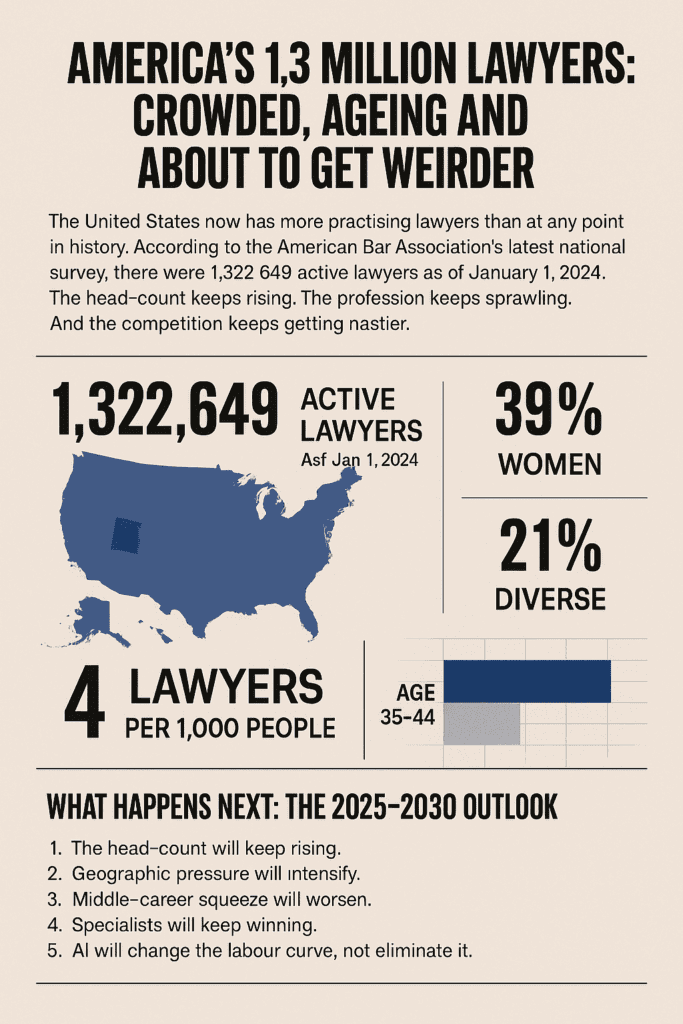
The United States now has more practising lawyers than at any point in history. According to the American Bar Association’s latest national survey, there were 1,322,649 active lawyers as of January 1, 2024. The head-count keeps rising. The profession keeps sprawling. And the competition keeps getting nastier.
New York and California remain the great legal sinkholes of the republic. Between them they account for roughly a quarter of all U.S. lawyers, with New York alone approaching 190,000 and California north of 170,000.
That concentration is no accident. That’s where the litigation money is, where Big Law clusters, and where the hourly rates support seven-figure partners without irony.
Nationally, the U.S. now averages about four lawyers per 1,000 people, which is an extraordinary saturation level by global standards.
It also explains why “standing out” in most major markets now requires either aggressive branding, industrial-strength marketing budgets, or genuine niche expertise. Preferably all three.
Who These Lawyers Actually Are
The profession is changing, but not at any revolutionary pace. Women now make up around 39 percent of U.S. lawyers, a slow grind upward that took decades of pressure to achieve.
Racial and ethnic diversity has improved too, with diverse lawyers now accounting for just over one-fifth of the profession. That’s meaningful progress. It’s also nowhere near reflective of the actual U.S. population.
Specialisation continues to harden.
The generalist small-town lawyer is fast becoming an economic relic. Growth is concentrated in regulatory law, data privacy, cybersecurity, healthcare, employment, M&A, restructuring and litigation funding-driven disputes. Routine work is steadily being automated, packaged, or price-compressed – moreso with the onset of legal tech tools.
What Happens Next: The 2025–2030 Outlook
Here is what the numbers are quietly telling anyone prepared to listen:
1. The head-count will keep rising.
Law schools continue to pump out graduates, immigration is supplementing the pipeline, and retirement keeps getting postponed. Expect the U.S. to push well past 1.4 million lawyers by the late 2020s.
2. Geographic pressure will intensify.
New York, California, Texas and Florida will continue hoovering up talent. Secondary markets will struggle to retain senior practitioners as remote work enables “big-market pay in small-market locations”.
3. Middle-career squeeze will worsen.
The 35–50 age bracket is becoming dangerously crowded. Promotion bottlenecks and lateral-hire saturation will drive more lawyers into boutique launches, fee-sharing models and quasi-consulting structures.
4. Specialists will keep winning.
General practice is being hollowed out. Specialists who can tie their expertise to regulation, risk and high-value commercial exposure will dominate. Everyone else fights on price.
5. AI will change the labour curve, not eliminate it.
Artificial intelligence will not suddenly wipe out lawyers. It will, however, reduce junior leverage hours, flatten staffing pyramids and accelerate pressure on traditional training models. Firms that can’t re-engineer their cost base around AI will bleed margin.
The Uncomfortable Truth
America does not have a shortage of lawyers. The problem is that it has a distribution, pricing and relevance problem.
Access to justice is still chronically under-served at the low-income end. At the top end, elite firms continue to gorge on disputes, regulation and corporate transactions that only the largest companies can afford to fight.
In between sits a swollen middle of highly capable lawyers competing harder every year for attention, differentiation and economic oxygen.
The profession is getting bigger, older, more specialised and more brutally competitive. And the numbers say the pressure is only just beginning.