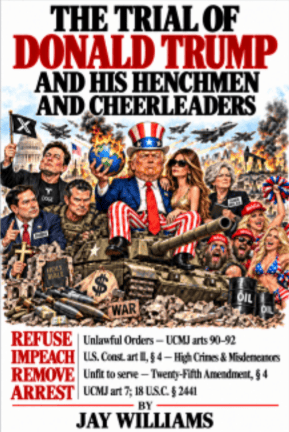
A fifteen-Ground inquiry considers the exercise of presidential power under domestic and international law.
SYDNEY, AUSTRALIA | — 1 NOVEMBER 2026
Author and retired barrister Jay Williams presents The Trial of Donald Trump and His Henchmen and Cheerleaders, an independent public-interest inquiry into the lawfulness of the presidential powers exercised by Donald J. Trump under domestic and international law.
Across fifteen Grounds, the book considers presidential immunity and constitutional limits; elections and democratic rights; the press and universities; immigration, detention and the use of federal force; economic conduct; criminal justice and capital punishment; and matters involving Ukraine, Gaza, Iran and Venezuela.
Each Ground examines the governing legal principles, the evidence, the Case Against and the Defense before setting out Findings. The inquiry asks not whether a President is popular, but whether the conduct examined was lawful.
“No Ground is strengthened by public outrage or weakened by partisan loyalty. Each Ground must stand or fall on what the evidence establishes and what the law requires.”
ABOUT THE AUTHOR
Jay Williams is a retired barrister, academic and PhD candidate in international law. Jay writes about law, power and change.
MEDIA CONTACT
Jay Williams · admin@jaywilliams.com.au · +61 423 336 393
www.jaywilliams.com.au
 Jay Williams
ABOUT THE AUTHOR
Jay Williams is a retired barrister, academic
and PhD candidate in international law.
PUBLICATION NOTICE
This book is an independent public-interest legal inquiry, not a judicial proceeding or judgment. Its allegations, analysis and findings do not constitute a determination of criminal guilt.
The Trial of Donald Trump and His Henchmen and Cheerleaders
MEDIA Q&A · FIVE QUESTIONS AND ANSWERS
Jay Williams · 1 November 2026
Question 1 — What is the book about?
Abraham Lincoln spoke of government “of the people, by the people, for the people.” This book concerns arguably the most important and consequential midterm elections facing the people of the United States, and indeed the world, in modern history.
As the United States approaches the 2026 midterm elections, President Donald J. Trump is now on trial before the American people and the world at large.
The book examines the major allegations facing President Trump and his administration, including violations of the United States Constitution, fundamental civil rights and freedoms, and the most serious crimes under international law.
The inquiry concerns five principal areas: first, presidential immunity and constitutional limits; second, elections and democratic rights; third, civil rights and freedoms, including freedom of the press, academic independence, immigration and protest; fourth, presidential power, private interests and the administration of justice; and fifth, international law and the use of force, including Ukraine, Gaza, Iran and Venezuela.
Each Ground examines the evidence, presents the Case Against and the Defense, and reaches reasoned findings with grave legal and constitutional implications.
This public-interest inquiry is independent, has received no outside funding and has no partisan allegiance. It does not purport to exercise the authority of a court or official commission.
Ultimately, the book asks whether presidential power remains accountable to the people and the rule of law. As James Madison observed, “If men were angels, no government would be necessary.”
Question 2 — Why did you write the book?
The presidential oath requires the President to “preserve, protect and defend the Constitution of the United States.” The book was written to examine the presidency of Donald J. Trump and the conduct of his administration against the promises upon which he sought office, particularly his undertaking to Make America Great Again. The inquiry tests that promise against the public record and examines the consequences of presidential power exercised beyond lawful limits.
The inquiry places that presidency within the historical and constitutional inheritance of the United States of America: the Founding Fathers’ commitment to representative democracy, the separation of powers, fundamental liberties and the rule of law. The Presidency is a constitutional trust held on behalf of the people, not an instrument of personal power or private gain.
American leadership helped shape the post-1945 international legal order. The Presidency carries responsibilities beyond national borders, including upholding the principles upon which that order rests. The book examines the consequences of presidential decisions for international peace and security, national sovereignty, human rights and civilian protection, measured against domestic and international law.
INTERNATIONAL PRESS KIT · JAY WILLIAMS · MEDIA Q&A
JAY WILLIAMS / LAW · POWER · CHANGE
The purpose is to preserve the historical record of this presidency, grounded in evidence and law, upon which public judgment may rest. As Charlie Chaplin warned in The Great Dictator, “Greed has poisoned men’s souls.”
Question 3 — What are the book’s principal findings?
Chief Justice Roberts declared in Trump v United States, “The President is not above the law.” Yet the Court recognised broad immunity from criminal prosecution. The book finds that immunity does not place presidential conduct beyond constitutional, statutory or international legal limits.
The book finds the claim that the 2020 election was stolen unsupported by the public record. Efforts to overturn its certification and subsequent interventions in election administration raise serious concerns for constitutional government and the integrity of democratic institutions.
The findings identify retaliation against journalists, coercive pressure on universities, unlawful deportations and contested federal deployments against protesters. They address constitutional protections for freedom of expression, academic independence, due process and peaceful dissent.
The inquiry examines the Qatari aircraft, Trump-family cryptocurrency ventures, politically directed prosecutions, presidential pardons and Epstein records. The findings address conflicts between presidential power and private financial interests and threats to impartial justice. The book concludes that deliberate State execution of persons securely held in custody is incompatible with human dignity.
The international findings are grave. The book finds American operations in Iran and Venezuela breached the UN Charter. A UN fact-finding mission found reasonable grounds to believe the Minab school strike was a war crime. The inquiry finds reasonable grounds to conclude genocide occurred in Gaza, while the ICJ has not issued a final merits judgment, and prima facie grounds to investigate possible American complicity. It calls for investigation of whether American officials knowingly assisted Russia’s unlawful conduct in Ukraine.
These are independent findings, not judicial determination. The book calls for independent investigation, accountability in accordance with the law. George Orwell supplied the satirical warning: “All animals are equal, but some animals are more equal than others.”
Question 4 — The aftermath: What happens after the midterms?
John Adams envisaged “a government of laws, and not of men.” On 3 November, Americans elect a new Congress, not a new President. Democrats require a net gain of three House seats and four Senate seats for majorities. Control of either chamber could strengthen scrutiny of the administration; control of both would expand congressional leverage, without itself removing the President. The new Congress takes office on 3 January 2027.
If close results are disputed, recounts, litigation, state certification and each chamber’s authority to judge its members’ elections provide lawful remedies. Allegations of fraud require evidence. Neither presidential objection nor threats of disorder may prevent the lawful certification and seating of the new Congress.
First, refuse. Under 5 USC § 3331 and Article 92 UCMJ (10 USC § 892), civilian and military personnel owe fidelity to the Constitution. Unlawful orders must be refused; officials must avoid knowing participation in wrongdoing and may withdraw or resign through lawful channels.
INTERNATIONAL PRESS KIT · JAY WILLIAMS · MEDIA Q&A
JAY WILLIAMS / LAW · POWER · CHANGE
Second, impeach. Under Articles I, §§ 2–3 and II, § 4, the House may investigate and impeach for serious abuses of public trust. The Senate must conduct a fair trial; conviction and removal require two-thirds of senators present. A criminal conviction is not a prerequisite.
Third, remove. The Twenty-Fifth Amendment, § 4, concerns presidential inability, not political disagreement or misconduct as such. The Vice President and a Cabinet majority, or an authorised body, may initiate the transfer of presidential powers to the Vice President as Acting President, subject to constitutional procedures and congressional review.
Fourth, arrest. Competent authorities should investigate supported criminal allegations and prosecute where justified, including under 18 USC §§ 2 and 2441 where applicable. Jurisdiction, immunity, evidence and due process must be respected. Electoral defeat establishes neither guilt nor immunity from lawful accountability. As Mark Twain observed of political corruption, “That’s the finest asset we’ve got—the ballot box.”
Question 5 — What do you hope the book achieves?
As Barack Obama declared at Selma, “the single-most powerful word in our democracy is the word ‘We.’ ‘We The People.’ ‘We Shall Overcome.’ ‘Yes We Can.’” The aim of this work is to restore and strengthen public confidence in democratic principles and constitutional government through an independent examination of presidential power, grounded in evidence and law. Public judgment must rest on facts, without fear or favour.
Accountability according to law is a constitutional responsibility, not a matter of political discretion. Credible allegations demand investigation; established violations require enforcement of the law and effective remedies. Justice must protect fundamental liberties, uphold due process and bring impunity to an end.
The enduring purpose is to reaffirm the principles of constitutional democracy and the public trust upon which the Presidency rests. Public power belongs to the people. Those who exercise it remain bound by law and owe fidelity to the Constitution and the people they serve. The Constitution declares the source of that authority: “We the People.”