Key Takeaway
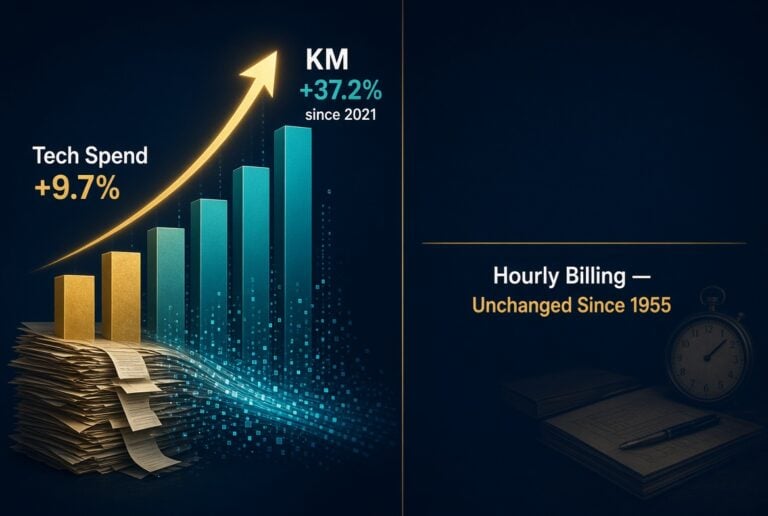
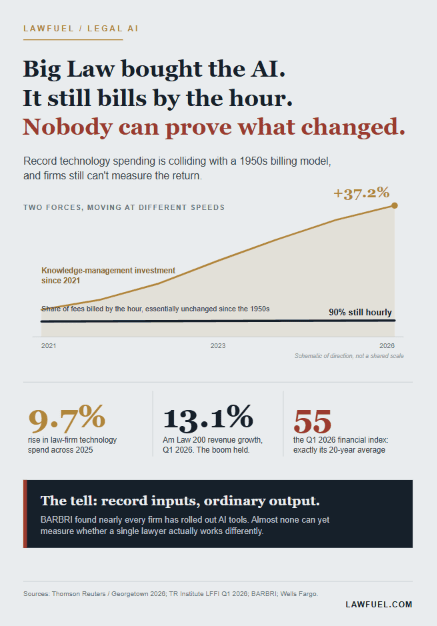
Law firms poured record money into AI through 2025, with technology spend up 9.7% and knowledge-management investment up 37.2% since 2021. New BARBRI research finds most firms rolled the tools out faster than they built any way to measure whether lawyers actually work differently. The question underneath: firms are deploying software that does in minutes what used to fill billable hours, while roughly 90% of legal fees still run on the hourly clock.
Lawyers have spent two years learning that buying artificial intelligence is the easy part, but understanding what it did for their firms was more difficult.
Research published on 6 August by BARBRI Professional Education puts a figure on the discomfort. Nearly every firm interviewed has made real progress getting tools into lawyers’ hands.
Almost none has built the organisational plumbing to sustain training, drive adoption, or produce a number that would survive contact with a sceptical managing partner.
The report draws on interviews with ten leaders across nine firms, and one former learning-and-development director summed up the internal reality as “feast or famine”: either the innovation, knowledge-management and L&D teams are all elbowing for the same territory, or nobody owns it at all.
Why Can’t Firms Prove their AI is Working?
The problem is that the AI arrived before the infrastructure and backup was ready. Firms bought Harvey seats and CoCounsel licences at speed, then discovered that measuring behaviour change requires someone whose actual job is to measure it.
The Hourly Billing Method Continues
“90% of legal fees still run on the hourly clock.”
When three teams share the tools they can easily trip over one another. Either way, the partnership is paying for a capability it cannot yet describe to a client. You can track this arms race across our legal AI reports and the pattern is remarkably consistent from the biglaw firms down.
The Billing Maths Issue
Here is the fault line the trade press keeps stepping around. The Thomson Reuters and Georgetown Law State of the US Legal Market report found that around 90% of legal fees still flow through standard hourly arrangements, the same structure that has governed the profession since the 1950s. Set that against a spending surge on tools built to compress hours into minutes, and you get what the report calls an “absurd tension”.
The maths only works if firms can push through rate rises steep enough to outrun their own efficiency.
Clients, unsurprisingly, are not thrilled at the idea of handing every productivity gain straight to partner profit, and general counsel have started signalling spending pullbacks.
Rising associate costs make the squeeze sharper still, as our Legal Pay Guide tracks in detail.
The Doom Stories
For the contrarians, the bubble-bursting narrative is only half right. Associate realisation rates already sit around 85.6%, meaning a meaningful slice of junior work never gets collected. AI can absorb the unbilled, unglamorous portion of the job without touching a dollar of revenue that was ever going to arrive.
It explains why elite firms are layering AI on top of headcount rather than cutting, with average midsized and second-hundred firms growing lawyer numbers by more than 8% since January 2023.
The smart play for law firms is not to spend the most but to to automate work that clients were not paying for anyway.
You will find those firms across our Power Firms List, and they tend to talk about AI far less than the ones still hunting for a use case.
Did the Predicted 2026 downturn actually Arrive?
The downturn did not arrive in the manner many expected. Demand kept climbing through the first half of 2026, with Wells Fargo clocking a 13.1% first-quarter revenue jump across the Am Law 200 and standard rates still rising into double digits.
Thomson Reuters’ own first-quarter index landed at 55, sitting dead on its twenty-year average, despite some of the strongest rate and demand inputs the market has ever recorded. Strong inputs, ordinary output.
Collections have begun to drag as well, with the cycle slowing more than three percent as unbilled work stacks up at the top of the market. The report called this the first drops of rain, and it was not wrong.
The average firm booked 13% profit growth in 2025. That is a genuinely good year built on genuinely unstable ground. The firm that gets caught out will be the one that spent the money, briefed the press, and still cannot show the client a number.