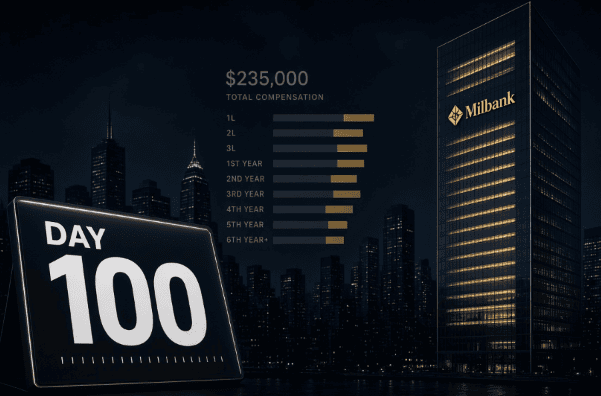

The coronavirus has spooked most law firms and the pending merger between Troutman Sanders and Pepper Hamilton has seen a four month delay until 1 July but it has also seen voluntary departures from the firm.
A report from AbovetheLaw carries a report from the firm that it is implementing voluntary temporary leave of absence as a program for its professional staff across all the firm’s offices.
“The voluntary leaves are expected to be three months, however Troutman Sanders plans to call people back earlier if circumstances allow,” the firm statement said.
Merger partner Pepper Hamilton has already cut associate salaries by 20 per cent.
- Trainee To Equity Partner: The 12-Year BigLaw Timeline, Mapped Honestly
Roughly one in twenty associates who start at a top US firm will make equity partner there. That is the number nobody puts in the recruiting brochure. The brochure says the partnership track is “approximately eight to ten years.” That is technically true and practically misleading — because it describes the timeline of people who finish, not the probability of finishing. The honest answer is that the BigLaw partnership track is a twelve-year funnel with five stages, four exit ramps, and a survival rate that would not pass muster as a clinical trial outcome. Here is what each stage actually looks like. Log in to read timeline . . . - Panel Games: Revolut’s New Legal Model is a Quarterly Hunger Games for Big Law
If you’re a partner at a Magic Circle firm currently leaning back in your Herman Miller chair, comforted by the warmth of a three-year panel appointment, you might want to sit up. The fintech disruptor that refuses to play by the rules is, predictably, about to break yours. Revolut, the neobank recently valued at a staggering $45 billion following a secondary share sale (with some internal projections whispering closer to $75 billion), is officially binning the traditional legal panel model. In its place comes “Revolut Partners,” a system designed to treat law firms less like venerable institutions and more like high-performance software vendors. Log in to read more . . - The Partner Who Signed the Brief: Inside Morgan & Morgan’s $5,000 AI Lesson
If you wanted a single case to put on the cover of every CLE brochure for the next five years, Wadsworth v. Walmart Inc. would do nicely. A hoverboard explodes in a Wyoming family’s home. The family sues. Their lawyers — from America’s loudest plaintiffs’ firm, no less — file a motion in limine citing nine cases. Eight of them do not exist. They have never existed. They were, in the now-familiar verb of our age, hallucinated. And so on 24 February 2025, U.S. District Judge Kelly H. Rankin handed down what is shaping up to be the defining American sanctions order of the generative-AI era. Rudwin Ayala — the Morgan & Morgan associate who actually fed the brief into the firm’s in-house AI tool, charmingly named MX2.law — lost his pro hac vice admission and was fined $3,000. Log in to read . . . - Crown Jewel or Holding Pattern? The Meredith Connell Question Won’t Go Away

- Sundaresh Thangavelu named as rising star by New Zealand Law Society’s Property Law Section