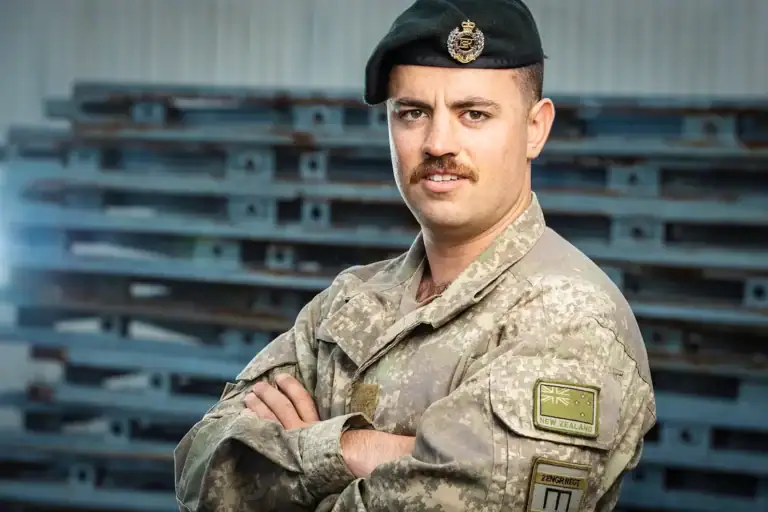
Currently advising a multinational military headquarters on the Korean Peninsula, New Zealand Army Captain John Whitcombe’s career has taken a path he could hardly have mapped out when he left the West Coast for university.
Today, the former New Zealand Army Reserve Force sapper and Crown prosecutor is serving as a legal officer in the Republic of Korea as part of New Zealand’s ongoing commitment to the Korean Armistice Agreement.
Working within the United Nations Command (UNC), Captain Whitcombe is contributing his military and legal expertise to the multinational effort that has helped maintain stability on the peninsula for more than seven decades.
Captain Whitcombe grew up in Greymouth, attending St Patrick’s Primary School and John Paul II High School before moving to study at the University of Canterbury.
He initially only wanted to study history but his mother encouraged him to try law and he eventually completed degrees in both subjects.
He met students who were serving in the Army Reserve and he enlisted and trained as a combat engineer (sapper), serving with 3 Field and Emergency Response Squadron at Burnham.
Reserve service fitted well around university life, giving him opportunities to train alongside Regular Force personnel and take part in exercises and domestic tasks.
Among those experiences was returning to the West Coast in 2019, where he helped replace a bridge that had been washed out during severe flooding.
After five years as a sapper, he commissioned as an Army officer in 2020. At the same time, his civilian legal career was developing. After graduating, he joined the Crown Solicitor’s Office in Christchurch, working primarily in criminal prosecutions and gaining experience in jury trials. His military and civilian careers increasingly began to overlap, including involvement in military prosecutions.
“Eventually, the two careers merged. I was looking to broaden my legal experience and pursue opportunities for military operational service, so I transferred to the Regular Force and joined Defence Legal Services in 2024.”
Initially focused on military prosecutions, his work expanded to encompass a broader range of responsibilities. He taught recruits, junior non-commissioned officers and units about the law of armed conflict and international law, advised commanders on disciplinary and administrative matters, and contributed to work associated with reform of New Zealand’s military justice system.
That combination of military experience and legal practice ultimately led to a six-month deployment to Korea, where he now serves in the Office of the Judge Advocate as a legal adviser within the international law team supporting the UNC.
It is a role that places the NZ Army captain inside a multinational headquarters dealing with a framework that has its origins in the Korean War.
His work ranges from reviewing headquarters policies to providing legal advice relating to the United Nations Command Military Armistice Commission (UNCMAC). That can include legal issues arising from inspections in the Demilitarized Zone and investigations into alleged breaches of the Korean Armistice Agreement.
Captain Whitcombe is the fourth New Zealand lawyer to undertake the role on a six-month rotation. He reviews investigations, provides legal advice to investigators, researches the meaning and application of the Armistice Agreement and associated regulations, and assists with reports.
He also attends headquarters meetings, assists with planning and VIP visits, supports professional development, and helps with some of the day-to-day requirements of New Zealand Defence Force personnel serving in Korea.
Having a New Zealand lawyer embedded within the headquarters brings a valuable national perspective to the predominantly United States legal team supporting the multinational UNC.
“They really value having another perspective when they’re considering various issues.”
The deployment has also provided professional opportunities outside his normal work.
Captain Whitcombe has observed the United States military justice system in action at a court martial and has been able to build relationships with military lawyers from across the wider installation.
He has joined the local rugby team, Stars and Stripes, which has given him the opportunity to meet people outside the military environment, while Korea’s extensive network of hiking trails has given him another way to explore the country.
Beyond Seoul’s high-rises and motorways, he said it had been surprising to discover wilderness areas, mountain trails and views that offered a very different side of Korea.
One of the more memorable experiences of the deployment was taking part in the 75th anniversary commemorations of the Battle of Kapyong, where New Zealand and Australian forces were heavily engaged during the Korean War.
Meeting a New Zealand Korean War veteran during the commemorations brought home the connection between those who served on the Korean Peninsula more than seven decades ago and the New Zealanders who continue to serve there today.