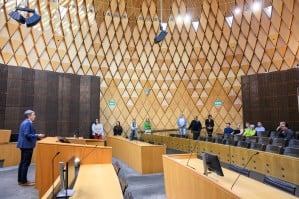
New Zealand’s courts have released comprehensive Guidelines for Courtroom Conduct for Counsel (July 2026). Endorsed by the Chief Justice and Heads of Bench, the document sets out practical expectations covering forms of address, dress, technology (including AI), introductions, junior counsel participation, accessibility, devices, behaviour, documents, remote hearings and more.
The guidelines apply to counsel and to prosecutors such as sworn police officers who are not lawyers. They do not replace lawyers’ professional obligations under the Lawyers and Conveyancers Act 2006 or the Conduct and Client Care Rules.
Instead, they clarify the judiciary’s day-to-day expectations and reduce uncertainty around customs that junior lawyers were previously expected to absorb by observation.
1. Forms of address – “Sir” and “Ma’am” to be phased out
Judges should be addressed as “your Honour” or the te reo Māori equivalent “e te Kaiwhakawā/Tiati”, not simply as “Judge”. For a panel, use “your Honours”, “the Court”, or the corresponding te reo forms (“e ngā Kaiwhakawā/Tiati” or “e te Kooti/Kōti”). “Sir” and “Ma’am” remain commonly used but are expressly intended to be phased out.
Specific forms are set out for coroners (“Coroner”, “your Honour” or “e te Kaitirotiro Matewhawhati”), Associate Coroners, Family Court Associates, Community Magistrates (“your Worship” or “e te Kaiwhakawā ā Hapori”) and Justices of the Peace.
Outside court, a judge encountered socially should ordinarily be addressed as “Judge” or “e te Kaiwhakawā/Tiati” unless invited to be less formal. Coroners are addressed as “Coroner” or the te reo equivalent.
2. Addressing opposing counsel – “my learned friend” also to be phased out
Counsel should address opposing counsel as “counsel for the plaintiff” (or the relevant party), “Crown counsel” or “defence counsel”. The phrase “my learned friend” may still be used, but the intention is to phase it out in favour of “my learned colleague”.
Co-counsel may be referred to as “senior counsel for the plaintiff, Ms X” or “junior counsel for the plaintiff, Mr Y” (with te reo Māori equivalents provided in an appendix).
Direct speech is acceptable. Counsel may say “Do you wish for me to proceed, your Honour?” rather than more elaborate third-person constructions.
3. Court dress remains formal; cultural dress recognised
Court is a formal setting. Appropriate dress is generally a dark suit with a plain or striped collared shirt and tie, a plain or striped blouse, or plain dark clothing (including a dress) with a jacket. Suit coats/jackets should be buttoned when standing to address the court where practicable. Brighter colours are generally acceptable in the Family Court and Māori Land Court. The same rules apply to police prosecutors who are not in uniform.
Culturally required headwear is permitted. Taonga may be worn, including in place of a tie (with the top shirt button done up). Korowai and kākahu may be worn on ceremonial occasions.
Gowns are required in the Employment Court, Court Martial, Court Martial Appeal Court, High Court (other than chambers matters), Court of Appeal and Supreme Court. They are also required for District Court jury trials but not judge-alone trials. Counsel should gown before entering the body of the courtroom (or inside prior to the judge’s entry if necessary).
King’s Counsel have priority for front-row seats and should sit in order of date of calling to the inner bar (right to left facing the judge). Other counsel in the front row should offer their seat to a King’s Counsel if no other front-row seats are available.
4. Electronic devices and AI
Electronic devices (laptops, tablets, phones, etc.) must be set to silent, “do not disturb” or turned off before counsel enter the courtroom.
They may be used provided the use does not undermine the dignity of the court, disrupt proceedings or interfere with professional duties. Context matters: what is acceptable in a list court may not be appropriate in a jury trial or defended hearing. The presiding judge may restrict use further.
Filming, photography and sound recording are prohibited, including for AI-powered electronic note-taking. Counsel are also directed to the separate Guidelines for Use of Generative Artificial Intelligence in Courts and Tribunals.
5. Names, titles and pronouns
Counsel are responsible for knowing the correct spelling and pronunciation of their clients’ and witnesses’ names, titles and pronouns. This information should be supplied to the registrar in advance wherever possible.
Witnesses should ordinarily be referred to by formal name and title, and their pronouns used. Children and young people may generally be referred to by given or preferred names.
6. Standardised introductions
When a case is called, counsel stand and introduce themselves and any junior counsel (who also stand). Introductions may be in English, te reo Māori or New Zealand Sign Language. Counsel must include the title they use (Mr, Ms or chosen title); professional or formal honours (Dr, Professor, Sir, Dame, Lady) are not used when introducing themselves.
Order of introductions is specified: plaintiff then defendant (civil); Crown/prosecutor then defence (criminal); applicant then respondent then lawyer for child/subject person/counsel to assist (family); appellant then respondent (appeals); counsel to assist, family, other counsel, then Police (Coroners Court). Counsel may also note the presence of clients, supporting whānau, communication assistants or interpreters where appropriate.
7. Junior counsel may take a larger speaking role
The previous practice that each counsel is heard only once in the principal argument no longer applies. This expressly allows junior counsel to make oral submissions during the principal argument, consistent with existing Supreme Court and Court of Appeal guidance encouraging substantive opportunities for juniors.
8. Standing and bowing – respect, not rigid ritual
Counsel stand when the judge enters or leaves (or when instructed), bow when the judge bows (judges bow only at the start and end of the day or shorter hearing), remain standing when addressing or being addressed by the judge, and bow when entering or leaving the bar while the court is sitting. Counsel should not sit until the judge is seated and should remain seated while waiting for their case.
Standing or bowing is not expected where disability, injury or any other reason makes it challenging, impossible or uncomfortable.
9. Accessibility and family responsibilities
Counsel should notify the registry as soon as possible if they, a client or a witness require assistance or accommodation (including disability, injury, childcare or breastfeeding responsibilities). When interpreters or communication assistants are involved, counsel should generally focus on the person speaking or being addressed rather than the interpreter (with limited exceptions).
10. Devices and courtroom behaviour
Devices are permitted subject to the rules above. Counsel must remain mindful of context and the judge’s authority to restrict use.
While another person is speaking, and even during breaks when the judge has left, expressions of displeasure or disagreement are inappropriate. Quiet conversation with co-counsel or junior counsel is allowed if it is neither distracting nor disruptive.
11. Documents and issues arising during hearings
Additional documents should be supplied to the court and opposing counsel (or self-represented party) in advance wherever possible.
Material handed up during a hearing must first go to the other side, then to the bench via the court taker/registrar; electronic copies should follow. Counsel must promptly alert the court to transcript errors, interpretation/communication problems, anticipated absences, or any indication that the allocated hearing time is becoming unrealistic.
12. Remote hearings are still court
The guidelines apply, with necessary modifications, to Virtual Meeting Room or Microsoft Teams hearings (and must be read with the Protocol for Participation in Remote Hearings). Remote counsel should remain seated and visible throughout.
Gown requirements continue for remote appearances in courts where gowns are ordinarily required, except for chambers hearings.
13. Do not leave the judge alone
A judge should not be left in the courtroom without at least one counsel present (a sworn police prosecutor or self-represented party does not count as “counsel” for this purpose).
The final counsel remaining (including remotely) should not leave before the judge without permission. The older convention requiring counsel to remain merely because only one other counsel was present has ceased.
Overall significance
The July 2026 Guidelines primarily codify, modernise and clarify long-standing customs rather than reinvent courtroom etiquette.
Court remains formal, respectful and hierarchical, but older conventions are being updated. “Sir”, “Ma’am” and eventually “my learned friend” are being phased out; te reo Māori and New Zealand Sign Language are expressly accommodated; cultural dress, accessibility needs and preferred forms of address are recognised; junior counsel gain clearer speaking opportunities; and technology is accepted within firm limits (especially on AI recording).
Courtroom etiquette remains very much alive—it has simply received a clear, practical 2026 update.