
What IS Happening in the London Legal Market?
The Q3 2026 Corporate Advisers Rankings Guide is out, and the interesting story is not who is on top.
Every quarter, a small data publisher in the UK causes a modest flurry of law firm marketing activity, and this week was no exception. Adviser Rankings Ltd has published its Q3 2026 Corporate Advisers Rankings Guide, and by close of business the LinkedIn posts had begun.
Slaughter and May is top. Linklaters is top.
Hill Dickinson is top. Howard Kennedy is top. Fieldfisher is top. Everyone, on some reading of some table, is top of something.
That is not a criticism of the data, which is unusually solid, but is a criticism of how it gets used.
So before the next round of “delighted to announce” posts, here is what the guide actually is, who compiles it, and what the Q3 numbers say when you read them properly.
Why It Is Not Chambers
Adviser Rankings Ltd is a financial data publisher, not a legal directory. It has produced the Corporate Advisers Rankings Guide every quarter since November 2005, currently in association with the accountancy firm PKF Littlejohn. The Q3 2026 edition has a data cut-off of 12 August 2026.
The distinction from Chambers, Legal 500 and the rest matters enormously. Directory rankings rest on submissions, referee interviews and editorial judgement about quality. CARG rests on a single question: which listed companies retain you.
ARL maps the adviser relationships of every company with ordinary shares quoted on the London Stock Exchange, tracking RNS announcements, statutory reports and press coverage, then sends each adviser a quarterly request to update its client list.
The critical bit is what happens next. Additions have to be validated by the company itself. No relationship appears in the tables unless both the adviser and the client have signed it off, which is a very good reason why these tables are worth reading.
There is no submission to polish, no referee to charm, no narrative to spin. A firm can either point to a listed client who agrees it is the adviser, or it cannot. It is close to the only law firm ranking in circulation that cannot be talked up.
The scoring is equally blunt. One point per confirmed relationship, whether the firm is sole adviser or one of several. A joint appointment counts the same as an exclusive mandate, which is worth remembering when a firm quotes its client count at you.
The Table Everyone Quotes
By total quoted clients across the whole London market:
| Rank | Firm | Aug ’26 | May ’26 |
|---|---|---|---|
| 1 | Slaughter and May | 103 | 105 |
| 2 | Herbert Smith Freehills Kramer | 93 | 97 |
| 3 | Dickson Minto | 81 | 83 |
| 4 | Hill Dickinson | 76 | 74 |
| 5 | Linklaters | 73 | 73 |
| 6 | Carey Olsen | 68 | 72 |
| 7 | Gowling WLG (UK) | 66 | 67 |
| 8 | Stephenson Harwood | 62 | 61 |
| 9 | CMS | 60 | 60 |
| 10 | A&O Shearman | 58 | 62 |
Slaughter and May remains the only firm in the market with a triple-digit client count, and it retains first place in the FTSE 100 (31 clients), FTSE 250 (49) and FTSE 350 (80). On volume alone it is not close.
Linklaters leads on client market capitalisation with £1.43 trillion across the total stock market, and is the only firm whose FTSE 100 client base alone is worth more than a trillion pounds, at £1.26 trillion.
Of the five magic circle firms, only Slaughter and May, Linklaters and A&O Shearman make the top ten by client numbers. By client market cap, the magic circle takes all five of the top five places. Volume and value are different businesses, and the tables say so.
The Number The Press Release Does Not Mention
Add up the top 31 firms by client count and the market told a story nobody put in a bullet point.
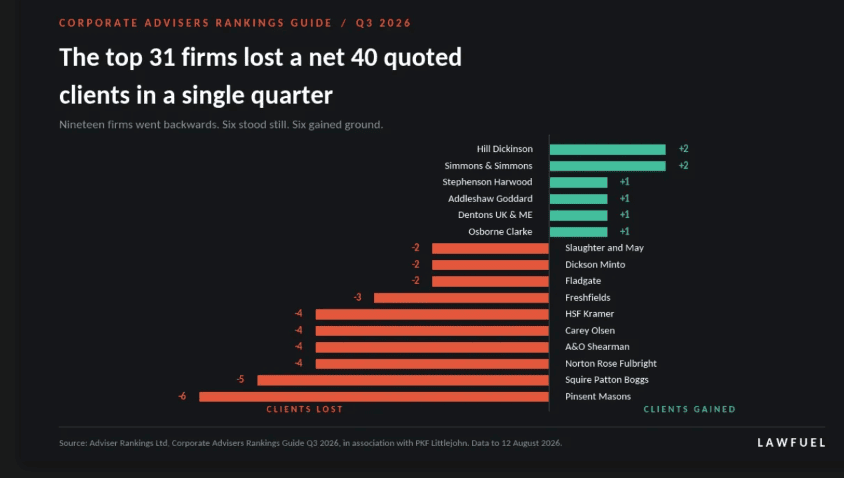
Those firms held 1,552 quoted client relationships in May. In August they held 1,512. Nineteen firms went backwards, six stood still, and six gained ground. The net movement was minus 40 in a single quarter.
Slaughter and May lost two. Herbert Smith Freehills Kramer lost four while climbing a place in the FTSE 250. A&O Shearman, Carey Olsen, Norton Rose Fulbright and Eversheds Sutherland each shed four. Squire Patton Boggs dropped five and five places. Pinsent Masons lost six, the steepest fall in the table, and slipped out of the top ten.
None of this reflects mass client defection, but rather it reflects the London market itself. More companies have left the LSE than joined it every year since 2022, take-privates have accounted for a growing share of UK private equity deal value, and the flow of departures in 2026 has included some genuinely large names.
When a client is acquired, taken private or reregistered in New York, it stops being a quoted client, and the adviser stops scoring a point for it. The advisers are not losing. The pond is draining.
This is the part of the story that should interest managing partners rather than marketing directors. A firm can hold its market share, keep every client happy, win new work, and still watch its CARG numbers fall for reasons entirely outside its control. It can also, as several firms did this quarter, climb the rankings while losing clients, purely because everyone else lost more.
Hill Dickinson Is Winning The Market Everyone Else Left

The exception to all of the above is Hill Dickinson, (pictured above from the firm’s ‘Northern Powerhouse Firm of the Year win) which added two net clients to reach fourth overall on 76, and extended its lead on AIM to 45 clients, nine clear of second-placed Fieldfisher.
AIM is the market that has taken the heaviest reputational battering of the past two years, and that is precisely where Hill Dickinson has built a franchise. It also holds first place in the health care sector rankings, first in basic materials after adding Braime Group, and first on Aquis with 15 clients. It is a strategy that looks unfashionable right up until you look at the tables.
Elsewhere, Dickson Minto keeps first place in FTSE Small Cap and Fledgling on 36 clients, Stephenson Harwood is second on 30 and climbing the overall table, Howard Kennedy takes outright first on the Main Market with 28, and Norton Rose Fulbright added three small cap clients, the largest single gain in that index.
Why Dickson Minto Is Third And Thirtieth
Here is the most useful thing in the entire guide, and it is free.
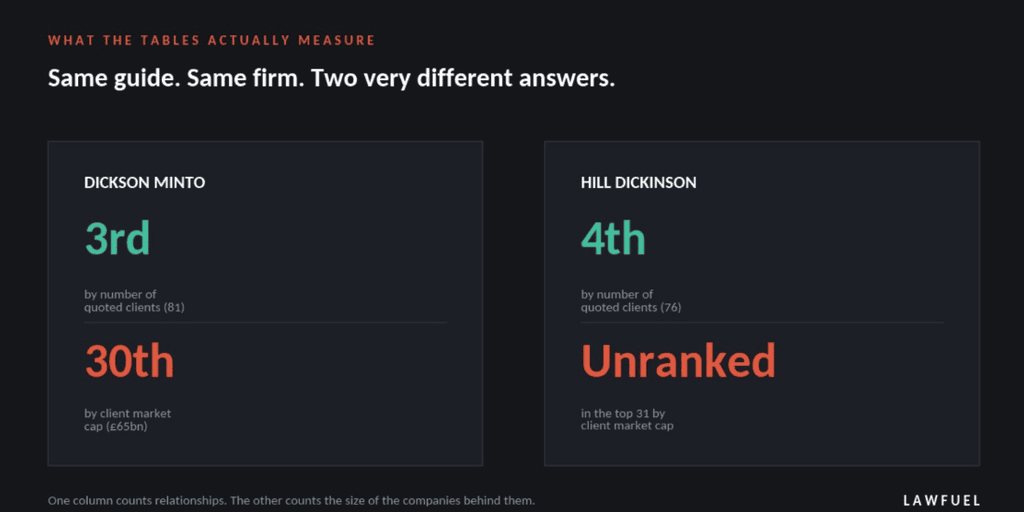
Dickson Minto ranks third in the market by number of quoted clients, with 81. It ranks thirtieth by client market capitalisation, at £65 billion. Hill Dickinson is fourth by client count and does not appear in the top 31 by market cap at all. Meanwhile Sullivan & Cromwell sits ninth by client market cap and nowhere near the top 31 by number, and Cravath is 23rd on value alone.
Those are not contradictions. They are the whole point. One column counts relationships. The other counts the size of the companies behind them. A firm with a large book of small caps and a firm with a handful of FTSE 100 mandates are doing different work for different money, and any firm quoting a CARG position at you without saying which table it came from is telling you roughly half of something.
Fieldfisher, for the record, tops the technology sector rankings with six clients. Sector tables run on small numbers, and a “market-leading” sector ranking can rest on a handful of relationships. Read the client count, not the ordinal.
The Merger Names Have Landed
Q3 2026 is also the first guide in which this year’s consolidation shows up as consolidated entities. Ashurst Perkins Coie, formed when the two firms completed their $2.8 billion combination at the end of June, appears at 17th on 41 clients. Hogan Lovells Cadwalader, launched on 1 July from what the firms billed as the largest law firm merger in history, sits 16th by client market cap on £152 billion. Herbert Smith Freehills Kramer, a year further into its own integration, is second on both counts.
Scale arrived. Whether it arrives in the client tables in any form other than arithmetic is a question for Q4 and beyond, and it is the one worth watching. Combining two client lists produces a bigger client list on day one. Producing a bigger client list in year three is the actual test.
How To Read The Next One
Three rules for the next quarterly round of announcements.
Ask which table. Total stock market, FTSE 100, AIM, sector and market cap are five different rankings and firms will quote whichever flatters them.
Ask about the direction of travel. Rising a place while losing clients is common in a contracting market and means considerably less than it sounds.
Ask what a point is worth. A joint appointment scores the same as a sole mandate, and a sector leader may hold six clients.
None of which makes the guide less useful. It makes it more useful than most of what passes for law firm ranking data, precisely because the clients have to agree.
The Q3 2026 Corporate Advisers Rankings Guide is published by Adviser Rankings Ltd in association with PKF Littlejohn. Data cut-off 12 August 2026.
4. Key numbers box (sidebar)
- 103 quoted clients for Slaughter and May, the only triple-digit count in the market
- £1.43 trillion combined client market cap for Linklaters, first overall
- £1.26 trillion Linklaters’ FTSE 100 client market value, the only firm above £1 trillion on that index
- 45 AIM clients for Hill Dickinson, nine ahead of Fieldfisher
- 19 of 31 top-ranked firms lost quoted clients in the quarter
- Minus 40 net client relationships across the top 31 firms since May
- 12 August 2026 data cut-off
5. FAQ block (renders under the article, feeds FAQPage schema)
Who publishes the Corporate Advisers Rankings Guide? Adviser Rankings Ltd, an independent UK financial data publisher, in association with PKF Littlejohn. It has appeared quarterly since November 2005.
How are the law firm rankings compiled? ARL tracks adviser relationships for companies quoted on the London Stock Exchange using RNS announcements, statutory reports and press coverage, and sends advisers a quarterly client update request. Additions must be validated by the client company. No relationship is listed unless both the adviser and the client confirm it. Each confirmed relationship scores one point, whether the appointment is sole or joint.
Which law firm has the most London-listed clients? Slaughter and May, with 103 quoted clients as at the Q3 2026 cut-off, the only firm with a triple-digit count. Herbert Smith Freehills Kramer is second on 93 and Dickson Minto third on 81.
Which law firm ranks highest by client market capitalisation? Linklaters, with combined client market cap of £1.43 trillion across the total stock market and £1.26 trillion in the FTSE 100 alone.
Is this the same as the Chambers or Legal 500 rankings? No. Chambers and Legal 500 assess quality of legal work through submissions, interviews and editorial judgement. The Corporate Advisers Rankings Guide counts confirmed client relationships and their market value. It measures market share of listed clients, not the quality of advice.
Why did so many firms lose clients this quarter? Largely because the London listed market is contracting. Delistings, take-privates and overseas relisting moves remove companies from the quoted universe, and their advisers lose the corresponding ranking point regardless of the client relationship itself.