Wall Street To BigLaw: AI Is Saving You Money. Where’s Our Cut?
Goldman Sachs, Morgan Stanley and Citi are asking a rather uncomfortable question of their outside lawyers: if AI is making legal work faster, why aren’t the bills getting smaller?
Power Points
- Goldman Sachs, Morgan Stanley and Citigroup are pushing major law firms to demonstrate how AI efficiencies are being reflected in their legal bills.
- Citi has begun asking firms bidding for work to explain their AI-related savings, while Morgan Stanley is moving much of its outside legal work toward competitive bidding and alternative fee arrangements.
- The pressure goes directly to the BigLaw leverage model, where armies of associates traditionally generated large volumes of billable hours.
- New LexisNexis research shows 94 per cent of lawyers now use AI for legal work and 55 per cent expect AI to change law firm billing.
- The battle is shifting from whether lawyers should use AI to a much more interesting question: who gets the financial benefit?
For the past few years BigLaw has been enthusiastically telling anyone within PowerPoint range that artificial intelligence will transform legal practice and clients have been listening.
Now some of the world’s largest corporate legal buyers are asking where are their legal cost savings? Once again, the billable hour question is raising its uncomfortable head.
Goldman Sachs, Morgan Stanley and Citigroup are pushing major law firms over the cost benefits being generated by AI, according to the Financial Times, putting new pressure on the billable-hour model that has helped make elite law firm partners spectacularly wealthy.
And this time the threat to the billable hour isn’t coming from a legal futurist addressing a conference in Las Vegas.
It’s coming from the people paying the invoices.
Citi Wants To See The Numbers

Citigroup global head of legal Adam Meshel told the FT that if AI means firms are spending fewer hours on a matter, the bank expects the cost of that transaction to fall significantly.
Citi has begun asking law firms competing for its work to explain the savings they are generating through AI.
Goldman Sachs has similarly sought information about the efficiencies firms are obtaining from the technology, while Morgan Stanley plans to put most of its external legal work through competitive bidding by the end of 2026, including greater use of fixed and alternative fees.
That represents a significant change in the AI conversation given that until recently law firms controlled much of it.
Remember that it was the lawyers who selected the technology. They paid for Harvey, Legora, Microsoft Copilot and increasingly sophisticated proprietary systems. They trained their lawyers and announced impressive efficiency gains.
But there was always a slightly awkward economic question lurking underneath all that innovation.
Who gets the AI dividend?
The $798 Associate Meets The Machine
The problem is particularly acute because AI attacks precisely the work upon which the traditional BigLaw pyramid was built, which is legal research, document review, due diligence, contract analysis, discovery, first drafts.
All the work that junior lawyers spent enormous amounts of time performing, while their employers billed the time at a great deal more than the associates cost to employ.
According to data cited by the FT from legal technology company Persuit, average associate billing rates at the largest US firms have reached $798 an hour in 2026, up 33 per cent since 2023. Partner rates have risen 29 per cent over the same period.
Then along comes AI promising to perform portions of that work dramatically faster, which looked wonderful for the law firms until – for the clients like the big corporates paying those major fees – the mathematics became rather obvious.
Morgan Stanley: The Model Is “Extraordinarily Unstable”

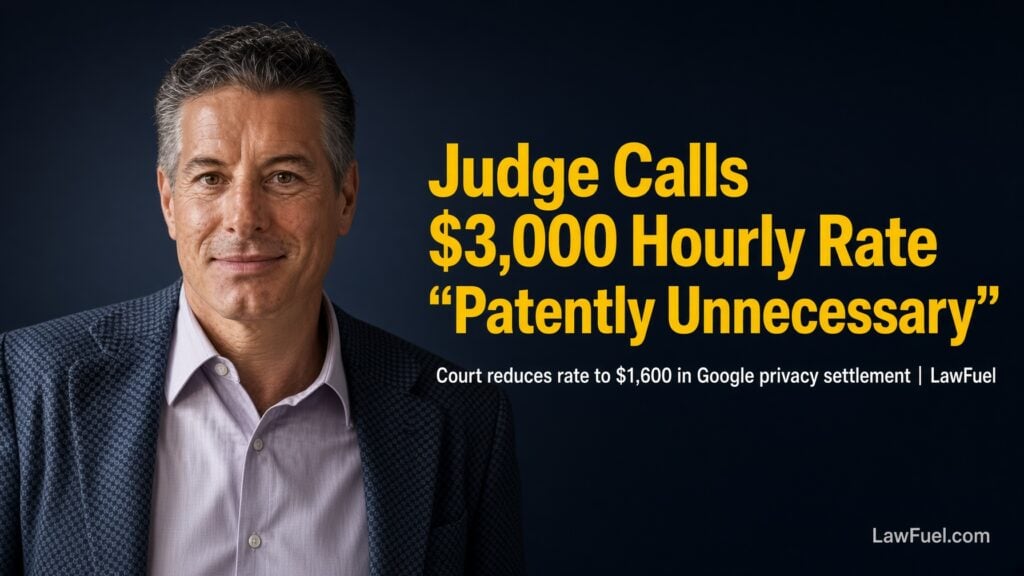
Morgan Stanley general counsel Eric Grossman (pictured) went considerably further.
He told the FT that the traditional compensation model built around associates recording large numbers of hours was now “extraordinarily unstable”, with AI potentially producing a fundamental change to the revenue foundation of major firms.
That does not mean sophisticated clients suddenly expect premium lawyers to work cheaply.
Quite the opposite.
Morgan Stanley says it remains willing to pay substantial sums for elite legal judgement and talent, which is a distinction that may prove crucial.
Clients aren’t necessarily objecting to paying $2,000 an hour for the lawyer who knows how to rescue a $10 billion transaction at 2am.
They’re increasingly questioning paying hundreds of dollars an hour for work that technology can perform in minutes.
Lawyers Are Already Using It
The timing could hardly be better for clients wanting to push the issue.
New LexisNexis research involving 543 legal professionals found that 94 per cent now use AI for legal work, with 74 per cent using it at least weekly and 34 per cent every day.
Legal research is the leading use case at 69 per cent, followed by document summarisation at 62 per cent, with drafting and document review both at 53 per cent.
Most significantly for law firm management, 55 per cent of lawyers now believe AI will change how firms bill, compared with 40 per cent in January 2025.
The hypothetical disruption has therefore become rather less hypothetical.
The Catch
There is, however, an inconvenient wrinkle in the argument that AI should automatically produce dramatically lower legal bills.
The fact is that BigLaw hours aren’t actually collapsing.
Bloomberg Law reports on a report from Citi’s Global Wealth at Work Group that demand for lawyers’ time increased 4.2 per cent during the first half of 2026, considerably above normal historical growth.
That suggests AI may not simply eliminate legal work, but may allow lawyers to perform more analysis, examine more documents and undertake work that previously would have been uneconomic.
Latham & Watkins M&A partner Sam Newhouse made essentially that argument to the FT: once AI performs the easier work faster, sophisticated clients can use the remaining time and vastly greater quantities of information to improve their strategic position.
In other words, AI might not turn a ten-hour matter into a two-hour matter.
It might turn it into two hours of routine work followed by eight hours of better lawyering.
That’s a rather different proposition.
The Real Fight Is Over Value
But the direction of travel is becoming difficult to miss.
Thomson Reuters reported earlier this year that corporate clients have moved beyond asking whether their firms use AI and they increasingly want firms to demonstrate how the technology produces measurable savings on their matters.
Some clients are even asking invoices to identify whether AI was used on particular tasks and what savings resulted.
And Ford general counsel Steven Croley told the FT that the automaker is moving more work in-house where AI makes doing so cheaper. His complaint about outside firms was particularly revealing: AI efficiencies simply weren’t sufficiently visible in their bills.
This is where the threat to BigLaw becomes real.
AI doesn’t need to destroy the billable hour.
Clients can do that themselves.
They can demand fixed fees. Run competitive tenders. Bring work in-house. Insist upon AI efficiency metrics. Refuse to pay premium associate rates for commoditised work.
And sophisticated corporate legal departments now possess much of the same technology as their outside counsel.
That changes the negotiating balance.
The AI Dividend Has Arrived
Law firms have spent billions collectively developing, licensing and implementing artificial intelligence on the promise that it makes lawyers faster and more productive.
The next stage of legal AI therefore isn’t principally a technology story, but a fight over economics.
Law firms will argue that clients are purchasing expertise, judgement and outcomes rather than minutes recorded on a timesheet. Clients will counter that if technology removes 30 per cent of the labour required to produce those outcomes, they would quite like to meet the missing 30 per cent.
Both arguments have merit. But Wall Street possesses one particularly useful negotiating advantage.
It pays the bill.
And after years of BigLaw explaining how AI is transforming legal practice, its biggest clients are beginning to ask the question firms might rather have postponed:
If AI is saving all this time, exactly who is getting the money?