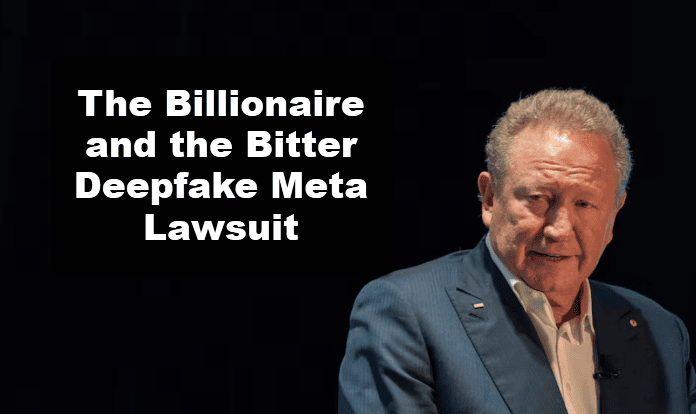
Australian mining billionaire Andrew “Twiggy” Forrest has poured more than $60 million, – and counting – of his own money into a high-octane federal lawsuit in California’s Northern District Court, accusing Meta of actively enabling and profiting from more than 230,000 deepfake scam ads that stole his likeness to fleece thousands of victims, many of them elderly Australians.

Coordinated by Forrest’s personal lawyer Simon Clarke (ex-Mallesons, Allen & Overy) and spearheaded in the US by powerhouse New York litigators Hecker Fink (partners John Quinn (pictured) and Joshua Matz), the action zeroes in on Meta’s ad-optimising algorithms, including AI-powered Advantage+, which the suit claims turn the platform from passive host into active co-author of the fraudulent content.
By tweaking copy, adding music, cropping images and super-targeting users, Meta allegedly crossed the line that Section 230 of the Communications Decency Act was meant to protect.
The case, before Biden-appointed Judge P. Casey Pitts, is back in court this week on explosive allegations that Meta destroyed vast swathes of evidence despite repeated preservation assurances, a potential shortcut to sanctions and liability.

Meta, defended by Paul Weiss’s Walt Brown, (pictured) maintains it is shielded by the 30-year-old immunity law.

As reported this week in the Australian Financial Review by Janek Drevikovsky, Forrest’s strategic litigation is deliberately narrow: it leaves Section 230 intact for user posts but rips the immunity away from the ad business that delivers 95 per cent of Meta’s revenue.
A win could trigger class actions from scam victims and force billions in compliance costs across social platforms, exactly the kind of precedent Big Tech has fought for years to avoid.
This is classic “strategic litigation”. Forrest has made clear damages are secondary; the goal is to force Meta (and the industry) to internalise the societal cost of scam ads.
The suit’s limited attack on Section 230 for ad tech makes it far more dangerous to the platform than broader challenges that have previously failed.
Watch for discovery rulings: forensic proof of how Meta’s algorithms “develop, optimise and deliver” the scam ads will be make-or-break. The case is also tracking alongside the ACCC’s parallel action in Australia’s Federal Court (next hearing late May).