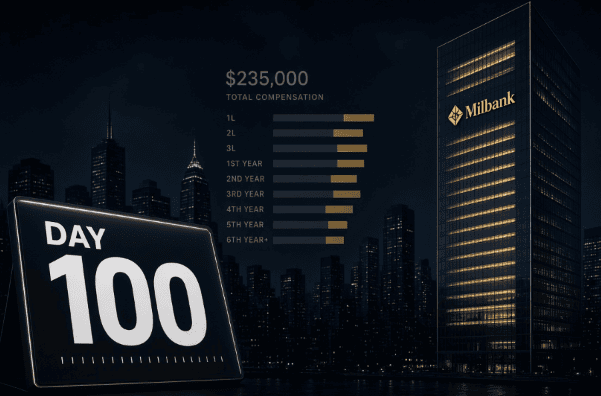
Milbank announced its new associate salary scale on Tuesday 2 June and today is Thursday 10 September. That is one hundred days, to the day, and the largest and most profitable law firms in the United States have still not said what they intend to pay their associates.
This is not how the associate pay ritual is supposed to run. The choreography of a BigLaw pay rise has been stable for a decade. A bellwether moves, the peer group matches within days because nobody wants to be the firm explaining to a fourth-year why the number on their payslip is smaller than their classmate’s, and the scale becomes the market.
Above the Law even keeps a scorecard for it. In 2022, Cadwalader matched Milbank within hours.
What happened this summer is more interesting than a raise because the firms that matched are, overwhelmingly, not the ones you would expect.
What Is The 2026 BigLaw Salary Scale?
Milbank raised base salaries by $10,000 for first through fourth-year associates and $20,000 for fifth through eighth-years, effective 1 July 2026. That reset the top of the market from $225,000 to $235,000 for a first-year, and from $435,000 to $455,000 for an eighth-year. Summer associates were included.
McDermott Will & Schulte matched the same day, publishing a full class-year grid running from $235,000 for the classes of 2026 and 2025 through $270,000 for the class of 2023, $385,000 for 2021 and $455,000 for the class of 2018. Milbank followed up on 27 July with a round of special bonuses, which nobody was in a rush to match either.
Then the ritual stopped with the ‘pay freeze’.
Which Firms Actually Matched Milbank?
By the middle of June, roughly fifteen firms had announced raises. David Lat counted five of them among the hundred highest-grossing firms in the country: Milbank, McDermott, Quinn Emanuel, Katten and Susman Godfrey.
The rest were litigation boutiques and midsize shops, several of them going over the top of the scale rather than merely meeting it.
Houston’s Ahmad, Zavitsanos & Mensing had already put first-years on $235,000 a year before Milbank made it the market, and matched the new grid anyway. Hueston Hennigan moved almost immediately.
By August, a consultant survey of the field found only a small group of matches and a large group of large firms waiting, either for Labor Day or for Cravath or Davis Polk to go first.
Labor Day has now been and gone. As at today, there is no public reporting of a Cravath or a Davis Polk move. What there is instead is a Los Angeles private equity and M&A boutique, Massumi + Consoli, putting its associates on the Milbank grid effective 1 September, which is roughly the point at which the silence upstairs stops looking like caution and starts looking like a position.
Can BigLaw Afford The Raise?
Yes. Comfortably, and this is the part that makes the standoff worth writing about rather than merely tracking.
Citi’s law firm group has BigLaw demand up 4.2% in the first half of 2026. The historical run rate for demand growth is somewhere between 1.5% and 2%, so this is roughly double a normal good year. Revenue across the surveyed firms rose 11.7% against the first half of 2025. Kirkland is a $10.6 billion business. Latham is an $8.3 billion one.
The counter-argument, which firm management will make, is on the expense line: costs rose 9.7% in the same period, with compensation up 8.9%, and Citi points to expanding income partner ranks, specialist lateral recruitment, real estate and technology. Firms spent 0.25% of revenue on AI by the end of 2025, up from 0.11% the year before.
Read that last figure again, because it is doing a lot of unearned work in the current conversation. A quarter of one percent of revenue. Whatever is making partners nervous about locking in a permanent increase to the associate cost base, it is not the money they are currently spending on artificial intelligence. It is what they suspect that spending is going to mean.
Why Are Big Law Firms Refusing To Match?
Three readings, none of them flattering, all of them defensible.
The first is that this is a bet on leverage. If a firm genuinely believes AI is about to compress the amount of junior work it needs done, then locking every associate into a higher lockstep number now is an expensive way to be wrong. Better to hold, watch, and pay individual people individually.
That is a rational position maybe but it is also one no managing partner will state out loud, because the sentence “we are not raising your pay because we may need fewer of you” does not survive contact with a recruitment brochure.
The second is that the anchor has come loose. Milbank has led six of the past decade’s raises. Cravath, the firm whose name is still attached to the scale, has not led one for some time and has spent 2026 losing partners, at least nine of them by mid-year. If the market is waiting for Cravath to sanctify a number, and Cravath is busy, the queue simply does not move. Everyone is standing behind a bellwether that has stopped ringing.
The third is the simplest. Not matching is now survivable. The old discipline held because defection was punished by the lateral market. If the firm across the street pays $20,000 more to fifth-years, your fifth-years leave.
That threat only works though if the alternative destinations are matching the pay rate, and this year the ones matching are largely boutiques with twenty associates, not platforms with two thousand. A Kirkland fifth-year can be aggrieved about the scale and still have nowhere obvious to take the grievance.
What Does This Mean For Associates?
Practically, three things.
Base is not total. Year-end bonuses land in November and December, and a firm that skipped the base raise can partially close the gap with a bonus scale nobody has announced yet. So judging a firm on 10 September is judging it at half-time.
Silence is information too and a firm that had intended to match the biglaw scale would generally have matched by now, because there is no strategic advantage in matching late. Late matching costs the same money and buys none of the goodwill. If your firm has said nothing for a hundred days, the most likely explanation is not administrative.
And the scale has stopped describing the market. The useful question for anyone weighing a move this autumn is no longer “does this firm pay Cravath scale”, because that phrase now covers firms paying $235,000 and firms paying $225,000 and calling it the same thing. The useful question is what the firm paid, when it paid it, and what it said when it did not.
The Thing Nobody Will Say
Biglaw has just had one of its strongest demand halves on record and has responded by not paying the market rate its own first mover set. That is a story about firms that have quietly stopped believing the associate pyramid they are being asked to fund at 2026 prices will look the same in 2029.
They may well be right. But it would certainly be more interesting if one of them said so. Associates deserve that much.