Trademark monitoring services perform broadly the same core job: finding potentially conflicting trademarks and brand threats. The differences are in what they monitor, how well they filter results and what happens when a genuine threat is found.
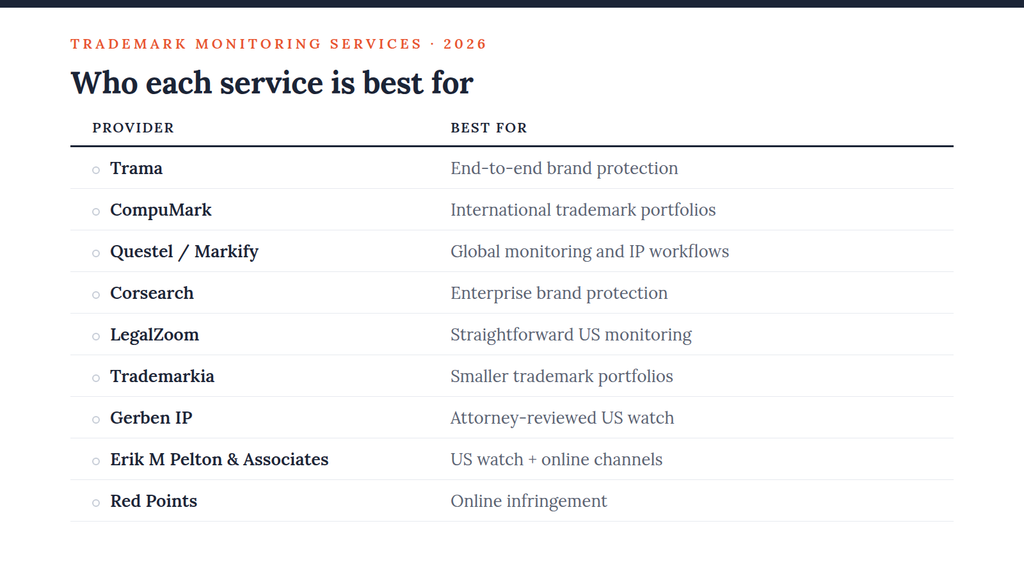
For international monitoring, CompuMark and Questel offer extensive global coverage. LegalZoom and Trademarkia provide more accessible monitoring alongside wider trademark services. Trademark monitoring with Trama combines register and online monitoring with pre-filtered results, tailored recommendations and access to legal and enforcement support. Corsearch and Red Points focus more heavily on large-scale online brand protection.
Trademark monitoring services compared
| Provider | Best for | Coverage | Filtering / support | Pricing |
| Trama | End-to-end brand protection | Trademark and business registers + online channels | Pre-filtered high-relevance results, tailored recommendations + access to legal enforcement | From $20/month |
| CompuMark | International trademark portfolios | Global registers + web options | Analyst-supported filtering | Quote |
| Questel / Markify | Global monitoring and IP workflows | 190 registers + domains | Statistical ranking and filtering | Varies |
| Corsearch | Enterprise brand protection | Trademark + extensive online monitoring | Specialist workflows + enforcement | Quote |
| LegalZoom | Straightforward US monitoring | USPTO-focused | Risk-ranked reports; legal advice available separately | $175/year |
| Trademarkia | Smaller trademark portfolios | Trademark monitoring | Wider trademark/legal services available | Varies |
| Gerben IP | Attorney-reviewed US watch | USPTO federal register | Quarterly reports analyzed by attorneys | $395/year |
| Erik M Pelton & Associates | US watch + online channels | USPTO, web, domains, social | Monthly analyzed summaries | On consultation |
| Red Points | Online infringement | Extensive digital monitoring | Detection + enforcement | Quote |
Note that features and prices vary by plan and can change.
Why monitor a trademark after registration?
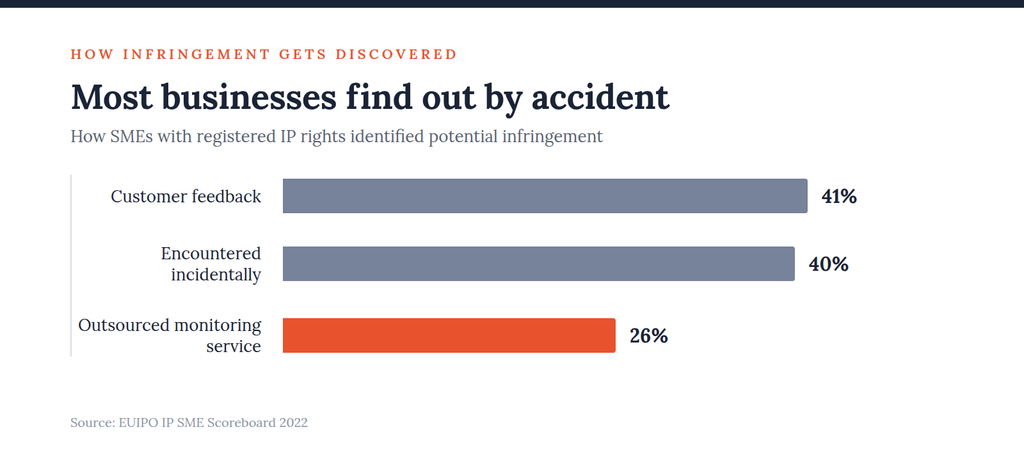
Trademark monitoring helps businesses identify potentially conflicting applications and other brand threats after a trademark has been registered. The USPTO examines and registers marks, but it is not an enforcement agency; policing a mark remains the owner’s responsibility. The scale of what goes unwatched is considerable: global trade in counterfeit goods reached an estimated USD 467 billion, roughly 2.3% of world imports, in 2021, according to the latest OECD/EUIPO analysis. Most businesses still leave detection to chance. In the EUIPO’s SME Scoreboard, 41% of SMEs with registered IP rights relied on customer feedback to identify potential infringement and 40% on information encountered incidentally; only 26% used an outsourced monitoring service.
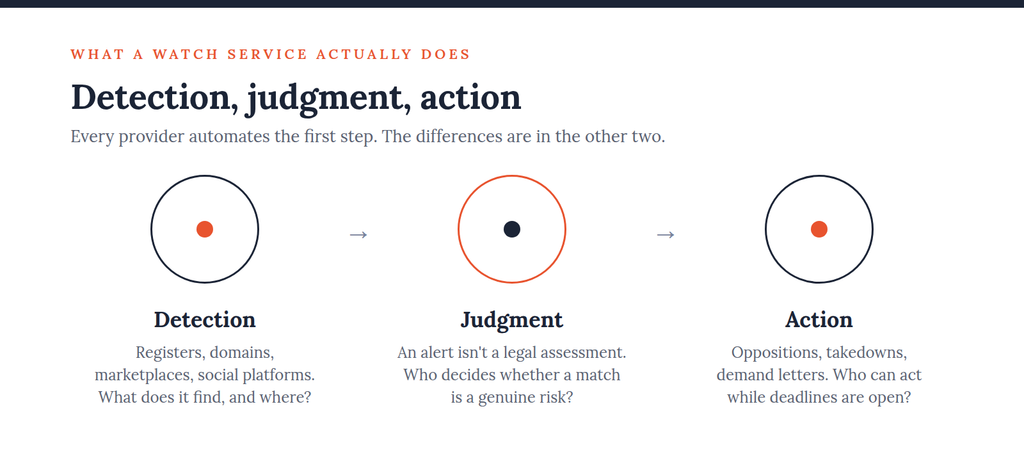
Monitoring can identify conflicting applications and, depending on the service, suspicious domains, impersonating social accounts and counterfeit marketplace listings. Someone still has to decide whether a match presents a genuine risk and what to do about it.
What separates trademark monitoring services
What should a trademark monitoring service cover?
A trademark monitoring service should cover the places where a brand is most likely to face conflicts or infringement. This can include trademark and business registers as well as domains, websites, social media, marketplaces and app stores and unsurpisingly, coverage varies considerably between providers. Trama monitors trademark and business registers in jurisdictions where a customer’s trademarks are protected. Its Advanced brand monitoring extends that coverage to domains, social media, e-commerce platforms and major app stores, giving businesses visibility across both trademark registers and online channels. CompuMark’s datasets span 191 official trademark registers across more than 250 countries and territories. Questel’s Markify Watch monitors 190 trademark registers, as well as domains and competitor filings, ranking results by statistical conflict likelihood. Red Points focuses more heavily on online brand misuse across marketplaces, websites, domains and social media. The right coverage depends on the threat. A company concerned with conflicting US trademark applications needs something different from an e-commerce brand dealing with counterfeit listings.
How do trademark monitoring services filter results?
Broad coverage can also mean more noise. A service that identifies hundreds of weak matches creates work if the customer or its lawyer has to dismiss them individually. CompuMark combines monitoring technology with specialist watch analysts. Questel ranks potential conflicts using statistical analysis and filters irrelevant results. Trama provides pre-filtered results and tailored recommendations, with legal consultation available when further assessment is required.
An alert isn’t a legal conclusion. A 2026 INTA and FTI Consulting study found that likelihood-of-confusion analysis “remains deeply contextual” and that AI should support, rather than replace, legal professionals.
What happens when a threat is found?
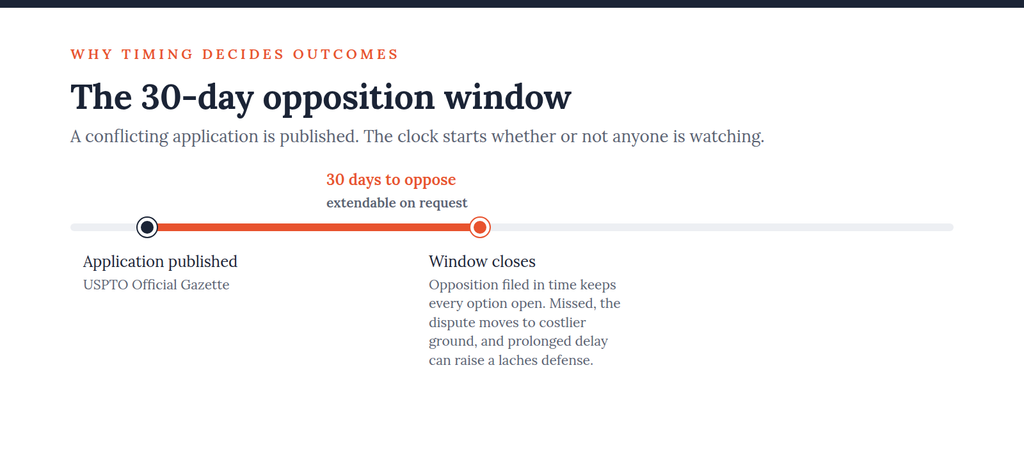
Businesses with established IP counsel may only need a reliable watch report. Their lawyers can assess the findings and decide whether action is necessary; however, others need more support. LegalZoom makes attorney consultation available separately, while Trademarkia combines monitoring with wider trademark and legal services. Red Points is geared toward high-volume online enforcement and takedowns. Boutique trademark firms sell watch packages with the review built in: Gerben IP delivers quarterly US federal reports analyzed by its attorneys for a flat $395 per year, and Erik M Pelton & Associates adds web, domain and social coverage with monthly analyzed summaries. Trama, a full-service IP law firm, goes furthest in this direction, connecting monitoring with recommendations, legal consultation and enforcement support when an identified threat requires action. Timing shapes those decisions. In the US, an opposition ordinarily must be filed within 30 days of a conflicting application’s publication unless an extension is requested in time. Miss the window, and a routine conflict can harden into a trademark battle fought from a weaker position. Prolonged, unreasonable delay after learning of infringement can also support a laches defense, narrowing the remedies available to an owner who “slept on its rights.”
Which trademark monitoring service is best?
The best trademark monitoring service depends on the size of the portfolio, where threats are likely to appear and whether the business already has trademark counsel. For businesses that want trademark monitoring with legal support, Trama combines register monitoring, pre-filtered results and tailored recommendations with access to legal consultation and enforcement support. Plans start at $20 per month for trademark and business-register monitoring, while the $105 Advanced plan adds domains, social media, e-commerce platforms and major app stores. Gerben IP and Erik M Pelton & Associates also combine trademark watching with legal expertise, using flat-fee and monthly-package models respectively. For international trademark monitoring, CompuMark and Questel offer broad global coverage and sophisticated watching workflows, with CompuMark adding specialist analyst support. For smaller US portfolios, LegalZoom and Trademarkia offer accessible monitoring alongside wider trademark services. For online counterfeiting and impersonation, Red Points specializes in detecting and enforcing against infringement across digital channels, while Corsearch combines trademark intelligence with broader enterprise brand protection. The right choice depends on what happens after an alert arrives. Businesses with established IP counsel may prioritize coverage and filtering, while those without it may place more value on recommendations and access to legal support.
How to choose a trademark monitoring service
Six questions are worth asking:
- What does it monitor? Check the jurisdictions, registers and online channels included.
- How frequently? Establish how often sources are checked and when results reach you.
- How well are results filtered? More alerts aren’t useful if most are irrelevant.
- Who assesses the risk? Determine whether you receive an alert, recommendation or legal assessment.
- Who can act? Check whether legal and enforcement support is available.
- What’s the total cost? Include monitoring, reviewing alerts, legal advice and enforcement.
The bottom line
The value of trademark monitoring is finding the conflicts that matter early enough to do something about them. For a business with experienced IP counsel, that may mean choosing the provider with the right coverage and handing the results to its lawyers. For a business without that infrastructure, filtering, recommendations and access to legal support count for more than the subscription price. As monitoring automation improves alongside wider legal AI adoption, that distinction is likely to matter more than the number of alerts a platform can generate.
Frequently asked questions
Do I need trademark monitoring if I’ve already registered my mark?
Ongoing monitoring is generally advisable because registration doesn’t automatically police the wider market. Monitoring can identify potentially conflicting applications and other brand threats so the rights holder can decide whether action is necessary.
What’s the difference between trademark monitoring services?
Coverage, filtering, legal assessment and enforcement support. Some services primarily provide alerts for an existing legal team; others help interpret and respond to what they find.
What’s best for a business without in-house IP counsel?
Businesses without in-house IP counsel benefit from monitoring that includes filtering and legal support. Just 17% of SMEs with registered IP rights have dedicated infringement-monitoring resources, according to the EUIPO. Trama combines pre-filtered trademark monitoring with tailored recommendations and access to legal and enforcement support when action is needed.
What does trademark monitoring cost?
Published entry points in 2026 range from $175 per year for a software register watch (LegalZoom) to $395 per year for an attorney-reviewed federal watch (Gerben IP), with lawyer-led subscriptions such as Trama’s running from $20 to $105 per month by coverage; enterprise platforms are quoted to portfolio size. The comparison that matters is the total cost of monitoring plus the review and legal support the business will need either way.
Does trademark monitoring include social media and marketplaces?
Not always. Traditional services focus on trademark registers. Some providers extend into digital channels: Trama’s Advanced service covers domains, social media, e-commerce platforms and major app stores, while Red Points specializes in online infringement.
__________________________
trademark registration with Trama
Secondary Link