
At least fifteen Am Law 100 firms are dangling sums of up to $50,000 at first-year law students who haven’t yet sat their first exams. The stated purpose is public service. The real purpose is something else entirely.
LawFuel Staff· – March 30, 2026 · Law Firm Recruiting
There’s a talent war going on in Biglaw, and it has reached a new frontier. Firms that once competed for second-year law students through carefully structured on-campus interview programs are now competing for first-year students, sometimes before those students have received a single grade, attended a single clinic, or even decided whether they like the law.
The latest weapon in this arms race is the public interest stipend: a payment of $25,000 to $50,000 offered to 1L students who agree to spend their first summer at a qualifying nonprofit, government agency, or judicial internship, in exchange for committing to the firm’s 2L summer associate program.
As one Biglaw talent professional told Law.com, with admirable candour, these payments are simply “a signing bonus wrapped up in public interest.”
It’s an extraordinarily frank description of what is, at its core, a financial lock-in mechanism. And the numbers are stark.
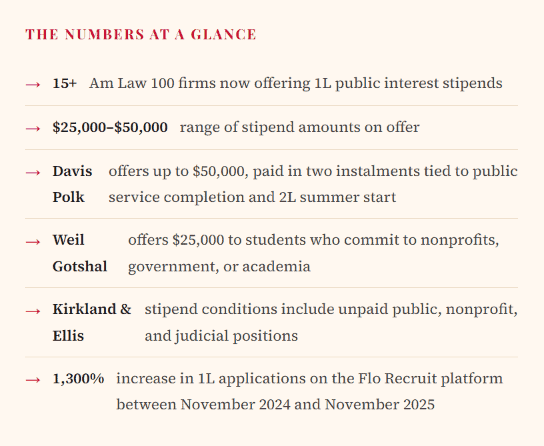
According to Law.com, at least fifteen Am Law 100 firms are now offering these stipends, ranging from $25,000 to $50,000.
Among the Am Law 25 firms leading the trend are Davis Polk & Wardwell, Kirkland & Ellis, Latham & Watkins, Sidley Austin, Simpson Thacher & Bartlett, Cooley, and Quinn Emanuel Urquhart & Sullivan.
Changes in BigLaw Recruiting
To understand why this is happening, you have to understand how dramatically Biglaw recruiting has changed since 2020. For decades, the on-campus interview process — OCI — was the stable, school-mediated pathway through which second-year law students obtained summer associate positions, which in turn served as the primary pipeline to full-time associate roles at top firms.
That system began unravelling during the pandemic, when in-person interviews collapsed and firms started communicating directly with students outside school channels.
Every year since, the timeline has crept earlier. What started as early OCI has now become something altogether different: firms interviewing first-semester 1L students, some of whom haven’t yet sat their first set of exams, all for positions that won’t start for eighteen months.
The data is startling. According to Reuters, applications submitted by 1Ls to firms through the Flo Recruit platform surged from 841 in November 2024 to 12,082 in November 2025, a jump of roughly 1,300 percent in a single year.
Simultaneously, the traditional OCI share of offers has collapsed: NALP data for 2024 showed that 56 percent of all offers resulted from direct applications or pre-recruiting outside school-sponsored programs, a historic shift.
NALP had once tried to keep a lid on early recruiting by maintaining guidelines preventing firms from approaching 1Ls until December 1 of the preceding year. But in 2018, following antitrust litigation, NALP scrapped both that engagement ban and the mandatory 28-day decision window and the dam broke. The pandemic did the rest.
“What has happened is that a few firms started offering jumbo packages and making offers super early, and now all of them believe they must follow suit.”— Rebecca Glatzer, Major, Lindsey & Africa
Public Interest as Cover Story?
The stipend structure is, by design, elegant. A firm cannot legally direct a 1L to work at a competitor or require them to spend the summer at the firm itself – that would simply be an early hire, and one fraught with complications.
But by paying a student to do public interest work, the firm effectively occupies that first summer without staffing a junior associate the student is off the market, financially bound, and arriving at the 2L summer program pre-committed.
For Davis Polk, that figure has now reached $50,000, paid in two instalments, with the option to elect either a split payment ($25,000 at the end of summer 2026 and $25,000 at the start of summer 2027) or both tranches at once on arrival.
The firm’s website notes, with some delicacy, that it “takes no position on whether accepting payment from the firm, or the timing of such payment, complies with any other employer’s requirements.” From that careful wording we can take it as saying ‘if you’re accepting money from another firm too, that’s between you and them.’
Not all firms tie the stipend to public interest work. Cooley, for example, permits students to satisfy the requirement through academia, government agencies, and certain in-house positions. This flexibility is arguably more honest about what these stipends actually are as they reflect compensation for early loyalty, not a commitment to some pro bono ideology.
The Collateral Damage Nobody’s Talking About
The public interest sector including organizations like legal aid organisations, civil rights groups, government offices, nonprofit law shops, already operates with a fraction of the funding of private practice. The internship positions at these organisations are scarce, competitive, and often the only pathway for students who genuinely intend to build careers in public service.
When fifteen or more Am Law firms funnel high-achieving 1Ls into those same internship pipelines, the competition for those positions intensifies.
As Above the Law observed, the incentive structure pushes Biglaw-bound students to prestige-maximise every line of their resume, meaning they’ll compete for the most prominent public service placements even if they have no intention of staying in that sector.
The student who genuinely wants to work in immigration law or housing rights is now competing for coveted ACLU or DOJ internships against someone who’ll be walking through Kirkland’s doors the following year.
“Probably the most unfortunate part of this process is that we have to make decisions that shape our early careers based on little information about ourselves and our interests.”— A Yale 1L student, quoted in Bloomberg Law
What It Costs Law Students
The financial incentive is not the whole story of what’s being asked of law students. Buried beneath the dollar figures is an extraordinary pressure being placed on people who, in many cases, have been in law school for weeks.

As Professor Jamie Abrams observed in analysis cited widely across legal education circles, this “manufactured arms race harms legal education pedagogy, creates a logistics nightmare for students and educators, and imposes psychological harms on students.”
Career services directors at institutions including the University of Chicago and Yale have been among the most vocal critics. “We should be letting first-year law students get their feet under them — by learning how to read cases, take cold calls, and study for exams,” said Lois Casaleggi, associate dean for career services at the University of Chicago Law School.
There are some significant equity concerns. First-generation students and those without pre-law networking backgrounds are disproportionately disadvantaged by accelerated hiring – for instance, they have fewer informal connections, less guidance on navigating early recruiting, and less capacity to compete when the race begins before the starting gun has fired.
Students who might show dramatic academic improvement across their 1L year, often a more reliable signal of long-term potential, are effectively locked out of consideration because offers are made before that trajectory can become visible.
One Biglaw talent professional, speaking anonymously to Law.com, admitted what recruiting teams already know: “I’ve talked to a few friends whose firms wanted to hold out, but they felt like they had to give in because they weren’t getting the candidates they wanted and they were afraid of losing out to other firms.”
A Notable Counter-Move
Not every firm has capitulated entirely to the arms-race logic. Cooley made headlines in early 2026 when its chief talent officer, Carrie Wagner, announced the firm was deliberately hiring only around half of its 2028 associate class during the 1L cycle, intentionally leaving seats open to fill later — after students have grades, practice-area exposure, and a clearer sense of what they want.
“It’s going to broaden the students that we’re able to see over time, rather than rushing to hire our entire entry-level class now with 1Ls who don’t necessarily know what they want to do,” Wagner told Bloomberg.
It’s a position that, in the current market, requires some institutional nerve — and it may be the most honest public acknowledgement yet that the existing system is producing poor fit decisions on both sides of the hiring table.
The AI Wildcard
Hovering over all of this is a question that the talent wars tend to suppress but cannot eliminate is what, exactly, are firms hiring for?
According to the 2026 Citi Hildebrandt Client Advisory, 63 percent of large firms now expect AI to affect their lawyer leverage models within the next decade, which is up from 43 percent the previous year.
As Harvard Law’s David Wilkins put it: “Some 1L students are interviewing right now, during law school exams, not just for 1L summer jobs but 2L summer jobs. But in two years, ChatGPT may be doing many of these entry-level jobs — and more.”
It creates a disquieting picture as firms spending tens of thousands of dollars per student to lock in associate pipelines against a backdrop of genuine uncertainty about how many entry-level lawyers they will actually need.
The talent war is being fought at maximum intensity precisely when the rationale for the intensity is most in question.
Our Assessment
It would be easy and a little lazy to dismiss these stipends as purely cynical. The truth is more complicated. For students who already plan to do public interest work in their 1L summer, a $25,000 to $50,000 payment from a firm that wants their 2L commitment is not nothing.
It offsets some of the financial burden of law school debt, it supports organisations that desperately need capable help, and it provides students with resume breadth that genuinely serves them. The firms that offer it are not doing anything illegal, and they’re not forcing anyone’s hand.
But the broader picture of accelerated Biglaw recruiting, of which the public interest stipend is only the latest feature, is doing real harm. It is compressing the timeline for major career decisions to a point at which meaningful self-knowledge is impossible.
It is disadvantaging students from less privileged backgrounds as well as distorting the public interest sector by flooding it, temporarily and strategically, with students whose long-term trajectories point firmly toward corporate practice.
The talent professionals who are engineering these programs know this. The law school administrators who are fielding the distress calls know this. The 1L students who are being asked to decide where to spend their careers before they’ve sat a single exam know this.
What nobody yet knows is who, if anyone, has the standing — or the nerve — to stop it.


