The Russell Brand and David Walliams fallout has put a key question to Britain’s media lawyers. When does protecting a client’s reputation become paying to keep someone quiet? And why does the law built to stop it miss both cases entirely?
Wealthy people have always hired lawyers to protect their reputations. We have first hand experience of that with the attempts by now deceased Russian oligarch Sergey Grishin to silence us here in New Zealand by hiring a large law firm, Simpson Grierson, to take action over articles alleging abuse and harassment by Grishin against his former wife and friend, who authored the offending content.
The issue demonstrated by the Walliams case is far such protection can reach, and how little stands in its way when the person on the other side has no lawyer, no money and no chance of a trial.
In the space of a week, Russell Brand was convicted of rape and David Walliams lost a fight to keep sexual misconduct allegations out of print. As the Law Society Gazette has noted, the fallout raises fresh questions about legal tools used against people who want to talk.
Gagged for life, invoiced £50,000
On 5 November a Southwark Crown Court jury convicted Brand of one rape and three sexual assaults involving four women. He was acquitted on three other counts and has since been sentenced to ten and a half years.
Within days, attention swung to an older case. In 2014 Szilvia Berki, a masseuse, accused Brand of assaulting her at Jemima Goldsmith’s home. Police took no further action. Berki took her claims to the press, Twitter and a Change.org petition. Brand and Goldsmith, then partners, sued her for harassment.
Berki had no lawyer. She never got a trial either. An interim injunction followed in 2014, and in October 2015 the High Court made it permanent on summary judgment, weeks before a scheduled trial.

The final order, published this month by former Clifford Chance tax partner turned campaigner Dan Neidle, (above) goes well beyond stopping harassment.
As published, it bars Berki from discussing the events with anyone: journalists, friends, family, even the police. She was told to pay £50,000 on account of costs within two weeks, with permission granted to bankrupt her if she did not. Neidle reckons the full bill ran past £100,000.
The courts found her campaign oppressive, and harassment law exists for good reason. But a lifetime ban on telling your own mother what you say happened to you is not obviously a harassment remedy.
Goldsmith has defended the order, saying Berki’s messages frightened her family and that the injunction was upheld by the High Court and Court of Appeal. Then she added two things few expected when she accused Brand of violence and coercive control during their relationship. And she said she supports changing the order’s terms.
Walliams: the court said no
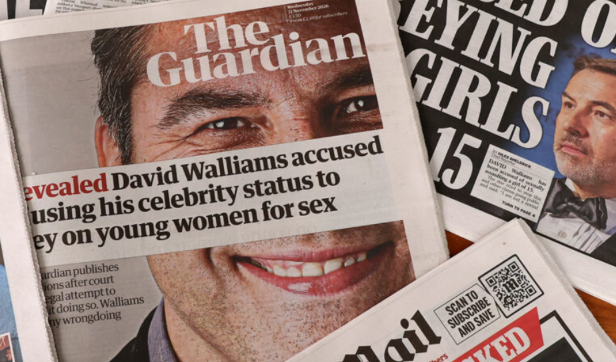
The Walliams case shows the system working, if only just.
Anonymised as “PPT”, Walliams sought a permanent injunction against ITN and Guardian News and Media with his lawyers arguing that publication posed a grave risk to his life after two suicide attempts that followed the journalists’ first approach in May.
On 3 November Mr Justice Nicklin refused and accepted the risk was genuine and grave, but held that an injunction would be an exceptionally serious interference with free expression. He did not decide whether the allegations were true. Walliams did not appeal in time, and the Guardian and ITV News named him on 10 November.
As yet he faces no criminal charges at all as at the time of writing.
The published allegations include claims involving teenage fans, all of which Walliams denies.

According to the investigation, a woman received correspondence from Schillings’ lawyer Jenny Afia (pictured) (who famously defended Johnny Depp in his ‘wife beating’ trial) demanding a written undertaking, within 24 hours, not to discuss her experience. Schillings said it understood she intended to sell an account its client believed was untrue.
That may be a perfectly proper letter but any such letter coming from a top-tier media firm, concerning a celebrity client and carrying with it a 24-hour deadline, provides a somewhat chilly reception, replete with consequence and concern. It received some intense criticism from organisations like the G
The SLAPP law that couldn’t
This is where lawyers usually reaches for the word SLAPP, or strategic lawsuit against public participation, but the law built to stop SLAPPs would not touch either case.
Britain’s only statutory anti-SLAPP regime, in sections 194 and 195 of the Economic Crime and Corporate Transparency Act 2023, came into force on 18 June 2025. It covers economic crime and so sexual misconduct allegations and harassment claims fall outside it.
A broader private member’s bill is due for a Commons second reading on 27 November while other jurisdictions continue to flert with the SLAPPs, as we have discussed in the New Zealand law with out own experience.
The UK Solicitors Regulation Authority issued a SLAPPs warning notice in November 2022 and toughened it in May 2024. It warns against aggressive pre-action letters, unrealistic deadlines and correspondence designed to intimidate unrepresented recipients. Its principles invoke the public interest where where duties conflict.
In practice the SRA has brought three SLAPP-related prosecutions before the Solicitors Disciplinary Tribunal and lost all three. In July it abandoned its appeal in the Carter-Ruck partner case and agreed to pay £85,794 in costs.
The question the profession can’t bill its way out of
None of this proves misconduct by any lawyer involved. Brand and Goldsmith won their case in open court and Schillings has explained why it wrote its letter. The Walliams injunction failed.
But the fact is that a lawful letter can still be a weapon when one side has a media firm on retainer and the other has a deadline and a mortgage. A lawful injunction can still outlive its purpose by a decade.
The duty to a client is real. So is the duty to the court and the rule of law, which the SRA says comes first. The hard cases are the ones that never reach a courtroom, because one side could not afford to turn up.
That is the lawfare of silence. And it is something that rarely makes the law reports. It just makes people stop talking.
Sources: Law Society Gazette, Tax Policy Associates, SRA warning notice, Law Society Gazette on the Carter-Ruck appeal.
Read More –