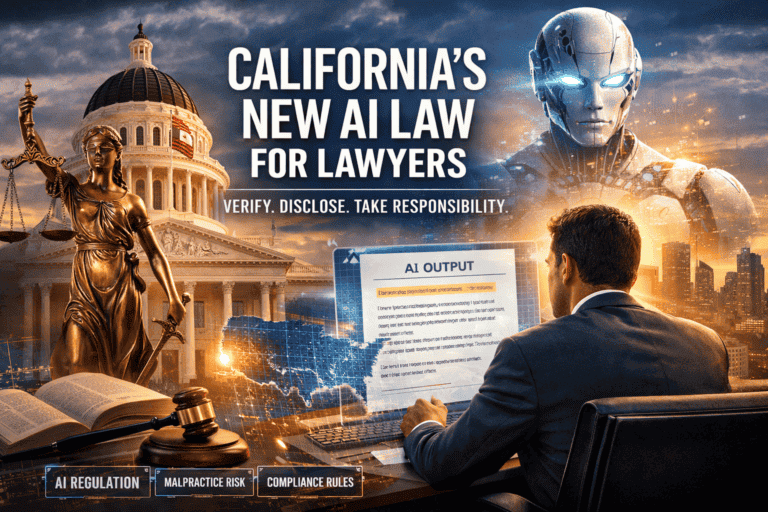
California Draws a Line on Legal AI And Lawyers Need to Pay Attention

California's legal AI law - LawFuel

California Senate Passes First-Ever AI Rules for Lawyers

For years, lawyers have been quietly experimenting with generative AI while publicly pretending it was all very theoretical. That luxury just expired however has expired as the California passes a first-of-its kind bill that will doubtless be replicated in other jurisdictions.

The California Senate has passed SB 574 aimed squarely at how lawyers use artificial intelligence in legal practice. If it becomes law, California will be the first major jurisdiction to formally regulate AI use by lawyers, not with vague principles, but with obligations that cut straight to competence, ethics, and liability.

In short: lawyers can use AI, but they own the consequences. And that’s something many will find daunting given the hallucinations and legal repercussions of legal AI’s misuse.

This matters far beyond California. What happens there has a habit of becoming tomorrow’s “best practice” everywhere else.

What SB 574 Actually Does (In Plain English)

SB 574 doesn’t ban AI. It does something far more unsettling for the profession – it removes plausible deniability. Lawyers no longer have the ability to hide behind the various machinations of legal AI hallucinogenic output.

Under the bill, lawyers would be required to do a number of things, including:

  • Verify the accuracy of AI-generated outputs before relying on them
  • Understand and disclose AI limitations when relevant to client representation
  • Avoid discriminatory or biased outputs, particularly where AI tools influence legal analysis or advice

In other words, “the software made me do it” is no longer a defence. If an AI tool hallucinates a case, embeds bias, or produces sloppy analysis, the lawyer wearing the name on the engagement letter carries the risk.

The full bill text is available via the California Legislature here:
👉 https://leginfo.legislature.ca.gov/

Why This Is a Big Deal for Law Firms

This is not just an ethics tweak. It’s a structural change in how legal risk is assessed.

1. Malpractice Risk Just Changed Shape

Insurers are already asking how firms supervise AI tools. SB 574 effectively answers that question for them. Expect underwriting questions to become sharper, premiums less forgiving, and “we have an AI policy somewhere” to stop being sufficient.

2. Internal AI Policies Are Now a Compliance Issue

Many firms rushed out AI guidelines in 2023–2024. Some were thoughtful. Others were thin, generic, or quietly ignored.

This bill turns some of the internal policies of law firms ‘playing around’ with legal AI into firm evidence. The repercussions can be severe under the law and if something goes wrong, the regulators and the insurers will want to know some key questions, such as –

  • What tools were approved?
  • What training was provided?
  • Who verified the output?
  • And whether the firm knew the risks and used the tools anyway.

3. Competitive Positioning Gets Real

Firms that can demonstrate disciplined, transparent AI use in their practices will gain a credibility edge. Firms that cannot will still use AI, but with more legal exposure and less confidence.

That is a gap that is set to widen.

How This Fits Into the Global AI Regulation Trend

California is not acting in isolation as Law technology and its AI derivatives continue to transform the profession. Regulators everywhere are circling the same problem: powerful tools, opaque outputs, and professionals who are still responsible for outcomes.

  • The American Bar Association has repeatedly warned that AI does not dilute a lawyer’s duty of competence or supervision
  • Courts have already sanctioned lawyers for AI-generated filings containing fabricated cases, a trend widely reported by outlets such as Reuters

SB 574 simply formalises what courts have been signalling for months.

A Practical Compliance Checklist for Law Firms Using AI

The legal AI issue is one that is only going to grow in importance for lawyers as AI tools continue to envelope the profession. For lawyers trying to decide what “good” looks like now, here’s the short, uncomfortable list, none of which is necessarily startling or revolutionary, but they do require some time and attention (two things lawyers can find difficult to obtain). Here’s our list:

  • Document which AI tools are approved and why
  • Train lawyers on limitations, bias risks, and verification standards
  • Require human review of all AI-assisted legal work
  • Update client engagement terms where AI tools are used
  • Treat AI outputs like junior associate work, not oracle-grade insight

The Bigger Picture

SB 574 doesn’t kill legal AI but legitimises it by dragging it into the same ethical framework lawyers already live under.

California has simply said the quiet part out loud: technology does not excuse professional judgment. It amplifies it or exposes its absence when the judgment has not been exercised.

Other jurisdictions will watch closely. Some will copy. Others will tweak. But we don’t think many will ignore it.

Scroll to Top