Legal AI Just Went All Hollywood
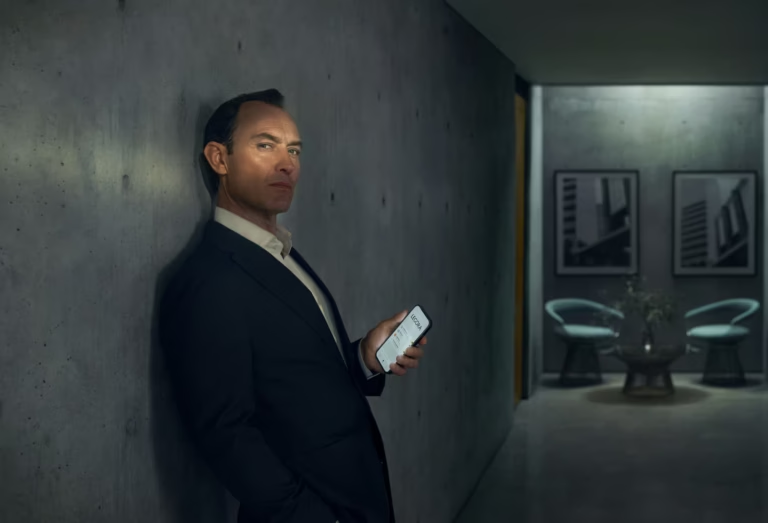
The legal technology sector has seen plenty of bold claims. But very few startups have had the audacity — or the funding — to enlist a People magazine Sexiest Man Alive to sell AI software to managing partners.
Swedish legal AI company Legora is doing exactly that.
“We felt that there was this cultural tension in people’s aspirations of what it would be like to be a lawyer and what the day-to-day had actually become, which was very admin-laden,” Stuart Shingler, Legora’s VP of Marketing, told Marketing Brew. The solution: commission Swedish agency NoA Åkestam Holst to produce something the legal world would actually talk about.
Mission accomplished.
The money behind the message
The campaign is not a bootstrapped gamble. Legora raised $550 million at a $5.55 billion valuation in a Series D round led by Accel, with participation from Benchmark, Bessemer Venture Partners, General Catalyst, ICONIQ, Redpoint Ventures, Y Combinator, and an array of new investors including Bain Capital and Salesforce Ventures.
That round, announced in March,was just the opening act. A $50 million Series D extension followed in late April, backed by Nvidia’s venture arm NVentures and Atlassian, pushing the total raise to $600 million and the valuation to $5.6 billion.
Legora has scaled from 40 to 400 employees in roughly 24 months, expanded from 200 to over 1,000 client organisations across 50 markets, and surpassed $100 million in annual recurring revenue. Clients include Barclays, White & Case, Linklaters, and Cleary Gottlieb — names that signal enterprise-grade credibility rather than startup experimentation.
For lawyers wondering what that translates to on the ground: firms using Legora report an average of 4.3 non-billable hours saved per lawyer per week, and 42 per cent say they have won new work as a direct result of using the platform. Tech.eu
The Harvey problem — and the marketing solution
Legora does not exist in a vacuum. Its primary rival, Harvey, backed by Andreessen Horowitz and valued at $11 billion after a $200 million raise in March, is simultaneously pushing into Europe while Legora makes its move on the US. Harvey recently signed actor Gabriel Macht, who plays a high-powered lawyer in Suits, as a brand ambassador — and Legora’s Jude Law campaign launched in direct response. The legal AI arms race has, somewhat improbably, gone Hollywood. TechCrunch
Both companies are built on top of large language models with Legora primarily on Anthropic’s Claude and both face the same existential threat: that the foundation model makers themselves will eventually move into legal workflows.

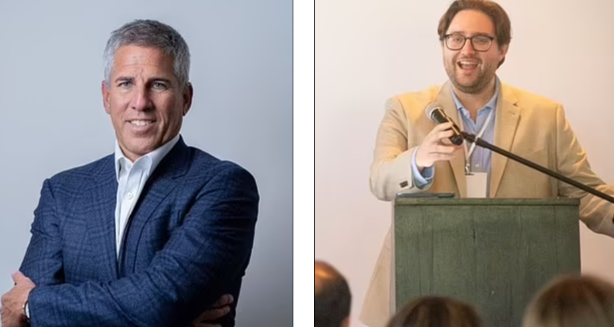
When Anthropic launched a legal plug-in for Claude, publicly listed legal software companies saw their share prices dip. Legora’s CEO Max Junestrand (above) is unperturbed. “Foundation models are improving quickly, but the real value is in how they’re applied,” he has said, positioning Legora not as an AI wrapper but as a full agentic operating system for legal work.
That distinction matters for law firms evaluating vendors and that matters for the marketing strategy underpinning the Jude Law campaign.
Why celebrity marketing works — and why it’s unusual here
Celebrity endorsements are the default playbook for luxury goods, financial services, and consumer brands. Enterprise software is a different beast. B2B buyers, the conventional wisdom goes, respond to case studies, pricing tables, and procurement processes — not Oscar-nominated actors with staplers.
Legora is betting the conventional wisdom is wrong, or at least outdated, when the enterprise buyer is a lawyer.
Shingler noted that Legora’s promotion spans LinkedIn, where its B2B sales audience is concentrated, through to TikTok and Instagram, exploiting the broader cultural cut-through of the Law campaign.
The company has also invested heavily in out-of-home advertising targeted at legal professionals: billboard space near Augusta National during the Masters, transit wrap advertising on routes frequented by delegates at New York’s Legalweek conference in March, and sustained OOH presence in what Shingler calls “the epicenter of the legal world” – New York and London.
The underlying logic: lawyers, like all professionals, are human beings with cultural lives and golf handicaps. Reaching them where they live — not just where they work — is a competitive differentiator in a market where every other AI company’s billboard looks, as Shingler put it, more or less the same.
The sports play
The Jude Law partnership is the flagship, but Legora’s sports sponsorship strategy is quietly just as ambitious. In March, the company partnered with Swedish PGA Tour golfer Ludvig Åberg and his caddie Joe Skovron on a campaign built around the analogy: “We are to lawyers what caddies are to golfers.” The black-and-white creative is understated and considered — a deliberate contrast to the Law campaign’s wink-and-nudge humour.
Then in April, Legora partnered with seven-time MLB All-Star Aaron Judge and the New York Yankees on a campaign centred on the idea of “the long game.” It is a shrewd piece of brand geography: the Yankees are synonymous with New York dominance, and New York is synonymous with BigLaw. The message to partners and general counsel is implicit but clear – Legora is playing for keeps.
Golf and baseball are, of course, not accidental choices. Lawyers have historically had a well-documented affinity for the fairway, and the Masters activation near Augusta National was a calculated attempt to reach senior practitioners in an environment where they are receptive rather than defensive.
What this means for lawyers — and the firms that employ them
For practitioners evaluating AI tools, Legora’s marketing blitz is both a signal and a distraction. The signal: this is a company with sufficient capital and confidence to play a long game in a market that is genuinely transforming legal practice. AI legal tech raised $3.7 billion globally in 2025, with 2026 on track to match or exceed that figure. The platforms that achieve brand dominance now — in the minds of associates, partners, and GCs alike — are likely to be harder to displace later. CNBC
The distraction risk: that a campaign this polished might cause firms to over-weight brand recognisability and under-weight the due diligence that any AI procurement decision demands.
Questions around data security, confidentiality obligations, accuracy of AI-generated legal research, and liability for AI-assisted errors remain live issues that no amount of billboard spend resolves. The Solicitors Regulation Authority and equivalent bodies in other jurisdictions have been clear that responsibility for AI-generated work product remains with the supervising lawyer.
Legora appears to understand this. The platform’s positioning — as an enterprise-grade, matter-centric, collaborative system rather than a consumer chatbot — is deliberately calibrated to meet those objections before they are raised.
The $600 million, Jude Law, Aaron Judge, and the Legalweek transit ads are the attention-grabbing exterior. The actual product pitch to law firms is more straightforward: fewer admin hours, more billable time, and a competitive edge over the firms that are still waiting to see how this all plays out.
As Legora’s own marketing might put it: the long game.