Sonia Hickey, LawFuel contributing writing
The Perkins Coie exodus in Seattle signals a permanent shift in the lateral hiring labor market that is changing the way top law firms operate. Lateral hiring is no longer just a tactic but an entire business model.
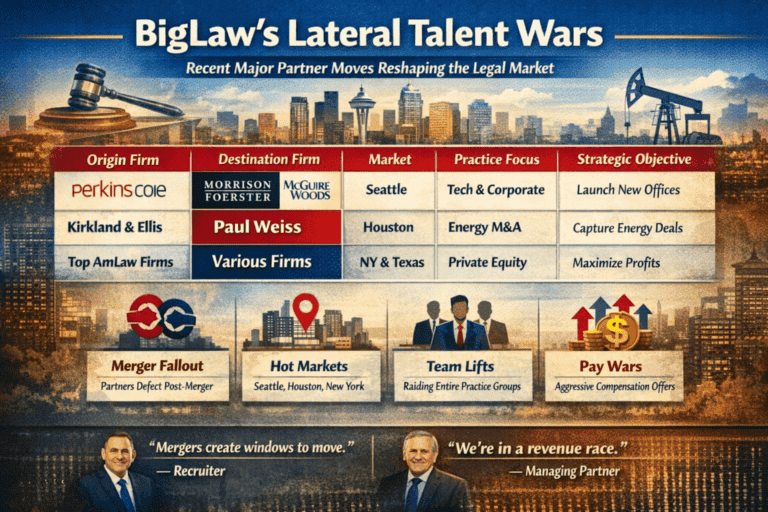
When Perkins Coie lost lawyers to the announcement new offices for Morrison Foerster and McGuireWoods. It was in fact a signal of something structural.
The departures came as Perkins Coie prepares for its merger with Ashurst, a combination that will create a global platform of roughly 3,000 lawyers. The timing reveals a pattern that now defines elite legal practice: mergers create opportunity, but they also create instability. And instability is oxygen for competitors.
What we are witnessing is not a phase. It is the emergence of lateral acquisition as BigLaw’s dominant growth strategy.
The New Economics: Why Firms Are Buying Revenue
Over the past eighteen months, a clear pattern has emerged across major law firms. Top-tier practices have aggressively expanded into energy, technology, and private capital hubs.
Revenue per lawyer continues to concentrate at the highest-performing firms. And compensation structures have become increasingly flexible, designed specifically to attract partners with portable books of business.
The recent move by Paul Weiss to recruit elite energy dealmakers from Kirkland & Ellis for a Houston expansion illustrates the strategy. This was not incremental hiring. It was strategic sector capture; a deliberate acquisition of market position through talent.
“Firms are no longer patient about organic growth. They are acquiring teams that arrive with clients attached.”
The mathematics are straightforward. Rainmakers move revenue faster than junior classes mature. Building a practice from associate development takes a decade. Acquiring a partner with an established book takes months. For firms competing on annual profit metrics, the choice is obvious.
Why Mergers Trigger Departures
When firms announce global combinations, three dynamics emerge almost immediately. Compensation models face review and potential restructuring. Leadership hierarchies shift as integration plans develop. And cultural alignment—always uncertain during transitions—becomes a source of anxiety for partners whose practices could fit elsewhere.
Key Pattern
Recruiters consistently report that merger announcements generate inbound calls from partners within days. The window between announcement and integration completion represents peak vulnerability for the merging firms—and peak opportunity for competitors.
As one senior US recruiter recently observed, mergers create “windows of mobility” where competitors can pitch stability and autonomy before new structures solidify. That is precisely the dynamic playing out around Perkins Coie and other firms navigating major combinations.
Where the Expansion Is Happening
The lateral acquisition strategy is not uniform across practice areas. Elite US firms have concentrated their expansion in specific sectors where portable revenue is highest and client relationships are most transferable.
Major Law Firm Mergers and Combinations (2024–2026)
| Firms | Announced | Completion | Revenue (Est.) | Lawyers | Geographic Focus | Core Practice Strengths | Strategic Rationale |
|---|---|---|---|---|---|---|---|
| Hogan Lovells + Cadwalader, Wickersham & Taft | Dec 18, 2025 | Mid-2026 (partner vote pending) | $3.6bn | 3,100 | Transatlantic (NY–London; global) | Business & finance, capital markets | Create the world’s fifth-largest law firm by revenue by marrying global reach with Cadwalader’s Wall Street pedigree |
| Ashurst + Perkins Coie | Nov 17, 2025 | Q3 2026 | $2.7bn | 3,000 | Global (US, UK, Europe, APAC) | Technology, energy, infrastructure, financial services | Combination of equals to build a top-20 global firm with sector depth and long-term growth focus |
| McDermott Will & Emery + Schulte Roth & Zabel | May 2025 | Aug 1, 2025 | $2.8–3bn | 1,750+ | US-focused with global offices | Private capital, hedge funds, healthcare, tax, litigation | Strengthen New York presence and private funds dominance through a transformational deal |
| Herbert Smith Freehills + Kramer Levin | Nov 11, 2024 | Jun 1, 2025 | $2bn+ | 2,700 | Transatlantic (US, Europe, APAC) | Energy, finance, technology, regulatory | Build an integrated global powerhouse with expanded US regulatory and tech capability |
| Winston & Strawn + Taylor Wessing | Dec 15, 2025 | May 2026 | $1.63–1.75bn | 1,400+ | Transatlantic (US, UK, Europe) | Litigation, IP, transactions, private wealth | Accelerate Winston’s UK ambitions and Taylor Wessing’s US expansion |
| Taft Stettinius & Hollister + Morris Manning & Martin | Aug 11, 2025 | Dec 31, 2025 | $1bn+ | 1,250 | US (Midwest, Southeast, Mid-Atlantic) |
- Energy and infrastructure — Houston and other energy hubs have become primary battlegrounds, with firms competing for partners who control relationships with major producers and infrastructure developers.
- Private equity and fund formation — The continued growth of private capital has made PE-focused partners among the most valuable lateral targets in the market.
- Technology transactions — Seattle, the Bay Area, and emerging tech corridors remain competitive, particularly for partners with relationships to growth-stage companies and venture investors.
- Regulatory and investigations — Former government officials and partners with established regulatory practices command significant premiums, particularly in Washington, D.C.
Meanwhile, industry data shows that top-tier firms are actively protecting profit-per-equity-partner figures by prioritising portable revenue over long-term associate development. This is not a criticism. It is a reflection of how partnership economics now function.
Strategic Implications by Stakeholder
The shift to lateral-driven growth carries different implications depending on where you sit in the legal ecosystem.
Retention is now competitive defence. Waiting for annual reviews to address dissatisfaction is too late. Firms that do not actively manage partner alignment during mergers will lose market share before integration is complete.
Proactive compensation discussions, clear communication about post-merger roles, and genuine attention to partner concerns are no longer optional but are key to survival.
So what can be said for lawyers in the different legal sectors?
The Recruiter’s Moment
For legal recruiters, this is a cycle of unusual influence. The combination of factors like mergers, compensation flexibility, and sector expansion align see a key role for the legal recruiters.
The recruiters driving the most significant market shifts are those who can broker team moves rather than individual placements, assembling groups that represent immediate practice-building capability for acquiring firms.
The 2026 Outlook
Expect continued discreet team lifts and sector-led raids through 2026. The firms winning lateral battles are investing in recruiter relationships and moving quickly when opportunities emerge. Speed and confidentiality matter more than ever.
The Structural Shift
The legal market has undergone a fundamental transition. We have moved from cyclical lateral hiring—driven by economic booms and busts—to continuous strategic lateral acquisition driven by competition for sector dominance.
The firms winning this competition are not necessarily the oldest or the largest. They are the ones willing to pay for immediate revenue, move decisively on talent opportunities, and accept that organic growth alone cannot sustain competitive position.
LawFuel Perspective
The Perkins Coie departures are not a headline anomaly but they are a signal of how BigLaw now operates. It is a key part of what Reuters have described as the ‘tectonic shift’ in the legal market.
“Law firms are facing a fundamental shift in the legal industry’s economic landscape, standing at a critical inflection point where they must navigate evolving client demands, rising expenses and a necessary transformation of their operating models,” Raghu Ramanathan, president, Legal Professionals, Thomson Reuters.
Elite law firms are behaving more like private equity than traditional partnerships. The talent market has become an M&A market, with partners as key assets.
For lawyers, this creates opportunity and volatility in equal measure. Portability provides leverage, but it also means that firm loyalty offers less protection than it once did. Career management now requires market awareness that previous generations of partners could safely ignore.
For firms, the dynamic poses a simple question—one that managing partners should be asking themselves every quarter: Are you growing deliberately, or being harvested?
Frequently Asked Questions
Why are law firms focusing on lateral hiring instead of organic growth?
Lateral hiring delivers immediate revenue through partners who bring established client relationships. Building a practice through associate development takes years; acquiring a partner with a portable book takes months. For firms competing on annual profit metrics, lateral acquisition provides faster returns.
How do law firm mergers create lateral hiring opportunities?
Mergers create uncertainty around compensation, leadership roles, and cultural fit. This uncertainty prompts partners to consider alternatives. Competitors can pitch stability and autonomy during the transition period, before new structures solidify.
Which practice areas are most active in the lateral market?
Energy and infrastructure, private equity and fund formation, technology transactions, and regulatory and investigations work are currently the most competitive areas for lateral hiring. These sectors feature portable client relationships and strong demand.
What does the lateral hiring trend mean for law firm partners?
Partners with portable books of business have significant leverage in the current market. Understanding your market value provides negotiating power whether you move or stay. However, the same dynamics that create opportunity also mean firm loyalty offers less career protection than it once did.
How can mid-tier law firms benefit from BigLaw lateral activity?
When major firms reshuffle, opportunities emerge for regional and mid-market firms to recruit dislocated talent. Mid-tier firms can offer cultural stability, clearer partnership tracks, and more meaningful client contact—advantages that appeal to partners frustrated by large-firm dynamics.
Mergers create opportunity. They also create instability as well as instability, which is oxygen for legal competitors.