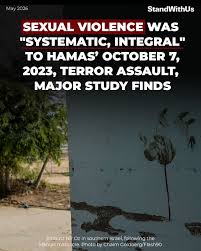
Silenced No More: Sexual Terror Unveiled is the most comprehensive independent investigation to date into the systematic sexual and gender-based violence committed by Hamas and its collaborators during the October 7 attacks and the subsequent hostage captivity in Gaza.
Compiled by the Civil Commission over two years, this landmark report draws on more than 430 interviews, 10,000+ photographs and videos, survivor testimonies, forensic evidence, and open-source intelligence. It documents thirteen recurring patterns of sexual torture, rape, mutilation, public humiliation, kinocidal violence against families, and the deliberate filming and digital dissemination of atrocities — establishing that sexual terror was not incidental but a deliberate, integral component of Hamas’s strategy.
The report concludes these acts constitute war crimes, crimes against humanity, and genocidal acts under international law.
EXECUTIVE SUMMARY
“You hear it. It’s right next to you. You hear the screams… and then you hear silence.”
The Civil Commission’s interview with Darin Komarov
Following a two-year independent investigation, the Civil Commission concludes that sexual and gender-based violence was systematic, widespread, and integral to the October 7 attacks and their aftermath. Across multiple locations and phases of the assault, including during abduction, transfer, and captivity, Hamas and its collaborators deployed recurring tactics of sexual abuse and torture against victims. These crimes were marked by extreme cruelty and profound human suffering, often inflicted in ways designed to amplify terror and humiliation.
This report presents a comprehensive independent evidentiary record, the most extensive assembled to date of the sexual and gender-based crimes committed on October 7 and during captivity. The report draws on extensive factual documentation, including original filmed survivor and witness testimonies, interviews, photographs, videos, official records, and other primary materials from the attack sites. The investigation examined materials from multiple locations, including residential communities, the Nova music festival and surrounding areas, roads and shelters, military bases, and sites associated with the identification of victims’ bodies. It further analyzed testimonies and evidence relating to the abduction, transfer, and prolonged captivity of hostages in Gaza.
Based on this large body of materials, the Commission constructed a dedicated archive preserving these materials within the Civil Commission’s October 7 War Crimes Archive, a secure and carefully curated repository. This evidentiary record is the product of a sustained and methodologically rigorous investigation conducted over the two-year period. The Commission systematically reviewed more than 10,000 photographs and video segments, amounting to well over 1,800 cumulative hours of analysis of visuals, alongside extensive testimonial work, including the collection, transcription, translation, and cross-referencing of survivor and witness accounts, as well as site visits, expert consultations, and meetings with families and affected communities. Overall, the Commission conducted over 430 formal and informal interviews, testimonies, and meetings with survivors, witnesses, returned hostages, experts and family members. All materials were logged, coded, and mapped across time and geographic locations, and integrated into a dedicated database on sexual and gender-based crimes, forming a structured subsystem within the Civil Commission’s secure archive. Data analysis conducted by the Commission reveals that the victims represented 52 different nationalities, underscoring the international scope of the crimes and their impact. The Commission further conducted an extensive open-source investigation, corroborated materials through geolocation-supported datasets and interdisciplinary expert input, and carried out its work in accordance with internationally recognized standards, including trauma-informed and survivor-centered practices and ethical principles, guided by the principle of “do no harm.” This methodological framework enabled the Commission not only to document individual incidents, but to identify recurring patterns, present a full and comprehensive account of the events, and delineate operational features across sites and phases of the attack.
Considered collectively, these materials illuminate a coherent and structured account that could not previously have been discerned in this manner. Through systematic cross-referencing of this material and detailed analysis of the modus operandi of the perpetrators, the Commission identified thirteen recurring patterns of sexual and gender-based violence committed across multiple locations. The repetition of these patterns demonstrates that the crimes were not isolated acts of brutality but formed part of a broader operational method used during the attack and its aftermath.
The investigation also documents how perpetrators weaponized visibility and digital dissemination as part of the violence itself, including sexualized content. Armed groups recorded acts of abuse, humiliation, and killing, and circulated the footage through social media platforms and victims’ own digital accounts. In numerous cases, family members first learned of the fate of their loved ones through images or videos distributed by perpetrators. This deliberate use of digital media transformed acts of violence into instruments of psychological warfare directed not only at victims but also at families and society at large.
The sexual violence continued beyond the attacks themselves. The report documents testimonies from released hostages and other sources demonstrating how sexual assaults, sexual humiliation, and sexualized torture persisted during captivity in Gaza for prolonged periods. In some cases, the sexual and gender-based abuse of hostages continued for months.
In addition to documenting individual crimes, the report identifies a distinct pattern of violence targeting family members and exploiting familial relationships as instruments of terror. In several documented incidents, victims were sexually assaulted or humiliated in the presence of relatives, and in one of the documented cases family members were coerced into participating in acts of abuse against one another. These acts reflect what the Commission characterizes as kinocidal sexual violence — violence deliberately designed to destroy the family as a social and emotional unit by weaponizing the bonds between family members.
Taken together, the Commission’s investigation reveals a coordinated assault in which sexual violence was used to terrorize victims, families, communities, and society at large. Our conclusion is unequivocal: sexual and gender-based violence formed a central component of the October 7 attack and of hostages’ captivity.
Based on its investigation, the Civil Commission’s findings conclude that these crimes constitute war crimes, crimes against humanity, and genocidal acts under international law. Therefore, the report establishes a clear roadmap for the prosecution of the crimes committed on October 7 and during captivity. The report presents a clear evidentiary and legal foundation for the investigation and prosecution of those responsible. It also highlights the need for specialized prosecutorial structures and gender-competent frameworks to effectively address these crimes.
This work carries a broader historical purpose. At its core, this report is an act of documentation, accountability, and remembrance. Many victims of these crimes did not survive to testify. Others continue to endure profound trauma. By preserving testimonies, documenting evidence, and analyzing the patterns and legal implications of the crimes, the Commission has sought to ensure that the suffering endured by the victims will not be denied, erased, or forgotten.
It records the voices of survivors and witnesses. It preserves the evidentiary foundations necessary for future prosecutions. And it affirms a fundamental principle of international justice: that even in the aftermath of the most extreme violence, truth must be documented and the suffering of victims must be acknowledged.
Their voices, and the record preserved here, ensure that they are silenced no more.
The Report’s Contribution
The report advances the factual and legal understanding of these crimes in the following ways:
- It constructs a dedicated evidentiary record of the crimes, with both historical and legal significance, preserving and systematically archiving survivor and witness testimonies, photographs, videos, and contemporaneous materials documenting sexual and gender-based crimes committed during the attacks and in captivity.
- It provides the first systematic, case-based record of these crimes. Over more than 160 pages of testimony-driven analysis, archived materials, and other primary evidentiary sources, the report’s factual chapter details individual cases and evidentiary records across multiple geographic locations, tracing sexual and gender-based violence during the assault itself and throughout the phases of abduction, transfer, and captivity.
- It identifies recurring patterns of sexual violence across sites and phases of the attacks. By examining recurring themes and modes of operation, the report demonstrates that these crimes followed identifiable patterns and methods, rather than constituting isolated acts of brutality.
- It demonstrates how sexual and gender-based violence functioned as an organized component of the attacks and reveals the operational logic of the violence. The repetition and organization of these acts reveal how sexual and gender-based violence functioned as a deliberate component of the attacks, deployed to terrorize victims, families, and communities.
- It expands the factual scope of inquiry beyond the attack itself. The report traces sexual violence across the full continuum of the crimes — from the attacks of October 7, through abduction and prolonged captivity, to the deliberate filming and digital dissemination of abuse as a means of amplifying terror.
- It translates the evidentiary record into a prosecution-oriented legal framework, analyzing how the documented conduct constitutes war crimes, crimes against humanity, genocidal acts, torture, and terrorism-linked sexual and gender-based violence, and outlines concrete pathways for investigation and prosecution.
By integrating a comprehensive factual foundation with rigorous legal analysis, the report establishes a structured historical evidentiary record and lays the groundwork for accountability.
Key Findings
In consultation with a panel of experts and leading international scholars, the following are the main factual and legal conclusions of the report:
Hamas and its collaborators used sexual and gender-based violence (SGBV) deliberately and systematically as an inherent part of a wider strategy of the attack, primarily targeting women, children and hostages. Evidence gathered and corroborated by the Civil Commission demonstrates the patterned, multisite, and organized use of SGBV, including sexual torture, committed during the October 7th attacks and against hostages thereafter. SGBV acts were repeatedly and similarly committed in private homes, in public spaces, at the Nova Music Festival grounds and adjacent areas, on roadsides, and in some cases in front of family members, amplifying the terror and suffering of the victims.
Hamas and its collaborators used sexual torture to maximize pain and suffering. Victims endured brutal acts, including burning, mutilation, rape, restraining, forced insertion of objects into the genitalia, shootings to the faces and genital area, killings and abuses in front of family members, and executions. Many victims were found handcuffed, bound, or otherwise physically restrained. Extreme forms of SGBV continued against hostages in captivity for prolonged periods, inflicted on both women and men. Those who survived, and those who witnessed these crimes, suffer severe and enduring physical and psychological injuries. This kind of sexualized torture leaves a distinct and lasting imprint on society, producing a form of terror that extends far beyond the immediate victims and long after the killings themselves.
Hamas and its collaborators inflicted SGBV in multiple locations, employing recurring patterns of abuse. The Civil Commission identified at least thirteen patterns of abuse across multiple sites, including:
- Rape, gang rape, and other forms of sexual assaults;
- Sexual torture, including intentional burning and mutilation;
- Deliberate shootings to the head, face and genital area;
- Killings and executions following or committed in conjunction with SGBV;
- Postmortem sexual abuse, humiliation, and desecration of bodies;
- Forced nudity and exposure;
- Handcuffing, binding, and restraint of victims;
- Public displaying and parading of women and children;
- Abduction of mothers and children;
- SGBV inflicted in the presence or near vicinity of family members;
- Filming and digital dissemination of SGBV, including use of social media to document, glorify, and amplify the atrocities;
- Threats of forced marriage;
- Rape and other forms of sexual violence against boys and men.
Hamas and its collaborators committed kinocidal sexual and gender-based acts: SGBV was deliberately perpetrated against family members, including a case in which family members were coerced into performing sexual acts on one another. Other documented cases include, inter alia, family members being sexually assaulted or humiliated in each other’s presence. The weaponization of familial bonds maximized the pain and suffering of victims and terrorized their families. This pattern was particularly evident during Hamas captivity.
Hamas and its collaborators made strategic use of videos, digital and social media to exert and intensify harm and to perpetuate, glorify, and amplify the atrocities they committed, including sexualized content made for public display. Perpetrators filmed themselves and circulated images and videos during the attacks, including assaulting, humiliating, abducting, killing women, children, and entire families, and desecrating bodies. They presented women and their bodies as trophies of war. Some videos show militants and Gazan civilians celebrating over abused bodies. Footage also depicts burned bodies, including focused burning in the genital area or of naked bodies. Hamas and its collaborators further circulated footage of injured women and girls, and elderly women being violently humiliated and abducted; many of these victims were taken in their sleepwear due to the early-morning timing of the attack, further heightening their vulnerability.
Hamas and its collaborators systematically staged, produced, and disseminated videos of hostages during captivity. The digital abuse of hostages continued for many months after October 7th. Videos and images filmed by Hamas during captivity, show hostages being tormented, abused, taunted, or humiliated on camera.
(The page continues with additional details on legal conclusions, recommendations, and related resources, but the core Executive Summary content ends around here in the extracted text.)
For the complete full report (recommended for upload): Visit the official page: https://www.civilc.org/silenced-no-more (includes Preface, Foreword, Executive Summary, and links to the full PDF/download options).
A direct PDF link (as referenced in sources): Search for or access via the site (e.g., versions hosted around May 2026 releases). It contains the full evidentiary chapters, case details, maps, and legal analysis.
This text is ready for clean copying/uploading. Let me know if you need formatting adjustments (e.g., Markdown, Word-style, or specific sections expanded).