
Eight Out of Nine Citations Were Fiction. He Signed Anyway.
Blame the bot, pay the fine: the Wadsworth sanctions and the quiet death of the “AI did it” defence.
Ben Thomson, LawFuel contributing editor
If you wanted a single case to put on the cover of every CLE brochure for the next five years, Wadsworth v. Walmart Inc. would do nicely. A hoverboard explodes in a Wyoming family’s home. The family sues. Their lawyers — from America’s loudest plaintiffs’ firm, no less — file a motion in limine citing nine cases. Eight of them do not exist. They have never existed. They were, in the now-familiar verb of our age, hallucinated.
And so on 24 February 2025, U.S. District Judge Kelly H. Rankin handed down what is shaping up to be the defining American sanctions order of the generative-AI era. Rudwin Ayala, the Morgan & Morgan associate who actually fed the brief into the firm’s in-house AI tool, charmingly named MX2.law, lost his pro hac vice admission and was fined $3,000.
The two lawyers who signed the motion without, on the court’s reading, ever actually reading it — supervising attorney T. Michael Morgan (yes, that Morgan; head of the firm’s product-safety practice) and local counsel Taly Goody of Goody Law Group — were each fined $1,000.
Total damage: $5,000 and a permanent search-result.
The mechanics of an own goal
The facts are almost endearing in their banality. Ayala drafted the motion himself, then uploaded it to MX2.law with the helpful instruction to “add to this Motion in Limine Federal Case law from Wyoming setting forth requirements for motions in limine.” The machine obliged. It always obliges. That is the problem.
Eight invented cases later, the brief landed on the docket. Walmart’s lawyers, perhaps the only people in the room actually reading the citations, could not find any of them. Neither could the judge. An Order to Show Cause followed; the motion was hastily withdrawn; the firm admitted everything within four days.
To Morgan & Morgan’s credit, and this is genuinely to its credit, the firm took the unusual step of falling on its sword early, implementing new policies and training, paying Walmart’s fees, and persuading Judge Rankin not to sanction the firm itself.
Which leaves the three signatures on the page.
The bit that should keep partners awake
Here is the detail that has been quietly travelling through plaintiffs’ partnerships since February. Morgan and Goody told the court they hadn’t drafted the motion. Morgan, the court accepted, may not even have seen it before it was filed. Their argument was, essentially, we were the names on top of the pleading, not the author of it.
Judge Rankin’s response, which deserves to be tattooed on the inside wrist of every signing partner in America, was that this is precisely the point: “Blind reliance on another attorney can be an improper delegation of this duty and a violation of Rule 11.”
Signing certifies that you read the thing and made a reasonable inquiry into the law. The duty is, in the judge’s word, nondelegable. He invoked first-year contracts class for emphasis — failing to read the contract does not unsign your name.
There were, the order notes drily, signs the cases were peculiar even on the face of the motion. No pinpoint citations. Unpublished decisions missing the full date that Lexis and Westlaw automatically paste in. The hallucinations were, Judge Rankin observed, “certainly noticeable on the Motions’ face.”
In other words: even a cursory read would have caught them. Nobody read them.
Not the first, won’t be the last — but possibly the most useful
We have, of course, been here before. Mata v. Avianca in 2023 introduced the world to ChatGPT-assisted aviation jurisprudence and produced the original cautionary tale (the Levidow Levidow & Oberman fines, the New York Times trend pieces, the awkward CLE panels). Judge Rankin quotes Mata directly. The line of authority is now forming.
But Wadsworth is different in three ways that matter to the readership of this site. First, it isn’t a sole practitioner caught out by a free consumer chatbot — it’s a 1,000-lawyer national firm using its own bespoke internal AI platform. Second, the supervising partner went down with the associate, on the strength of a signature. Third, and most awkwardly for those marketing legal AI, the hallucinated cases came out of a tool that was, by definition, built for this exact use.
The reassuring fiction that “enterprise legal AI doesn’t hallucinate like ChatGPT does” died on this docket.
What the order actually changes
For partners signing AI-assisted work, the practical takeaways are uncomfortable and short:
A signature is now, expressly, a representation that you did the verification. The court will not be persuaded that you delegated reading to a junior, and it certainly will not be persuaded that you delegated reading to a model.
“The AI did it” has been judicially classified as an explanation, not a defence. If anything, Wadsworth increases the standard of care, because lawyers are now on notice — Judge Rankin’s phrase — that this category of error exists.
Verification protocols are no longer best practice. They are the minimum needed to satisfy Rule 11(b). Firms that cannot demonstrate a citation-checking workflow against an actual database may struggle to argue they made a “reasonable inquiry under the circumstances” when the inevitable happens.
And, though Judge Rankin doesn’t say this, firms that build their own internal AI tools may have inadvertently made themselves easier to sanction, because the “we used a normal commercial product within its intended scope” excuse is unavailable when you both built and deployed the offending thing.
Where this leaves T. Michael Morgan
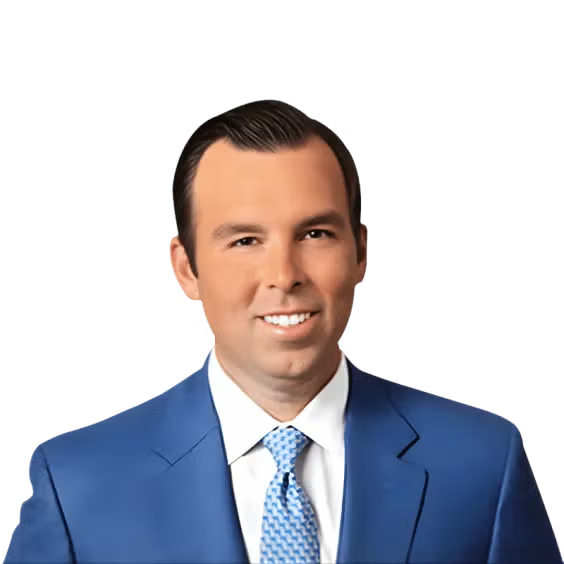
A $1,000 fine will not end Mike Morgan’s career. Morgan & Morgan, which bills itself as America’s largest injury firm, has shown more institutional grace under fire than most would in its position — withdrawing the motion within 24 hours of the show-cause order, reimbursing the other side, building new training, and securing what amounts to judicial absolution for the firm itself.
The Wadsworths and Walmart have since agreed to end the underlying litigation. The hoverboard, presumably, has not.
What Wadsworth will do is sit in the footnotes of every Rule 11 sanctions order for the rest of the decade. T. Michael Morgan, head of product safety, name on the door of the practice, has become, against his will, a case citation in the very canon his own firm’s bot failed to consult.
There is a lesson in there about the difference between supervising a tool and trusting one. Most readers of this site already know it. Quite a few, if they’re honest about their last six months of filings, may want to check anyway.