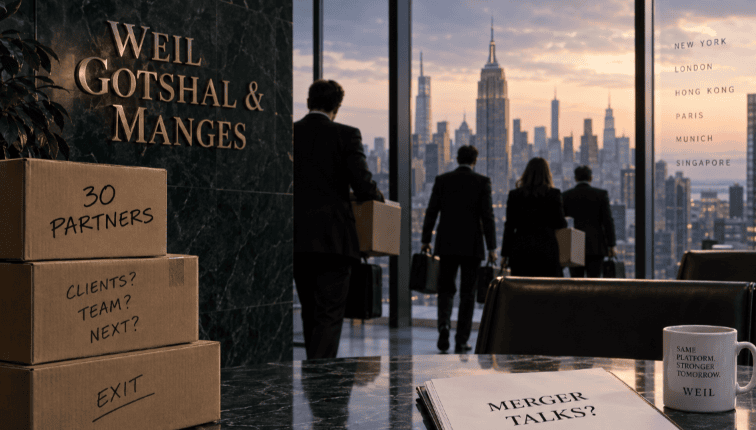
Weil says it is not in merger talks. Read the sentence again, slowly
Bloomberg Law reported on Friday that Weil, Gotshal & Manges, battered by an exodus of senior talent, is weighing options for its future that include a possible combination with a rival.
Firm leaders have reportedly grown more receptive to the idea, and some have had informal conversations to test appetite for a deal. Weil has been canvassing partners to stop the bleeding, is looking at strategic hires and promotions as an alternative, and could yet stay independent.
The firm’s response was a masterclass in the genre. “Weil is not engaged in merger discussions with any firm,” a spokesperson said, before adding that like every leading firm it continually evaluates ways to strengthen its platform. bloomberglaw
Both halves of that statement are probably true and neither of them denies what Bloomberg actually reported.
“Not engaged in merger discussions” is present tense, and it says nothing about informal soundings, exploratory coffees, or a managing partner taking a call he would not have taken in June. Anyone who has drafted a deal announcement knows what a sentence like that is built to do.
How Weil Got Here
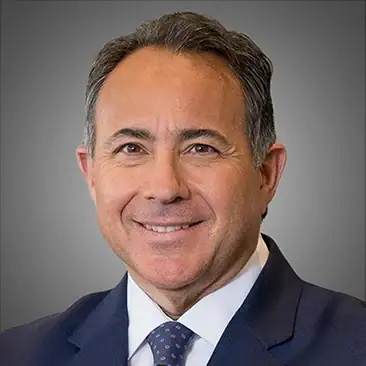
The trigger was Michael Aiello but it may also have been a decision made some time ago by Weil management who made a big bet some years ago that there would be a significant downturn ahead for Big Law firms and the firm cut partner pay and handed out some significant layoffs. The opposite happened and business picked up hugely – Weil were left somewhat behind the herd.
Aiello was chair of Weil’s 600-lawyer corporate department is leaving for Cravath, Swaine & Moore with five M&A partners: Matt Gilroy, Eoghan Keenan, Amanda Fenster, Michelle Sargent and Megan Pendleton.
Gilroy co-heads Weil’s M&A practice. Aiello is not a figurehead. He is the man who sold the work, a Band 1 dealmaker who ran Fox Corp’s $22 billion Roku acquisition and MarketAxess on its $6 billion sale to ICE, and colleagues routinely called him the most powerful partner in the building. Bloomberg Law
Weil’s public reaction was to note that Aiello and his team were leaving for “a smaller platform.” Cravath. The firm whose name is attached to the associate pay scale Weil’s own associates are paid on. It was a choice. Above the Law
Then London went. Sullivan & Cromwell confirmed it is hiring David Avery-Gee, Weil’s London co-managing partner, along with corporate partner Sarah Flaherty. Avery-Gee takes over as co-head of European M&A at S&C.
As LawFuel reported, that follows Murray Cox to Simpson Thacher and a three-partner restructuring team to Akin led by Neil Devaney, on a City lateral route between Weil and S&C that is now so well worn it has signage.
Add the rest: Chris Machera, co-head of private equity in a recent firm restructure, to Paul Weiss. Stephanie Srulowitz, co-head of US private funds, to Simpson Thacher, where Brian Parness and others are also landing. Legal Business counts close to 30 partner departures globally since the start of the year, including two members of the global leadership and strategy committee formed only last year.
That committee was the architecture built to manage the handover from Barry Wolf to Ramona Nee. Aiello chaired it. The architecture has lost its architect, six weeks before Nee takes over as executive partner on 1 January.
The Counter-Case
Weil is not Dewey. It is worth saying plainly, because every managing partner reading the Bloomberg piece felt the same small cold draught.
The firm turned over roughly $2.02 billion in 2025, has about 1,200 lawyers across 15 offices, and says it is heading for record revenue and profitability in 2026. It has added more than 50 lateral partners since the start of last year, a genuinely aggressive growth programme rather than a defensive crouch. It has backfilled in London with James Crooks from Sidley and Charles Cooper-Isow from Kirkland, and it moved within five days of Aiello’s exit to name Kyle Krpata and Michael Lubowitz co-chairs of the corporate department. Nee framed that as a deliberate step in a growth strategy rather than damage control, which is exactly what you would say either way. Above the Lawweil
There is also an argument, briefed enthusiastically to reporters by Weil partners over the past fortnight, that the firm is better off. Aiello was described as territorial and sceptical of expansion, and insiders have been queuing up to say the departure frees Weil to grow. Whether that is strategic clarity or the world’s most elaborate face-saving exercise, it is at least a coherent position.
And Weil has survived worse. In 2013 it lost eight Dallas partners to Sidley in a single raid, ran layoffs, and cut partner compensation. The obituaries were written then too.
So Who Would Actually Merge with Weil?
This is where the story gets interesting, and where the market chatter runs ahead of the facts.
Elite New York firms do not merge with each other. They never have. What has been happening instead is transatlantic consolidation at the tier below: A&O Shearman in 2024, HSF Kramer in 2025, Ashurst Perkins Coie and Winston Taylor this year, and Hogan Lovells Cadwalader, the largest transatlantic combination ever attempted at more than 3,100 lawyers and around $3.6 billion in combined revenue.
The potential partners that are the subject of the merger-rumor cycle include Freshfields, who have built a decent M&A practice and also built its ‘market credibility’, according to Law.com. It also has a good private equity and funds practice, which would meld easily with Weil’s bankruptcy practice.
Clifford Chance has shed partners in the US and may be another potential merger partner, while Linklaters have been talking about merging for a long time, with a history of talks with Fried Frank, Sherman, Bingham, Cleary, Latham and Proskauer.
Even Skaddens has been rumored to be talking. And so it goes.
The rumor mill will keep turning, as rumor mills are wont to do.
Fairfax Associates tracked 59 completed law firm mergers in 2025, up 18% on the previous year, though Law360 counted 35 announced deals in the first half of 2026, the slowest first six months in a decade outside the pandemic year.
The logical Weil partners are therefore not Wall Street, but rather the large international firms wanting a genuine New York restructuring and M&A platform, or a US firm wanting instant scale in London and Germany.
Weil’s bankruptcy franchise remains one of the crown jewels of the American legal market. Lehman and Enron were its work. That practice is countercyclical, it is fee-rich, and it does not walk out the door with a corporate rainmaker.
Which points to the uncomfortable truth underneath the denial. A merger for Weil would not be a rescue but would be a way of buying back, in a single transaction, the deal-flow density that the lateral market has been extracting from it partner by partner for two years.
That is a rational thing for a management committee to think about, and a mad thing to admit to while you are still trying to persuade the partners you have left to stay.
What to watch
Three things will tell you more than any statement.
First, whether the departures stop. Weil is canvassing partners now, and the next fortnight is the test of whether the canvassing worked. bloomberglaw
Second, the January handover. Nee inherits a firm in a different condition than the one she was elected to run. Her first hundred days set the direction.
Third, the arrivals column. A firm that is genuinely accelerating growth hires three or four serious laterals before Christmas. A firm that is looking for a partner in the other sense goes quiet.
For now, Weil is not merging with anybody – but that is not going to stop the rumors – or even a merger that emerges.